
Now Reading: Stellar And Orbital Characterization Of Three Low Mass M Dwarf Binary Stars With Dynamical Spectroscopy From The Habitable Zone Planet Finder
-
01
Stellar And Orbital Characterization Of Three Low Mass M Dwarf Binary Stars With Dynamical Spectroscopy From The Habitable Zone Planet Finder

Stellar And Orbital Characterization Of Three Low Mass M Dwarf Binary Stars With Dynamical Spectroscopy From The Habitable Zone Planet Finder

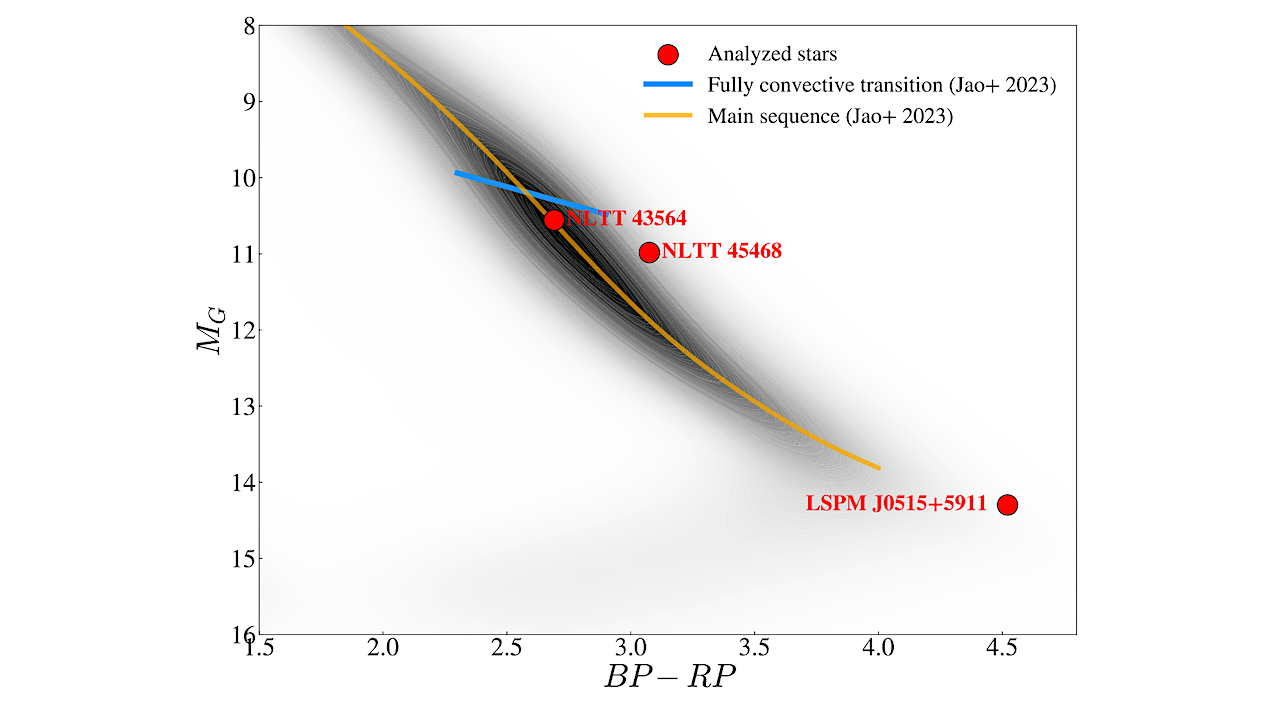
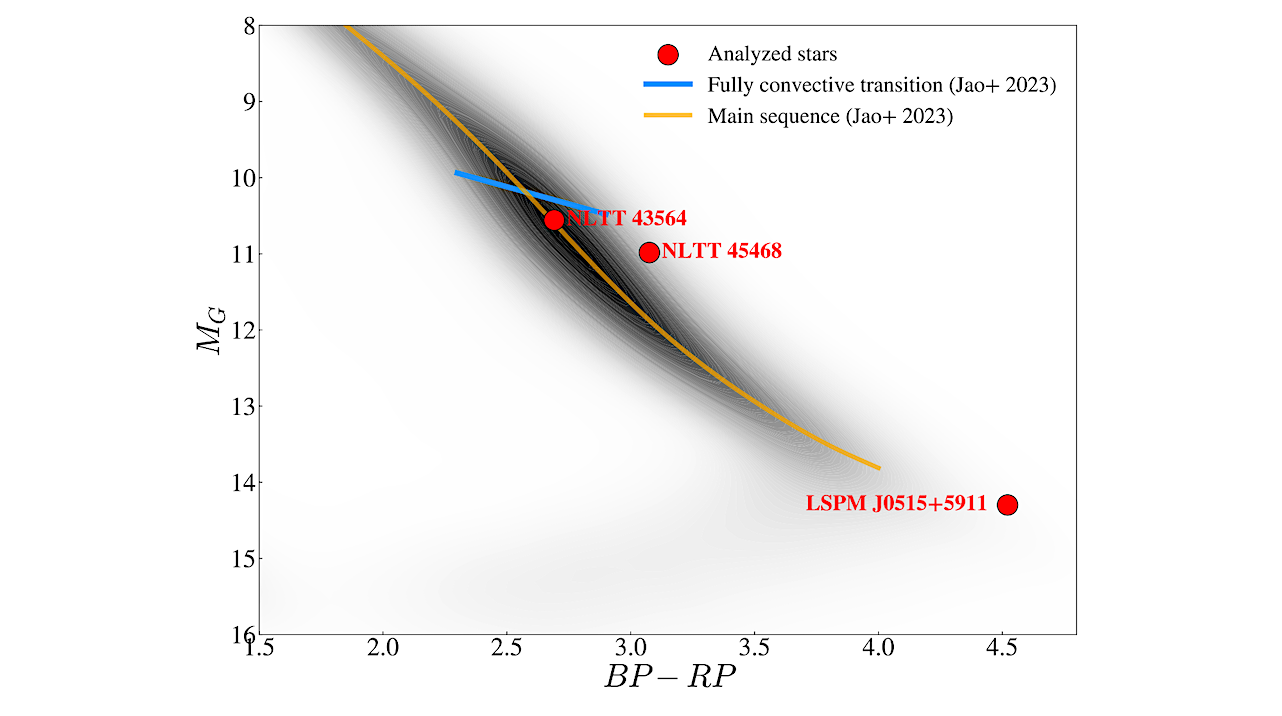
Color-magnitude diagram for nearby stars (within 100 pc) showing the local main sequence in MG vs BP − RP. The background density map is constructed from the Gaia Catalogue of Nearby Stars (Gaia Collaboration et al. 2021). The three analyzed binary star targets, LSPM J0515+5911, NLTT 45468, and NLTT 43564, are plotted as red markers and they include light from the unresolved companion as seen by Gaia. The blue line indicates the observational transition to fully convective M dwarfs and the orange curve shows the empirical main-sequence points from Jao et al. (2023). — astro-ph.SR
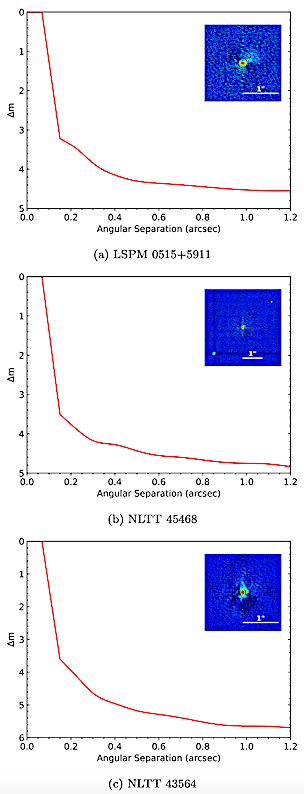
Contrast curves and reconstructed images from the NESSI speckle imager for a: LSPM 0515+5911, b: NLTT 45468, and c: NLTT 43564. Neither LSPM 0515+5911 nor NLTT 43564 show companions within the field that could contaminate the HPF observations. NLTT 45468 shows a nearby star at 2.1” in the lower left of the inset in b; the signal in the upper right is an artifact of the speckle processing. — astro-ph.SR
Theoretical models of low-mass stars continue to be discrepant with observations when used to examine the mass-radius relationship and other physical parameters of individual stars. High-resolution spectroscopy that leads to dynamical measurements of binary stars can directly improve these models.
We have been using the Habitable-zone Planet Finder spectrograph to monitor binary stars with M dwarf components. Here, we measure the orbital and stellar parameters for three such systems: LSPM J0515+5911, NLTT 43564, and NLTT 45468. Each system has dozens of spectra obtained over a baseline of several years.
None of the systems appear to be eclipsing, so our ability to turn them into true benchmark binaries with purely dynamical measurements is limited. We use literature photometry to estimate each system’s spectral energy distribution and utilize models in combination with detection limits of our spectroscopic measurements to probe characteristics of the companions.
LSPM J0515+5911 is a double-lined spectroscopic binary with period of 126.948±0.029 days and derived minimum masses, M1sin3i=0.058±0.002 M⊙ and M2sin3i=0.046±0.001 M⊙ for the primary and secondary components, respectively.
We solved NLTT 43564 with period of 1877±24 days and NLTT 45468 with period of 9.686±0.001 days as single lined systems, and modeled the primary masses to be M1=0.32±0.02 M⊙ and M1=0.35+0.02−0.07 M⊙, respectively.
Suhani Surana, Chad F. Bender, Caleb I. Cañas, Daniel M. Krolikowski, William D. Cochran, Mark Everett, Arvind F. Gupta, Shubham Kanodia, Suvrath Mahadevan, Andrew Monson, Joe P. Ninan, Leonardo A. Paredes, Paul Robertson, Arpita Roy, Christian Schwab, Gudmundur Stefansson
Comments: 20 pages, 7 figures, Accepted for Publication in the Astronomical Journal
Subjects: Solar and Stellar Astrophysics (astro-ph.SR); Earth and Planetary Astrophysics (astro-ph.EP)
Cite as: arXiv:2601.19996 [astro-ph.SR] (or arXiv:2601.19996v1 [astro-ph.SR] for this version)
https://doi.org/10.48550/arXiv.2601.19996
Focus to learn more
Submission history
From: Suhani Surana
[v1] Tue, 27 Jan 2026 19:06:05 UTC (3,901 KB)
https://arxiv.org/abs/2601.19996
Astrobiology










Related Posts
Stay Informed With the Latest & Most Important News
Previous Post
Next Post


Advertisement
-
 01Two Black Holes Observed Circling Each Other for the First Time
 -
 02From Polymerization-Enabled Folding and Assembly to Chemical Evolution: Key Processes for Emergence of Functional Polymers in the Origin of Life
 -
 03Astronomy 101: From the Sun and Moon to Wormholes and Warp Drive, Key Theories, Discoveries, and Facts about the Universe (The Adams 101 Series)
 -
 04True Anomaly hires former York Space executive as chief operating officer
 -
 05Φsat-2 begins science phase for AI Earth images
 -
 06Hurricane forecasters are losing 3 key satellites ahead of peak storm season − a meteorologist explains why it matters
 -
 07Binary star systems are complex astronomical objects − a new AI approach could pin down their properties quickly