
Now Reading: Stellar Chemistry And Planet Size: Insights From GALAH DR4
-
01
Stellar Chemistry And Planet Size: Insights From GALAH DR4


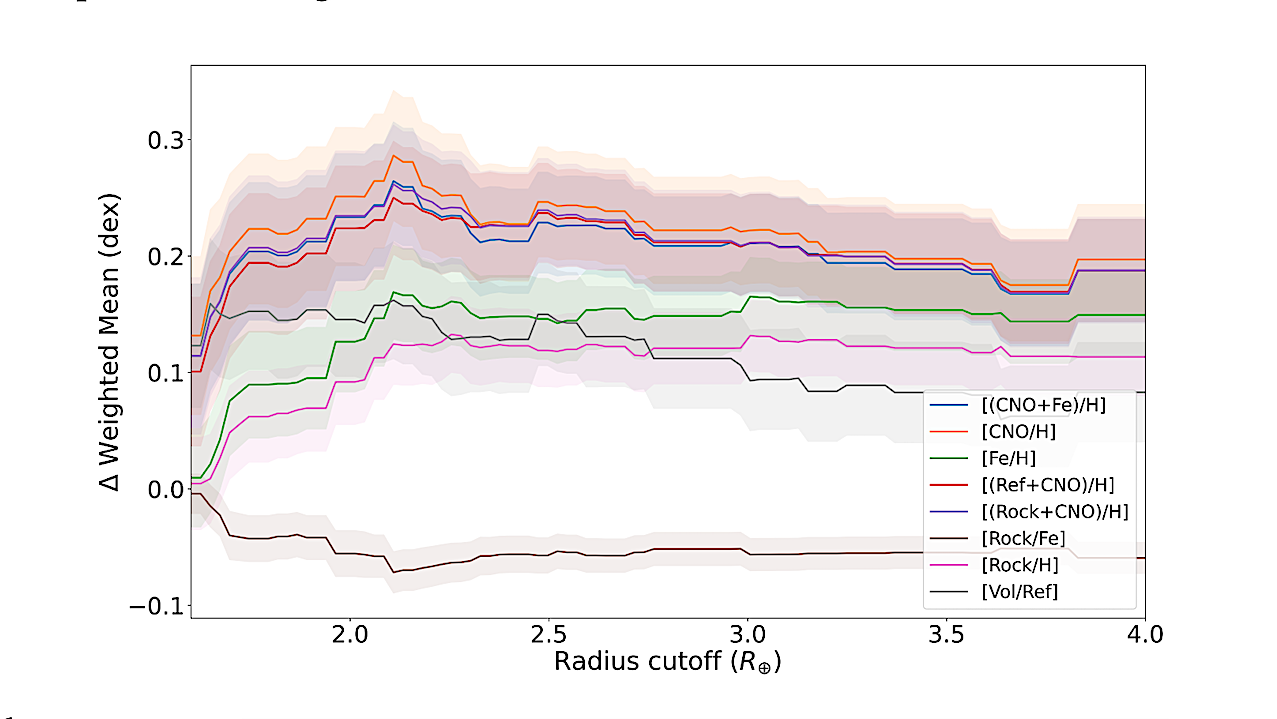
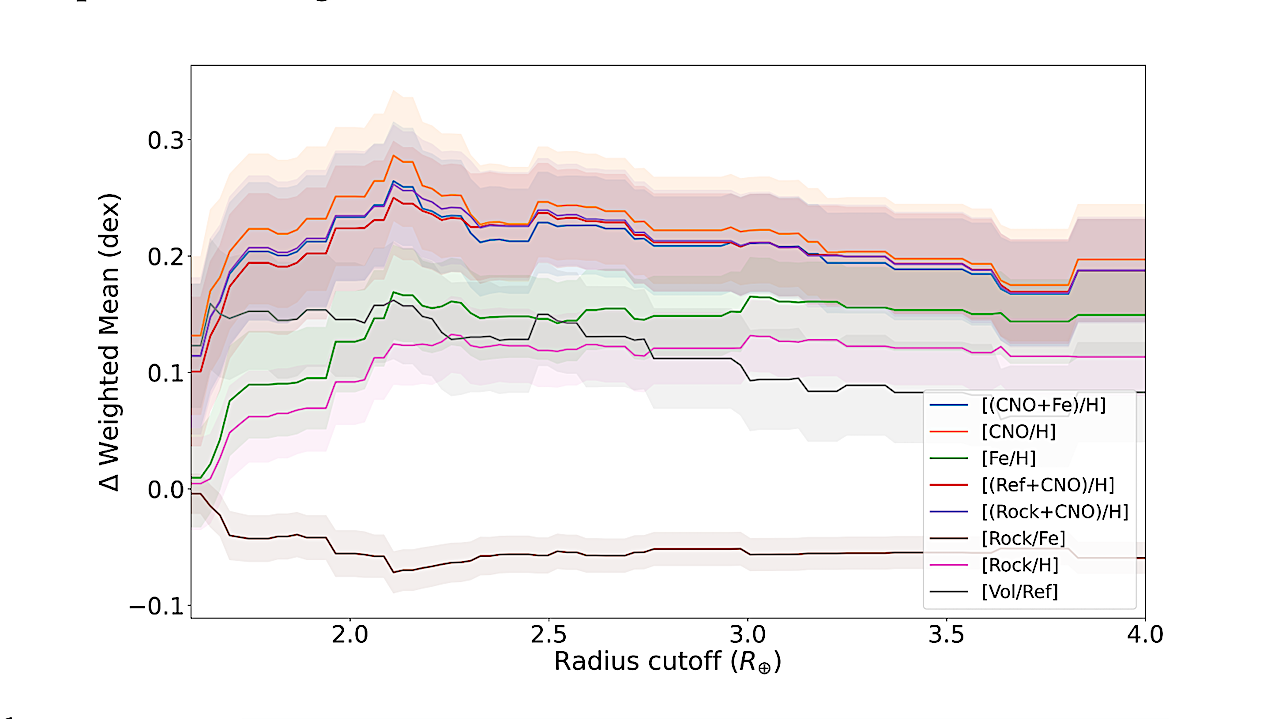
Weighted mean abundance differences (large–small planet hosts) as a function of the chosen radius cutoff. Colored curves trace the various composite indices, with shaded bands showing uncertainties. The apparent volatile enhancement should be regarded as tentative given the limited reliability of C and N measurements. — astro-ph.EP
The well-known correlation between stellar metallicity and planet occurrence is strongest for giant planets, but weaker for smaller planets, suggesting that detailed elemental patterns beyond [Fe/H] may be relevant.
Using abundances from the fourth data release of the GALAH spectroscopic survey, we analyzed 104 host stars with 141 confirmed transiting planets. We divide planets at 2.6 Earth radii, the theoretical threshold radius above which planets are unlikely to be pure-water worlds.
We find that large-planet hosts are enriched by approximately 0.2 dex in iron and show a possible excess of highly volatile elements (C, N, O), though these measurements are affected by observational limitations, whereas small-planet hosts exhibit an enhanced contribution of the classical rock-forming elements (Mg, Si, Ca, Ti) relative to iron, corresponding to a modest [Rock/Fe] offset of 0.06 dex, which is statistically significant, with a p value of 10^{-4}.
These offsets remain significant for alternative radius cuts. A matched control sample of non-planet-host stars shows only weak and mostly statistically insignificant similar trends, confirming that the stronger chemical signatures are linked to the planetary characteristics.
As our study relies on transiting planets, it mainly probes short-period systems (periods shorter than 100 days). These results refine the planet-metallicity relation, highlighting the role of the relative balance between iron, volatiles, and rock-forming elements in planet formation.
N. Sussholz (1), S. Zucker (1 and 2), R. Helled (3), D. Bashi (4) ((1) School of Physics and Astronomy, Raymond and Beverly Sackler Faculty of Exact Sciences, Tel Aviv University, Tel Aviv, Israel, (2) Department of Geophysics, Raymond and Beverly Sackler Faculty of Exact Sciences, Tel Aviv University, Tel Aviv, Israel, (3) Institut fur Astrophysik, Universitat Zurich, Zurich, Switzerland, (4) Astrophysics Group, Cavendish Laboratory, University of Cambridge, Cambridge, UK)
Comments: Accepted for publication in A&A. 8 pages, 4 figures, 3 tables. Official acceptance date is 28.11.2025. Keywords: Methods: statistical; Planets and satellites: composition; Planets and satellites: formation; Stars: abundances; planetary systems; Techniques: spectroscopic
Subjects: Earth and Planetary Astrophysics (astro-ph.EP); Solar and Stellar Astrophysics (astro-ph.SR)
Cite as: arXiv:2512.02601 [astro-ph.EP] (or arXiv:2512.02601v1 [astro-ph.EP] for this version)
https://doi.org/10.48550/arXiv.2512.02601
Focus to learn more
Submission history
From: Noy Sussholz
[v1] Tue, 2 Dec 2025 10:06:07 UTC (141 KB)
https://arxiv.org/abs/2512.02601
Astrobiology,










Related Posts

Stay Informed With the Latest & Most Important News


Advertisement
-
 01Two Black Holes Observed Circling Each Other for the First Time
 -
 02From Polymerization-Enabled Folding and Assembly to Chemical Evolution: Key Processes for Emergence of Functional Polymers in the Origin of Life
 -
 03Astronomy 101: From the Sun and Moon to Wormholes and Warp Drive, Key Theories, Discoveries, and Facts about the Universe (The Adams 101 Series)
 -
 04True Anomaly hires former York Space executive as chief operating officer
 -
 05Φsat-2 begins science phase for AI Earth images
 -
 06Hurricane forecasters are losing 3 key satellites ahead of peak storm season − a meteorologist explains why it matters
 -
 07Binary star systems are complex astronomical objects − a new AI approach could pin down their properties quickly