
Now Reading: Strange shock wave around dead star surprises astronomers
-
01
Strange shock wave around dead star surprises astronomers


ESO published this original story on January 12, 2026. Edits by EarthSky.
EarthSky’s 2026 lunar calendar is available now. Get yours today! Makes a great gift.
Strange shock wave around dead star surprises astronomers
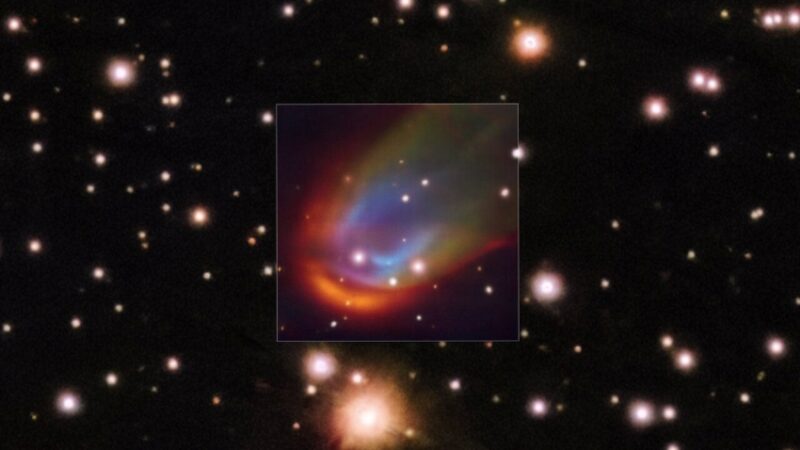
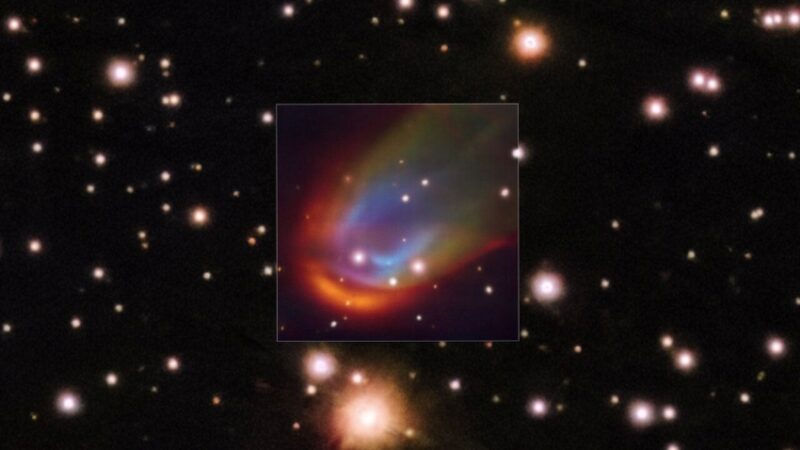
Gas and dust in interstellar space can, under the right conditions, clash with a star’s surroundings and create a shock wave. Now, astronomers using the European Southern Observatory’s Very Large Telescope have imaged a beautiful shock wave around a dead star … and they can’t quite explain it.
According to all known mechanisms, the small, dead star – named RXJ0528+2838 – should not have such structure around it. This discovery, as enigmatic as it’s stunning, challenges our understanding of how dead stars interact with their surroundings.
Simone Scaringi, co-lead author of the new study, said:
We found something never seen before and, more importantly, entirely unexpected.
The researchers published their findings in the peer-reviewed journal Nature Astronomy on January 12, 2026.
Bow shock of a dead star
The star, RXJ0528+2838, is located 730 light-years away. And, like the sun and other stars, it rotates around our galaxy’s center. As it moves, it interacts with the gas that permeates the space between stars, creating a type of shock wave called a bow shock.
Noel Castro Segura, a collaborator in this study, described this as:
… a curved arc of material, similar to the wave that builds up in front of a ship.
Material outflowing from a central star usually creates these bow shocks. But in the case of RXJ0528+2838, none of the known mechanisms can fully explain the observations.
RXJ0528+2838 is a white dwarf – the left-over core of a dying low-mass star – and has a sun-like companion orbiting it. In such binary systems, the material from the companion star is transferred to the white dwarf, often forming a disk around it. While the disk fuels the dead star, some of the material also gets ejected into space, creating powerful outflows.
But RXJ0528+2838 shows no signs of a disk, making the origin of the outflow and resulting nebula around the star a mystery.
Scaringi said:
The surprise that a supposedly quiet, diskless system could drive such a spectacular nebula was one of those rare ‘wow’ moments.
Dead star discovery
The team first spotted a strange nebulosity around RXJ0528+2838 on images from the Isaac Newton Telescope in Spain. Noticing its unusual shape, they observed it in more detail with the MUSE instrument on ESO’s Very Large Telescope.
Krystian Ilkiewicz, study co-lead, said:
Observations with the ESO MUSE instrument allowed us to map the bow shock in detail and analyze its composition. This was crucial to confirm that the structure really originates from the binary system and not from an unrelated nebula or interstellar cloud.
An answer to the mystery?
The shape and size of the bow shock imply that the white dwarf has been expelling a powerful outflow for at least 1000 years. Scientists don’t know exactly how a dead star without a disk can power such a long-lasting outflow … but they do have a guess.
This white dwarf is known to host a strong magnetic field, which the MUSE data have confirmed. This field channels the material stolen from the companion star directly onto the white dwarf without forming a disk around it.
The results hint that the hidden energy source is this strong magnetic field. But this “mystery engine”, as Scaringi puts it, still needs to be investigated. The data show that the current magnetic field is only strong enough to power a bow shock lasting for a few hundred years. That means this only partly explains what the astronomers are seeing.
To better understand the nature of such diskless outflows, many more binary systems need to be studied. ESO’s upcoming Extremely Large Telescope (currently set to be operational in 2030) could be instrumental here, Scaringi foresees:
[It will help astronomers] to map more of these systems, as well as fainter ones and detect similar systems in detail, ultimately helping in understanding the mysterious energy source that remains unexplained.
Bottom line: Astronomers have spotted a beautiful shock wave around a dead star and can’t fully explain how it’s possible.
Source: A persistent bow shock in a diskless magnetized accreting white dwarf
Read more: Hungry white dwarf devours surprisingly icy Pluto-like world
The post Strange shock wave around dead star surprises astronomers first appeared on EarthSky.










Related Posts
Stay Informed With the Latest & Most Important News
Previous Post
Next Post





Advertisement
-
 01Two Black Holes Observed Circling Each Other for the First Time
 -
 02From Polymerization-Enabled Folding and Assembly to Chemical Evolution: Key Processes for Emergence of Functional Polymers in the Origin of Life
 -
 03Astronomy 101: From the Sun and Moon to Wormholes and Warp Drive, Key Theories, Discoveries, and Facts about the Universe (The Adams 101 Series)
 -
 04True Anomaly hires former York Space executive as chief operating officer
 -
 05Φsat-2 begins science phase for AI Earth images
 -
 06Hurricane forecasters are losing 3 key satellites ahead of peak storm season − a meteorologist explains why it matters
 -
 07Binary star systems are complex astronomical objects − a new AI approach could pin down their properties quickly