
Now Reading: Strange star mystery solved after 50 years
-
01
Strange star mystery solved after 50 years




- The strange star Gamma Cassiopeiae has intense X-rays associated with it. For more than 50 years, astronomers have wondered why.
- A hidden white dwarf companion is the answer to the mystery, said astronomers using the XRISM X-ray space telescope.
- The unseen companion is emitting hot X-ray gas, and not Gamma Cassiopeiae itself. The discovery helps explain how massive stars evolve.
ESA published this original story on March 24, 2026. Edits by EarthSky.
Mystery of strange star solved after 50 years
For more than 50 years, astronomers have puzzled over the strange X-ray emission coming from the star Gamma Cassiopeia (gamma-Cas). This is the star that marks the central point of the distinctive W-shaped constellation Cassiopeia. But on March 24, 2025, astronomers said observations from the X-Ray Imaging and Spectroscopy Mission (XRISM) revealed that the X-rays are not coming from gamma-Cas after all. Instead, they’re linked to the orbital motion of a hidden companion white dwarf star. This solves the 50-year mystery.
Yaël Nazé of the University of Liège, Belgium, led the study. The peer-reviewed journal Astronomy and Astrophysics published the study on March 24, 2026. Nazé said:
There has been an intense effort to solve the mystery of gamma-Cas across many research groups for many decades. And now, thanks to the high-precision observations of XRISM, we have finally done it.
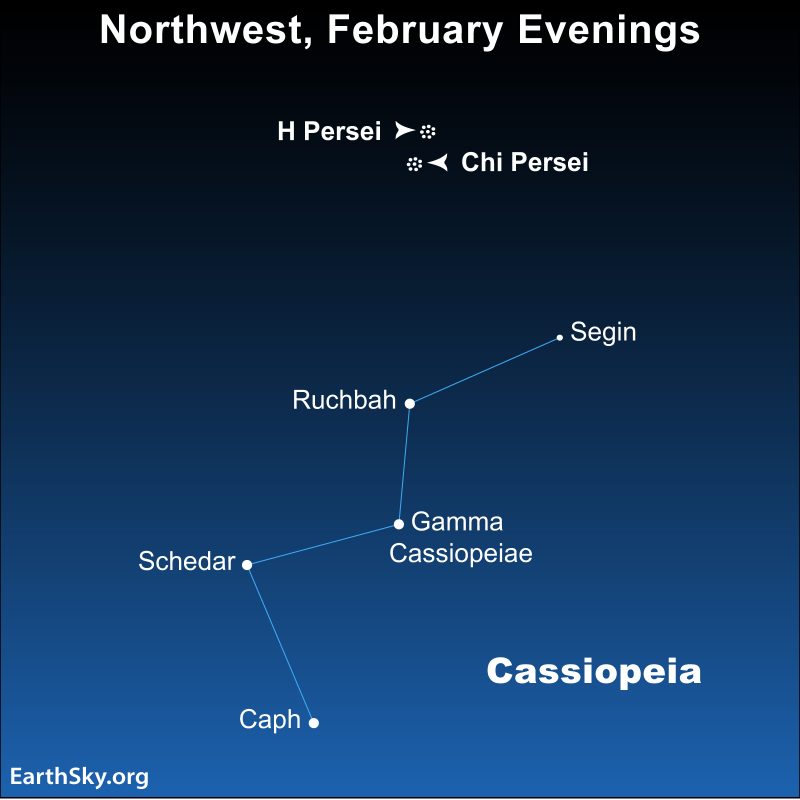
A strange star in hydrogen and X-rays
Despite gamma-Cas’s prominence in the night sky, it has been shrouded in mystery since 1866. That’s when Italian astronomer Angelo Secchi noticed something odd in its light signature. Its hydrogen fingerprint was bright, whereas in stars like our own sun this normally shows up as a dark line.
This weird feature inaugurated a new class of stars, called Be stars, merging the B associated with hot blue-white massive stars with the e from the peculiar hydrogen emission.
It took several decades before astronomers understood these emissions were coming from a rotating disk of matter ejected by the fast-spinning star. Such disks can build and disperse over time, resulting in variations in the star’s brightness. This makes it a popular target for amateur astronomers still today.
As telescope observations became more refined, monitoring gamma-Cas’s motion was possible, revealing that it must have a low-mass companion star. Since the companion remains invisible to spot directly with telescopes, astronomers think it might be a white dwarf star. A white dwarf is a compact object with the mass of the sun but the size of Earth.
Then, in the mid-1970s, a new mystery emerged. Astronomers discovered gamma-Cas shone in unusual high-energy X-rays. Further studies found the glow to be mostly coming from extremely hot 150-million-degree plasma, shining with a brightness some 40 times greater than typically expected for such massive stars.
Enter X-ray space telescopes
With the dawn of X-ray space telescopes including ESA’s XMM-Newton, NASA’s Chandra and the Germany-led eROSITA, astronomers have found around two dozen gamma-Cas-type stars with similar, unusual X-ray emission, making them a special group among Be stars in general.

One theory emerges as the winner
Over the years, the explanation for the high-energy X-rays boiled down to two competing theories. Could the star’s local magnetic fields be interacting with that of its surrounding disk, producing the hot material? Or, are X-rays generated by the Be star’s disk material falling onto the white dwarf companion?
Finally, an instrument with high enough precision to solve the mystery launched: XRISM’s high-resolution spectrometer Resolve. In a dedicated observation campaign, XRISM revealed that the signatures of the hot plasma follow the orbital motion of the otherwise invisible companion star. In other words, the white dwarf companion consumes material from gamma-Cas, emitting X-rays as it does so. Nazé said:
The previous work using XMM-Newton really cleared the way for XRISM, enabling us to eliminate numerous theories and prove which of the last two competing theories was correct. It’s extremely satisfying to have direct evidence to solve this mystery at long last!
A deeper understanding of Be type stars
Understanding that gamma-Cas objects are Be type stars paired with a white dwarf that’s accreting material is what solves the X-ray mystery. But it also opens up another curiosity in terms of how the wider population of this type of binary systems forms and evolves.
Such pairs were long expected to be common, mainly among low-mass stars. However, new research shows they are rarer than predicted and instead tend to occur in high-mass Be stars. Nazé said:
We think the key is in understanding how exactly the interactions take place between the two stars. Now that we know the true nature of gamma-Cas, we can create models specifically for this class of stellar systems, and update our understanding of binary evolution accordingly.
Alice Borghese, an ESA Research Fellow specializing in the field of high-energy astrophysics, said:
It’s incredible to see how this mystery has slowly unfolded over the years. XMM-Newton did so much of the groundwork in ruling out various theories about gamma-Cas. And now with the next generation of advanced instrumentation, XRISM has brought us over the finish line.
Matteo Guainazzi, ESA’s XRISM Project Scientist, said:
This wonderful result underlines the strong collaboration between XRISM’s Japanese, European and American teams. This international team combines the technical and scientific expertise needed to solve the X-ray universe’s biggest mysteries and open new avenues for research.
Bottom line: For 50 years, astronomers have puzzled over a strange star in Cassiopeia that’s bright in X-rays. But new data from the XRISM X-ray space telescope showed it’s a hidden companion that is emitting the X-rays.
Source: Orbital motion detected in gamma Cas Fe K emission lines
The post Strange star mystery solved after 50 years first appeared on EarthSky.










Related Posts

Stay Informed With the Latest & Most Important News
Previous Post
Next Post



Advertisement
-
 01Two Black Holes Observed Circling Each Other for the First Time
 -
 02From Polymerization-Enabled Folding and Assembly to Chemical Evolution: Key Processes for Emergence of Functional Polymers in the Origin of Life
 -
 03Astronomy 101: From the Sun and Moon to Wormholes and Warp Drive, Key Theories, Discoveries, and Facts about the Universe (The Adams 101 Series)
 -
 04True Anomaly hires former York Space executive as chief operating officer
 -
 05Φsat-2 begins science phase for AI Earth images
 -
 06Hurricane forecasters are losing 3 key satellites ahead of peak storm season − a meteorologist explains why it matters
 -
 07Binary star systems are complex astronomical objects − a new AI approach could pin down their properties quickly