
Now Reading: Study: Current, future megaconstellations risk space-based astronomy
-
01
Study: Current, future megaconstellations risk space-based astronomy


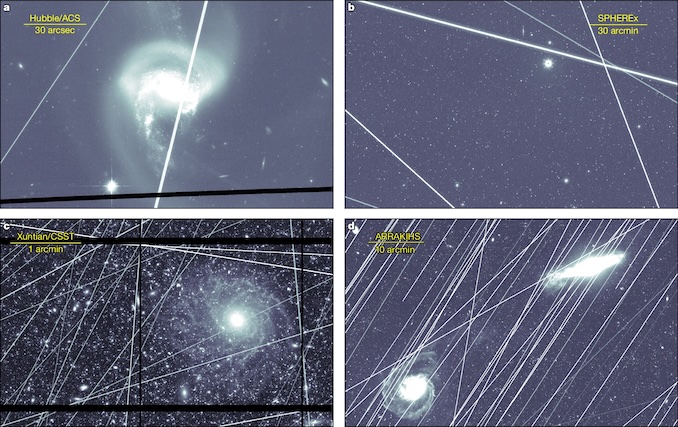
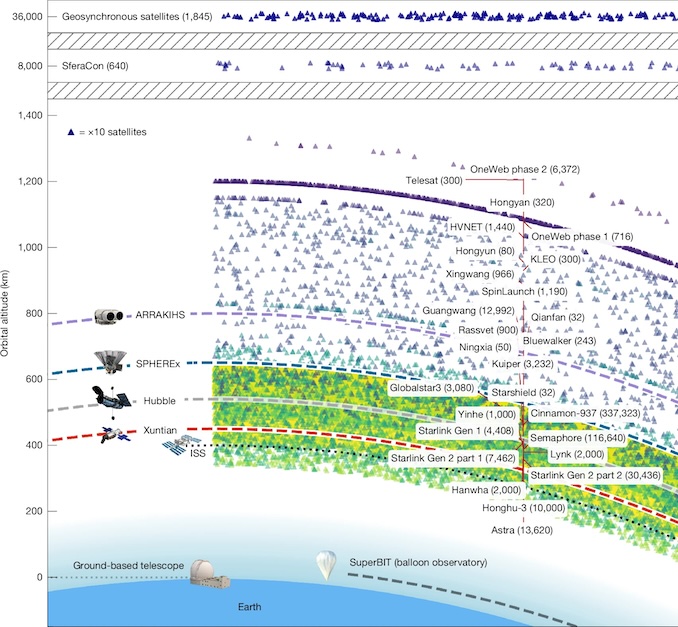
One of the biggest impacts to the low Earth orbit environment in the near-term and long-term future are satellite megaconstellations, according to a new study, published in the journal Nature. Companies, like Amazon, OneWeb and SpaceX, along with governments, like China and the United States are keen on the idea of controlling hundreds, thousands or even tens of thousands of satellites that serve a connected purpose.
The paper published on Dec. 3 comes from three researchers at NASA Ames Research Center in California. The trio point to “strong concerns among the scientific community” as a result of satellite reflections polluting astronomical images, both from the ground in space.
The researchers said some of the current and future observatories threatened include NASA’s SPHEREx (Spectro-Photometer for the History of the Universe, Epoch of Reionization, and Ices Explorer), the European Space Agency’s ARRAKIHS (Analysis of Resolved Remnants of Accreted galaxies as a Key Instrument for Halo Surveys) and the forthcoming Xuntian from China.
“A recent study demonstrated that 4.3 percent of the images obtained by Hubble Space Telescope between 2018 and 2021 already present artificial satellite trails,” the paper states. “Considering that the proposed number of satellites is two orders of magnitude higher than the current count, the fraction of impacted images will increase very soon.”
This assessment comes as SpaceX recently launched its 3,000th Starlink satellite in 2025 alone, approaching a third of the total number of Starlinks launch launched since 2019. The company has aspirations of operating upwards of 30,000 Starlink satellites in low Earth orbit and plans to start launching its larger Starlink Version 3 satellites in 2026 using its Starship rocket.
China meanwhile is beginning to pick up the pace of its Guowang satellites. According to Ars Technica, China is seeking to operate a 12,992-satellite fleet, per filings the publication reviewed with the International Telecommunication Union.
The paper proposes some mitigation suggestions, like reducing the number of images that astronomers capture at dawn and dusk.
However, researchers argue that Starlink and other low Earth orbit constellations will have a substantial impact to just about all images captured, even with the space-based observatories, like NASA’s SPHEREx, ESA’s ARRAKIHS and China’s Xuntian.
“Our results show that astronomical images from current and new-generation space telescopes will be contaminated by light reflected from telecommunication satellite constellations in LEO,” the paper stated. “If all the proposed satellite constellations are completed, we forecast that 96 percent of the exposures of SPHEREx, ARRAKIHS and Xuntian will present at least one Sun-illuminated satellite trail.”
Over the years, SpaceX published multiple updates to its website about how it would attempt to reduce its overall impact to astronomers through efforts like brightness mitigation and working directly with the astronomy community to establish best practices.
“While SpaceX is the first large constellation manufacturer and operator to address satellite brightness, we won’t be the last,” SpaceX wrote in an April 2020 update. “As launch costs continue to drop, more constellations will emerge and they too will need to ensure that the optical properties of their satellites don’t create problems for observers on the ground. This is why we are working to make this problem easier for everyone to solve in the future.”
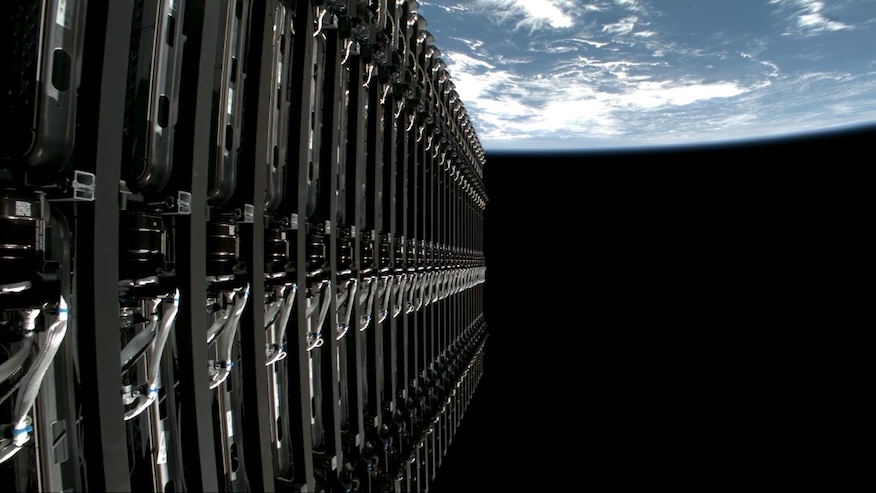
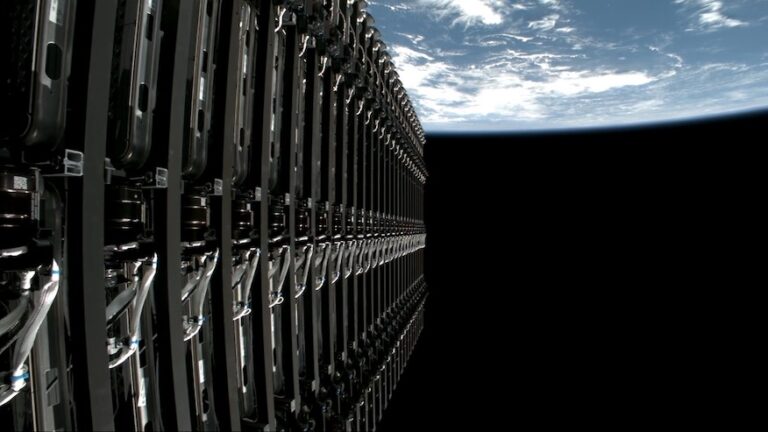
The paper argues though that even some techniques implemented by SpaceX — like shifting from an “open-book” orientation following deployment to an orientation perpendicular to the ground “to minimize reflection to ground-based observers” — have the consequence of increasing “the cross-section from the point of view of a LEO space telescope.”
“Owing to the Sun-facing orientation of the solar panels, a space telescope pointing away from the Sun can easily receive the reflected light from the solar panels,” researchers wrote.
“In addition, mitigation plans on the basis of attitude control depend on end-of-life operations. As satellites become non-operational, they may lose attitude control, causing them to tumble and reach angles in which more light reaches the telescopes than originally intended, increasing the complexity of the satellite trails, making their potential correction more challenging or even impossible. Detailed de-orbit plans and enforcement policies are critical.”










Related Posts
Stay Informed With the Latest & Most Important News
Previous Post
Next Post





Advertisement
-
 01Two Black Holes Observed Circling Each Other for the First Time
 -
 02From Polymerization-Enabled Folding and Assembly to Chemical Evolution: Key Processes for Emergence of Functional Polymers in the Origin of Life
 -
 03Astronomy 101: From the Sun and Moon to Wormholes and Warp Drive, Key Theories, Discoveries, and Facts about the Universe (The Adams 101 Series)
 -
 04True Anomaly hires former York Space executive as chief operating officer
 -
 05Φsat-2 begins science phase for AI Earth images
 -
 06Hurricane forecasters are losing 3 key satellites ahead of peak storm season − a meteorologist explains why it matters
 -
 07Binary star systems are complex astronomical objects − a new AI approach could pin down their properties quickly