
Now Reading: Study Of The Migration Of Earth-like Planets In Planetesimal Disks And The Formation Of Debris Disks
-
01
Study Of The Migration Of Earth-like Planets In Planetesimal Disks And The Formation Of Debris Disks

Study Of The Migration Of Earth-like Planets In Planetesimal Disks And The Formation Of Debris Disks

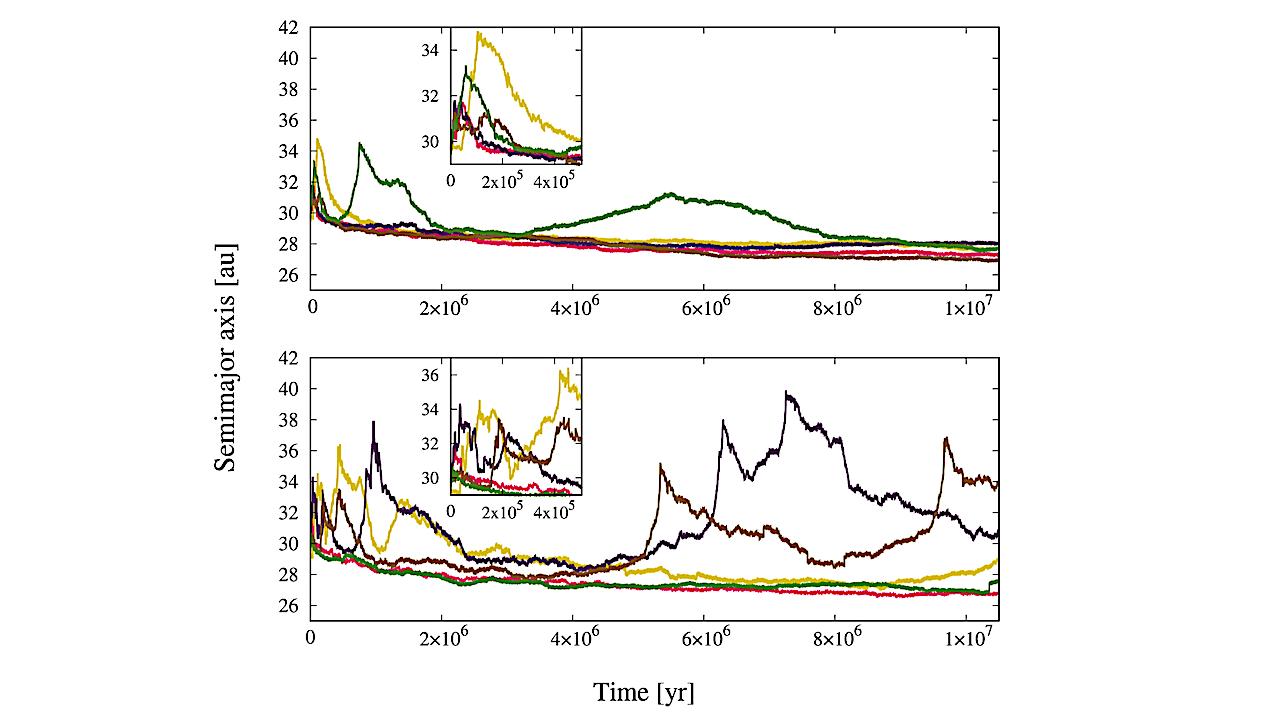
Evolution of the semimajor axis of a 0.5 M⊕ planet in planetesimal disks with masses of 20 M⊕ (top panel) and 40 M⊕ (bottom panel). The same curves are also shown in a zoomed-in view over the time interval 0–0.5 Myr. — astro-ph.EP
The aim of this study is to investigate the interaction of Earth-mass planets with a planetesimal disk.
It is shown that an Earth-mass planet, initially located near the inner boundary of the planetesimal disk, migrates into the disk. The depth of penetration of the planet into the disk is a random quantity determined by the angular momentum distribution of planetesimals approaching the planet.
However, at a certain stage, the direction of the planet’s migration changes, and the planet returns to the inner boundary of the disk. During such reversible migration, the planet perturbs the orbits of planetesimals and increases their relative velocities in the region of the disk traversed during its migration.
The relative velocities of planetesimals increase to values sufficient for their fragmentation in collisions. Our estimates show that, after the passage of an Earth-mass planet through the outer planetesimal disk, the mean relative velocities in the main part of the disk increase to values sufficient to disrupt monolithic basaltic planetesimals with sizes of 40 km.
Thus, the interaction of even a relatively low-mass planet (of order an Earth mass) with a planetesimal disk can lead to the formation of dust particles observed in outer debris disks.
O. S. Oleynik, V. V. Emel’yanenko
Subjects: Earth and Planetary Astrophysics (astro-ph.EP)
MSC classes: 70F10
Cite as: arXiv:2604.05902 [astro-ph.EP] (or arXiv:2604.05902v1 [astro-ph.EP] for this version)
https://doi.org/10.48550/arXiv.2604.05902
Focus to learn more
Journal reference: Astronomy Reports, Volume 69, Issue 9, pp. 803-818, 2025
Related DOI:
https://doi.org/10.1134/S1063772925702130
Focus to learn more
Submission history
From: Vacheslav Emel’yanenko
[v1] Tue, 7 Apr 2026 14:06:55 UTC (4,574 KB)
https://arxiv.org/abs/2604.05902
Astrobiology, exoplanet,











Related Posts
Stay Informed With the Latest & Most Important News
Previous Post
Next Post


Advertisement
-
 01Two Black Holes Observed Circling Each Other for the First Time
 -
 02From Polymerization-Enabled Folding and Assembly to Chemical Evolution: Key Processes for Emergence of Functional Polymers in the Origin of Life
 -
 03Astronomy 101: From the Sun and Moon to Wormholes and Warp Drive, Key Theories, Discoveries, and Facts about the Universe (The Adams 101 Series)
 -
 04True Anomaly hires former York Space executive as chief operating officer
 -
 05Φsat-2 begins science phase for AI Earth images
 -
 06Hurricane forecasters are losing 3 key satellites ahead of peak storm season − a meteorologist explains why it matters
 -
 07Binary star systems are complex astronomical objects − a new AI approach could pin down their properties quickly