
Now Reading: Subsurface Ocean Salinity And Dissipation Rate Inferred From Enceladus Ice Shell Morphology
-
01
Subsurface Ocean Salinity And Dissipation Rate Inferred From Enceladus Ice Shell Morphology

Subsurface Ocean Salinity And Dissipation Rate Inferred From Enceladus Ice Shell Morphology

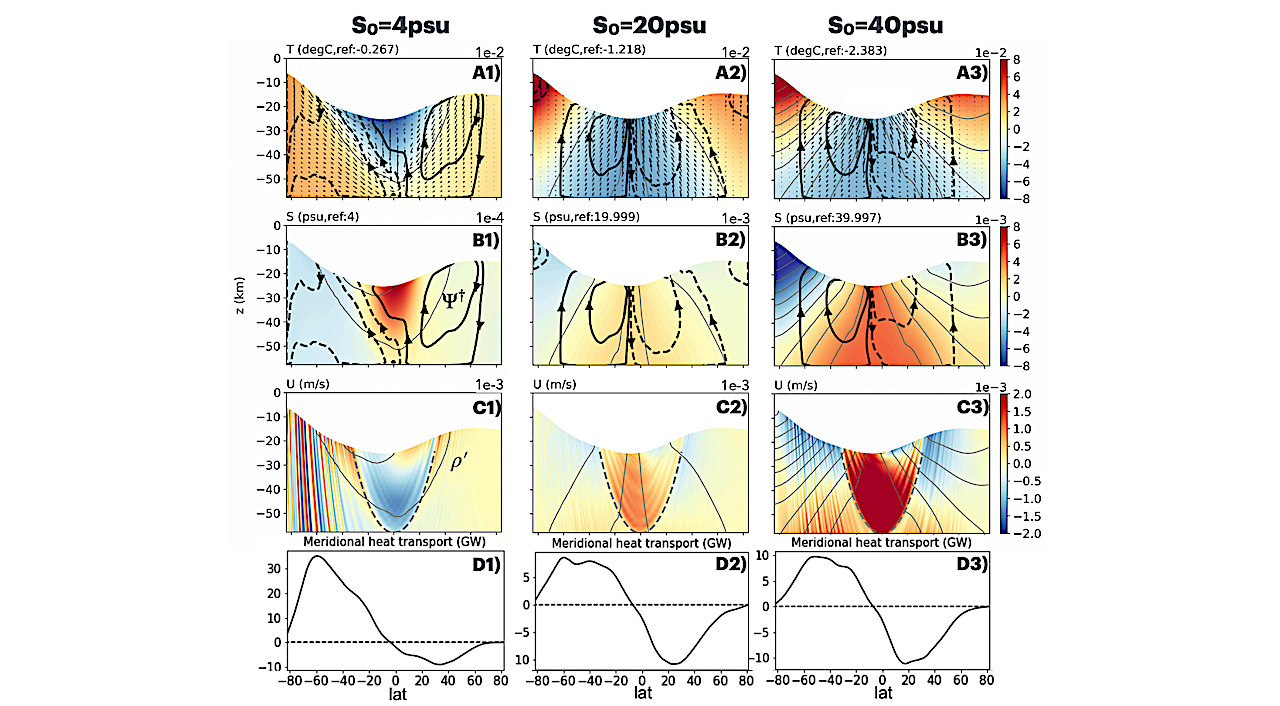
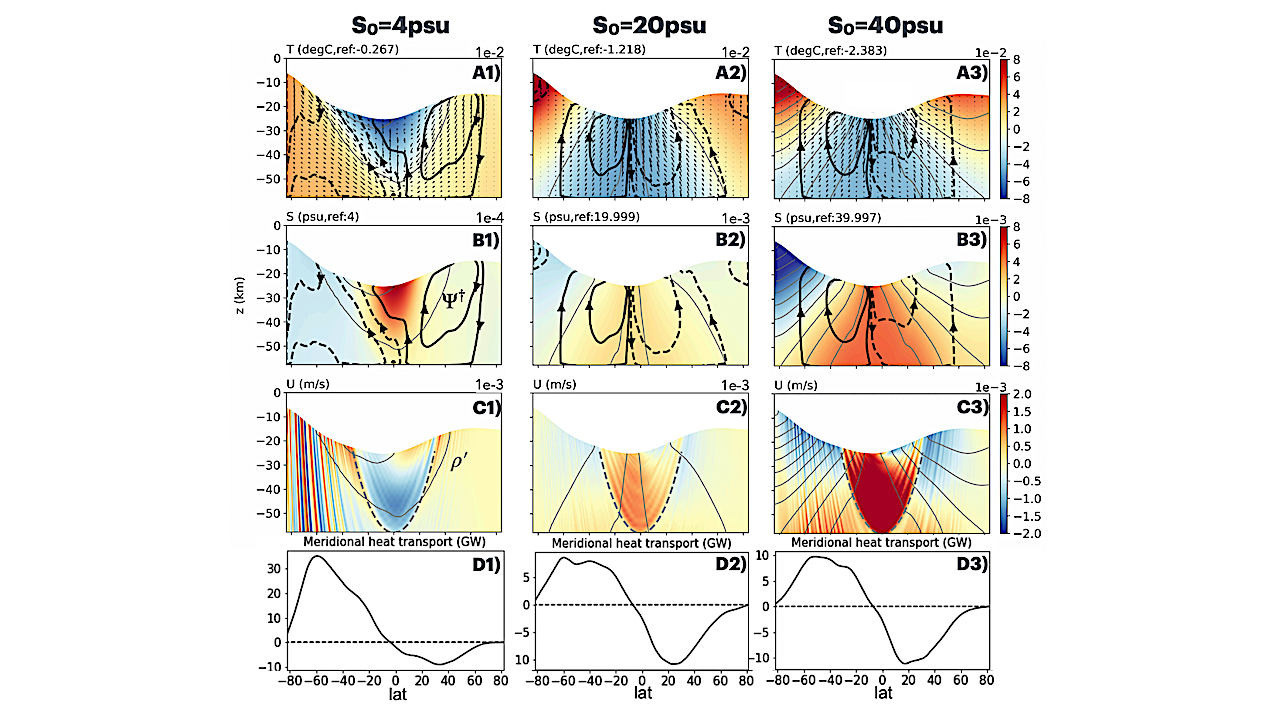
Numerical solutions for the three high-diffusivity (κv = 10−2m2/s) simulations with different salinities. Shadings in panels (A-C) show the zonal-mean time-mean temperature T, salinity S and zonal flow U respectively. Thin gray contours in each panel present density. The spacing between two adjacent contours is set to 2 × 10⁻³kg/m3, and density increases with depth in all cases. Thick black contours with arrows in panels (A,B) show the diagnosed residual circulation streamfunction Ψ†, and solid/dashed Ψ† contours denote clockwise/counter-clockwise circulation, respectively. The contour levels are ±1.2 × 10⁷, ±5 × 10⁷, ±2 × 10⁸kg/s. The arrows in panel (A) present the diagnosed eddy heat transport. Panels (D) show the time-mean meridional heat transport with positive values denote northward heat transport. — astro-ph.EP
The habitability of Enceladus’ subsurface ocean and the detectability of potential biosignatures depend on efficient ocean circulation and suitable ocean conditions.
Directly probing the ocean is challenging because it lies beneath a thick ice shell; however, the ice thickness distribution is relatively well constrained and provides indirect insight into the underlying ocean dynamics. This study investigates how ocean circulation and the associated heat transport depend on ocean salinity and tide-induced vertical mixing using scaling analysis, supported by numerical simulations.
We find that ocean circulation and equatorward heat convergence are stronger under extremely high or low salinity conditions than under intermediate salinity, and both increase with tidal mixing rates.
Because the poleward thinning of Enceladus’ ice shell cannot be maintained in the presence of strong equatorward ocean heat transport, these results place constraints on the ocean salinity, diffusivity, circulation timescale, and ocean dissipation rate.
Energetic analysis further shows that Enceladus’ ocean behaves like an extremely efficient heat pump (inefficient heat engine), potentially transporting up to 1000 times more heat across latitudes than the energy dissipated within the ocean itself, thereby placing strong constraints on the ocean’s energy dissipation rate.
Wanying Kang, Yixiao Zhang
Subjects: Earth and Planetary Astrophysics (astro-ph.EP)
Cite as: arXiv:2603.22602 [astro-ph.EP] (or arXiv:2603.22602v1 [astro-ph.EP] for this version)
https://doi.org/10.48550/arXiv.2603.22602
Focus to learn more
Submission history
From: Wanying Kang
[v1] Mon, 23 Mar 2026 21:56:39 UTC (19,594 KB)
https://arxiv.org/abs/2603.22602
Astrobiology











Related Posts

Stay Informed With the Latest & Most Important News
Previous Post
Next Post




Advertisement
-
 01Two Black Holes Observed Circling Each Other for the First Time
 -
 02From Polymerization-Enabled Folding and Assembly to Chemical Evolution: Key Processes for Emergence of Functional Polymers in the Origin of Life
 -
 03Astronomy 101: From the Sun and Moon to Wormholes and Warp Drive, Key Theories, Discoveries, and Facts about the Universe (The Adams 101 Series)
 -
 04True Anomaly hires former York Space executive as chief operating officer
 -
 05Φsat-2 begins science phase for AI Earth images
 -
 06Hurricane forecasters are losing 3 key satellites ahead of peak storm season − a meteorologist explains why it matters
 -
 07Binary star systems are complex astronomical objects − a new AI approach could pin down their properties quickly