
Now Reading: Sulfur Enrichment In Close-in Exoplanet Atmospheres Induced By Pebble Drift Across The Salt Line
-
01
Sulfur Enrichment In Close-in Exoplanet Atmospheres Induced By Pebble Drift Across The Salt Line

Sulfur Enrichment In Close-in Exoplanet Atmospheres Induced By Pebble Drift Across The Salt Line

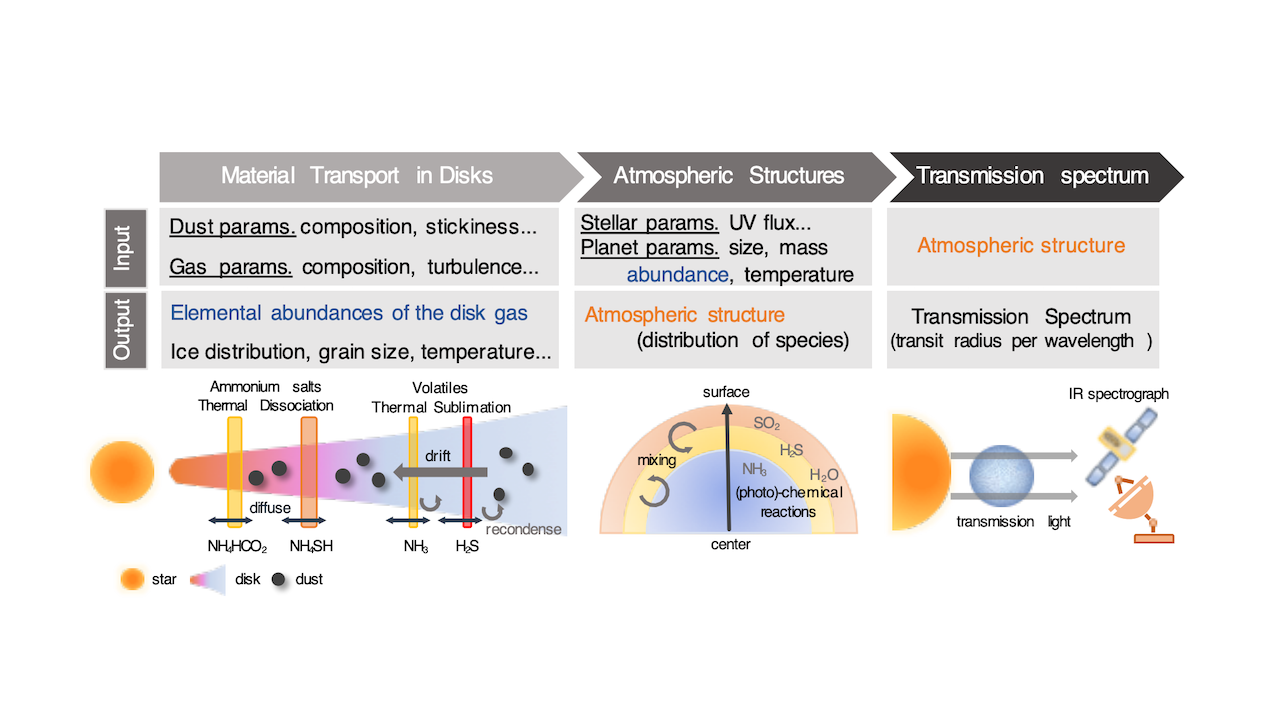
The calculation flow in our model. We model the dynamics of gas and dust containing volatile ices and semi-volatile salts to calculate the C, O, N, and S abundances in the disk. Subsequently, we simulate the evolution of the planetary atmospheric structure that inherits the disk’s composition and predict its transmission spectrum. The colored input parameters at the top of the figure correspond to the results obtained from the previous calculation step. — astro-ph.EP
Observations of JWST have revealed that several close-in exoplanets have sulfur-rich atmospheres through SO2 detections. Atmospheric sulfur is often thought to originate from solid accretion during planet formation, whereas recent simultaneous detections of SO2 and NH3 challenge this conventional scenario.
In this study, we propose that ammonium salts, such as NH4SH tentatively detected in comets and molecular clouds, play a significant role in producing sulfur-rich disk gases, which serve as the ingredient of giant planet atmospheres.
We simulated the radial transport of dust containing volatile ices and ammonium salts, along with the dissociation, sublimation, and recondensation of these materials, thereby predicting the atmospheric chemical structures and transmission spectra of planets inheriting these compositions. Assuming that ammonium salts sequester 20% of the elemental nitrogen and sulfur budgets, our results reveal that they enhance sulfur and nitrogen abundances in disk gases to 2-10 times the solar values near the salt dissociation line.
Photochemical simulations demonstrate that SO2, NS, H2S, NO, and NH3 become the dominant N and S chemical species in the atmospheres on planets that inherited the gas compositions inside H2O snowline. SO2 features clearly appear in the infrared transmission spectra when the salt-bearing grains enhance the sulfur abundance of disk gas by pebble drift.
Our model provides a novel scenario that explains the SO2 detected in some exoplanet atmospheres solely from disk gas accretion. Volatile-element ratios, particularly N/S and C/O, would provide a key to disentangle our scenario from the conventional solid-accretion scenario.
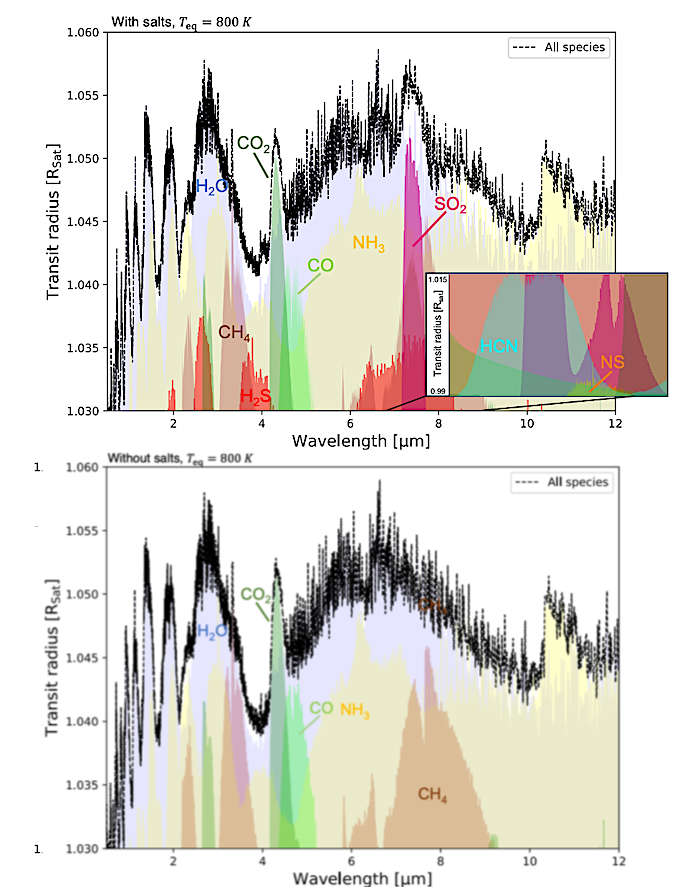
Transmission spectra of a planet with an atmospheric structure inheriting the elemental abundances of the disk at 1.5 au and 0.5 Myr. The black line represents the combined transmission spectrum of all molecules (H2, He, H2O, CO2, CO, CH4, NH3, H2S, SO2, CS, COS, NO, HCN, NS), while the shaded areas show the contributions of individual molecules. Upper panel: Spectrum for a planet formed in a salt-bearing disk. The corresponding atmospheric structure is shown in the upper left panel of Figure 7. The inset in the lower right corner provides an enlarged view of the 7–9 µm bands in the range of 0.99–1.015 Rsat transit radius, highlighting the small contributions of HCN and NS. Lower panel: Spectrum for a planet formed in a disk without salt. The corresponding atmospheric structure is shown in the lower left panel of Figure 7. — astro-ph.EP
Kanon Nakazawa, Ohno Kazumasa
Comments: Accepted for publication in ApJ
Subjects: Earth and Planetary Astrophysics (astro-ph.EP)
Cite as: arXiv:2602.05300 [astro-ph.EP] (or arXiv:2602.05300v1 [astro-ph.EP] for this version)
https://doi.org/10.48550/arXiv.2602.05300
Focus to learn more
Submission history
From: Kanon Nakazawa
[v1] Thu, 5 Feb 2026 04:49:41 UTC (6,346 KB)
https://arxiv.org/abs/2602.05300
Astrobiology, Astrochemistry,










Related Posts
Stay Informed With the Latest & Most Important News
Previous Post
Next Post


Advertisement
-
 01Two Black Holes Observed Circling Each Other for the First Time
 -
 02From Polymerization-Enabled Folding and Assembly to Chemical Evolution: Key Processes for Emergence of Functional Polymers in the Origin of Life
 -
 03Astronomy 101: From the Sun and Moon to Wormholes and Warp Drive, Key Theories, Discoveries, and Facts about the Universe (The Adams 101 Series)
 -
 04True Anomaly hires former York Space executive as chief operating officer
 -
 05Φsat-2 begins science phase for AI Earth images
 -
 06Hurricane forecasters are losing 3 key satellites ahead of peak storm season − a meteorologist explains why it matters
 -
 07Binary star systems are complex astronomical objects − a new AI approach could pin down their properties quickly