
Now Reading: Susceptibility Of Microbes To far-UVC Light (222 nm) On Spacecraft And Cleanroom Surfaces
-
01
Susceptibility Of Microbes To far-UVC Light (222 nm) On Spacecraft And Cleanroom Surfaces

Susceptibility Of Microbes To far-UVC Light (222 nm) On Spacecraft And Cleanroom Surfaces

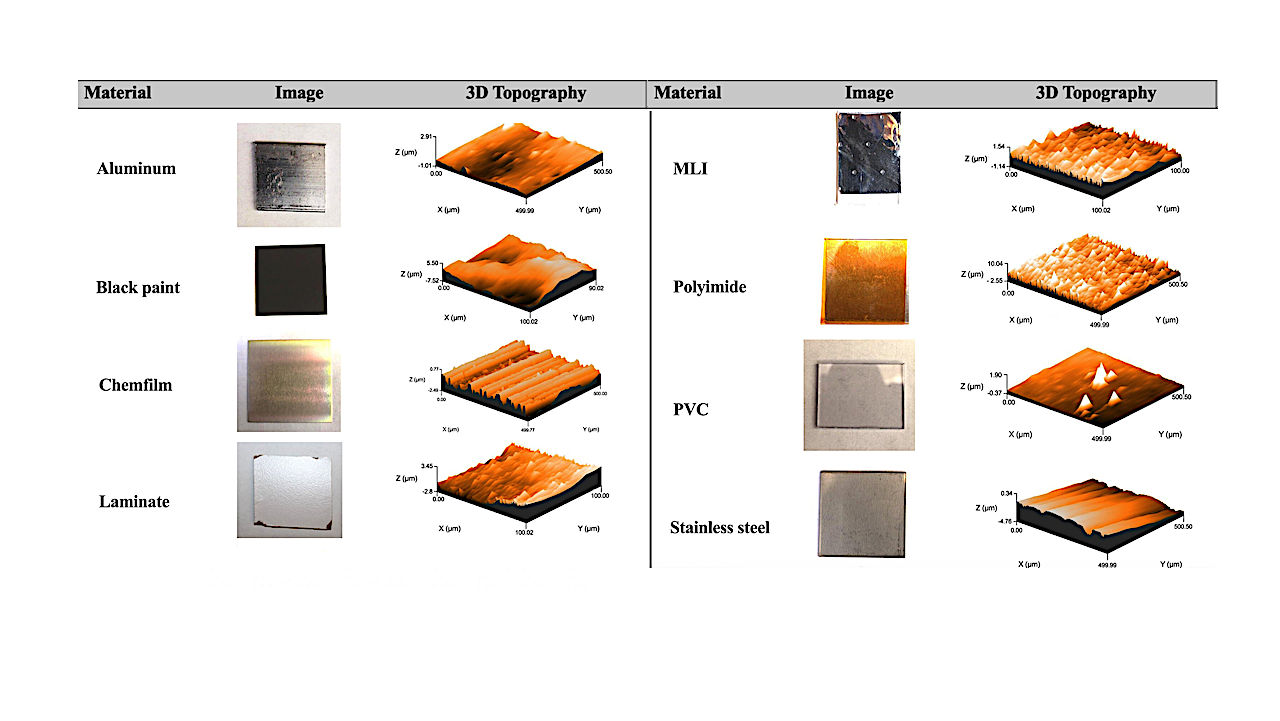
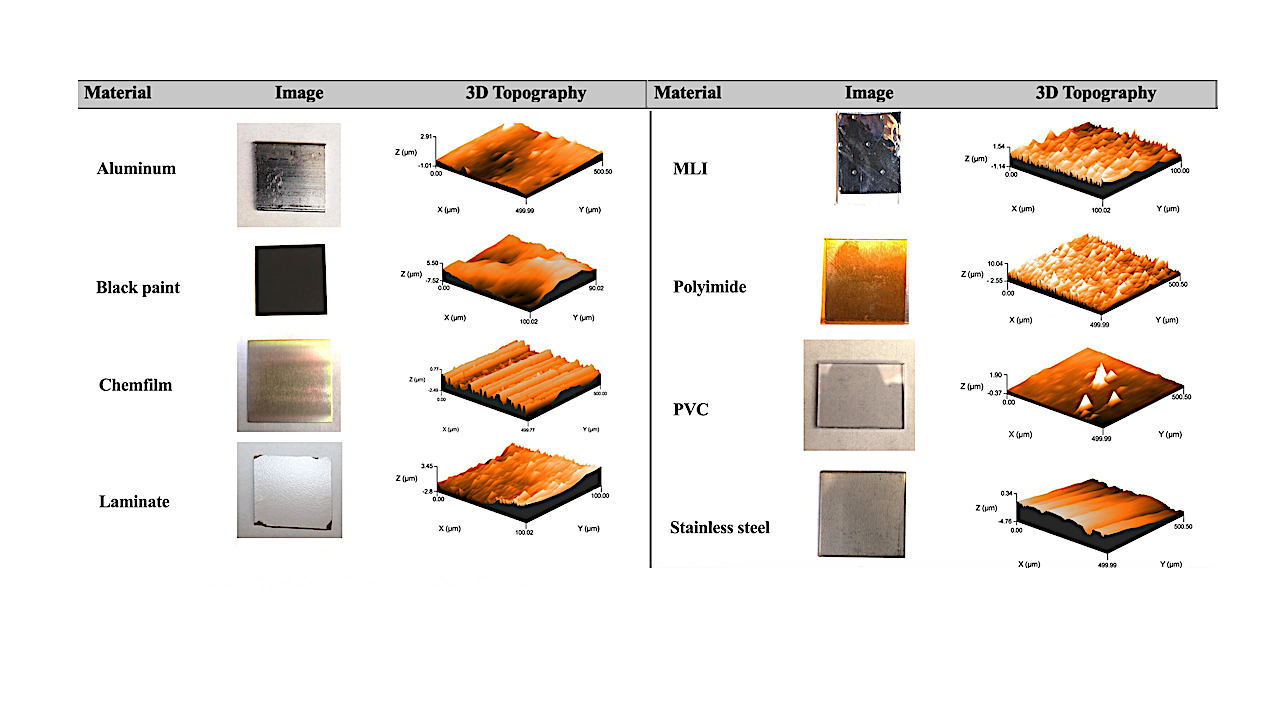
Photos of tested material surfaces and their corresponding three-dimensional (3D) topography. Z-axis labels represent the surface height range. Some 3D scan lengths were limited to 100 µm due to data point constraints. — Environmental Microbiology via PubMed
Far-UVC light (222 nm) is an emerging decontamination tool with potential for spacecraft assembly applications due to its strong germicidal efficacy and minimal risk to human health.
This study evaluated the susceptibility of three UV-resistant microbial species, Deinococcus radiodurans and Bacillus subtilis as vegetative cells and Bacillus pumilus as spores, across eight spacecraft and cleanroom-relevant materials with varying surface properties, including contact angle, reflectivity, and roughness.
While D. radiodurans demonstrated the highest overall resistance to far-UVC, material properties significantly influenced its inactivation rate (k1 [cm2/mJ]), and its susceptibility varied significantly by surface.
No significant relationship between material properties influencing k1 values was observed for B. subtilis and B. pumilus.
Collectively, these findings highlight far-UVC as a robust and practical bioburden reduction tool capable of inactivating resistant microbes regardless of material surface characteristics.
Astrobiology, Planetary Protection,











Related Posts
Stay Informed With the Latest & Most Important News
Previous Post
Next Post
Advertisement
-
 01Two Black Holes Observed Circling Each Other for the First Time
 -
 02From Polymerization-Enabled Folding and Assembly to Chemical Evolution: Key Processes for Emergence of Functional Polymers in the Origin of Life
 -
 03Astronomy 101: From the Sun and Moon to Wormholes and Warp Drive, Key Theories, Discoveries, and Facts about the Universe (The Adams 101 Series)
 -
 04True Anomaly hires former York Space executive as chief operating officer
 -
 05Φsat-2 begins science phase for AI Earth images
 -
 06Hurricane forecasters are losing 3 key satellites ahead of peak storm season − a meteorologist explains why it matters
 -
 07Binary star systems are complex astronomical objects − a new AI approach could pin down their properties quickly