
Now Reading: Swift spacecraft reorientation buys time for reboost mission
-
01
Swift spacecraft reorientation buys time for reboost mission


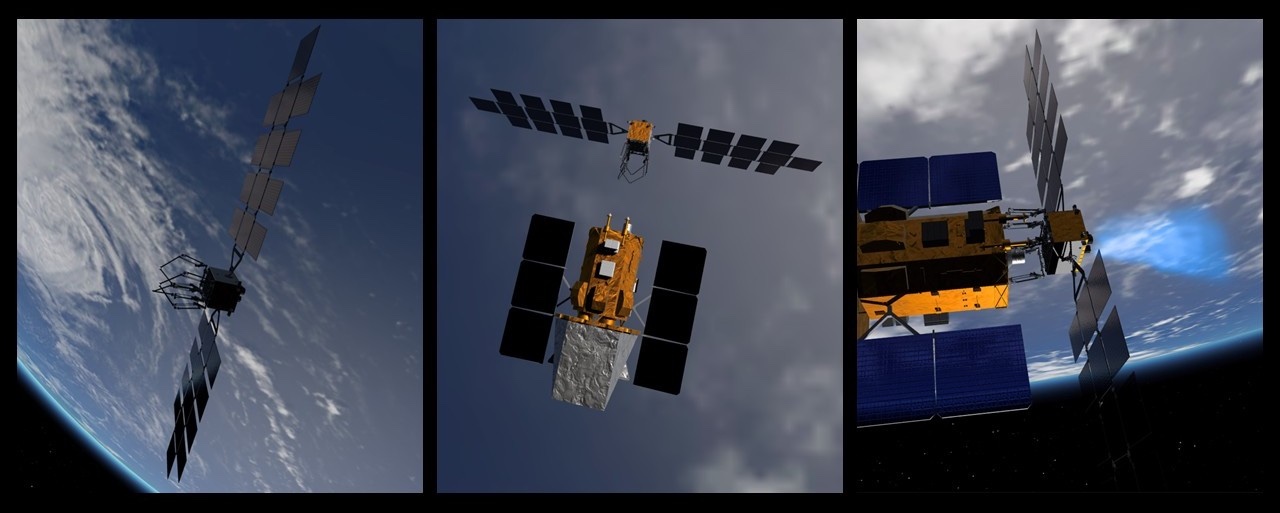

WASHINGTON — NASA modified operations of an astrophysics spacecraft in a decaying orbit to buy more time for a mission later this year that will attempt to raise its orbit.
NASA announced in September it selected Katalyst Space to develop a spacecraft that will rendezvous with the Neil Gehrels Swift Observatory and raise its orbit. Swift, launched in 2004, is in a decaying orbit, and the $30 million reboost mission would keep the spacecraft from reentering.
At an astronomy conference in early January, Jamie Kennea, a research professor at Penn State University who is head of Swift’s science operations team, said models projected that Swift’s orbit would decay below 300 kilometers, the minimum altitude for the reboost mission, sometime between mid-October 2026 and January 2027. That provided several months of margin for Katalyst’s Link spacecraft, scheduled to launch as soon as June 1 on a Northrop Grumman Pegasus XL.
However, in a presentation to the National Academies’ Committee on Astronomy and Astrophysics March 26, Kennea said updated models in January moved up the date when Swift would pass below 300 kilometers. There was now a 10% chance Swift would decay below 300 kilometers in late May, before the Katalyst mission would launch, and a 90% chance of doing so by mid-July.
“With this news in hand, we had to do something about it,” he said. On Feb. 10, the spacecraft halted most of its science operations so that it could be reconfigured to reduce drag.
Engineers had developed a plan to reorient Swift when it passed through an atmospheric bulge on the sunward side of its orbit, limiting science operations for 20 minutes at a time. “With the existence of this very dramatic prediction of orbit decay, we decided to move into doing it for the entire orbit,” he said.
The goal of the reorientation of the spacecraft was to reduce drag by 30%, and tracking data shows that the rate of orbital decay has slowed as a result. A new model of the spacecraft’s orbit now predicts Swift has a 10% chance of reaching the 300-kilometer mark by Aug. 11 and a 90% chance of doing so by Sept. 24.
“We’re really maximizing our chances here,” he said.
The spacecraft reorientation does have drawbacks. In this reconfigured mode, only the spacecraft’s Burst Alert Telescope, which is designed to detect gamma-ray bursts, is in operation. Other instruments, which require the spacecraft to reorient itself, have stopped operations.
Kennea said that, if the Katalyst mission is successful in raising Swift’s orbit, those instruments will be able to resume observations. The instruments themselves will likely be turned off during the reboost, requiring some time afterward to turn them on and recalibrate them before resuming science operations.
“I feel like this is going to be a phoenix-from-the-ashes situation where the mission starts anew,” he said.
That depends, though, on Katalyst’s Link spacecraft launching on schedule and being able to dock with and reboost Swift. He said he is not involved in planning for the reboost and did not know how firm that proposed June 1 launch date is.
Earlier in the meeting, Shawn Domagal-Goldman, director of NASA’s astrophysics division, said he had visited a Katalyst facility in Colorado earlier in the month to check on the progress they are making with Link. Engineers there, he said, are working nights and weekends to get the spacecraft ready.
“This team is facing a major hurdle every week between now and mid-April. If they clear all of those hurdles, they’re going to be on a good path to go and boost Swift,” he said. He added a launch at the beginning of June would set up Link to dock with Swift on or around July 4.
“If everything goes well,” Kennea said, “Swift will be as good as it’s always been.”










Related Posts
Stay Informed With the Latest & Most Important News
Previous Post
Next Post


Advertisement
-
 01Two Black Holes Observed Circling Each Other for the First Time
 -
 02From Polymerization-Enabled Folding and Assembly to Chemical Evolution: Key Processes for Emergence of Functional Polymers in the Origin of Life
 -
 03Astronomy 101: From the Sun and Moon to Wormholes and Warp Drive, Key Theories, Discoveries, and Facts about the Universe (The Adams 101 Series)
 -
 04True Anomaly hires former York Space executive as chief operating officer
 -
 05Φsat-2 begins science phase for AI Earth images
 -
 06Hurricane forecasters are losing 3 key satellites ahead of peak storm season − a meteorologist explains why it matters
 -
 07Binary star systems are complex astronomical objects − a new AI approach could pin down their properties quickly