
Now Reading: Tempawral: A Time-Resolved Retrieval Framework for Variable Brown Dwarfs and Exoplanets
-
01
Tempawral: A Time-Resolved Retrieval Framework for Variable Brown Dwarfs and Exoplanets

Tempawral: A Time-Resolved Retrieval Framework for Variable Brown Dwarfs and Exoplanets

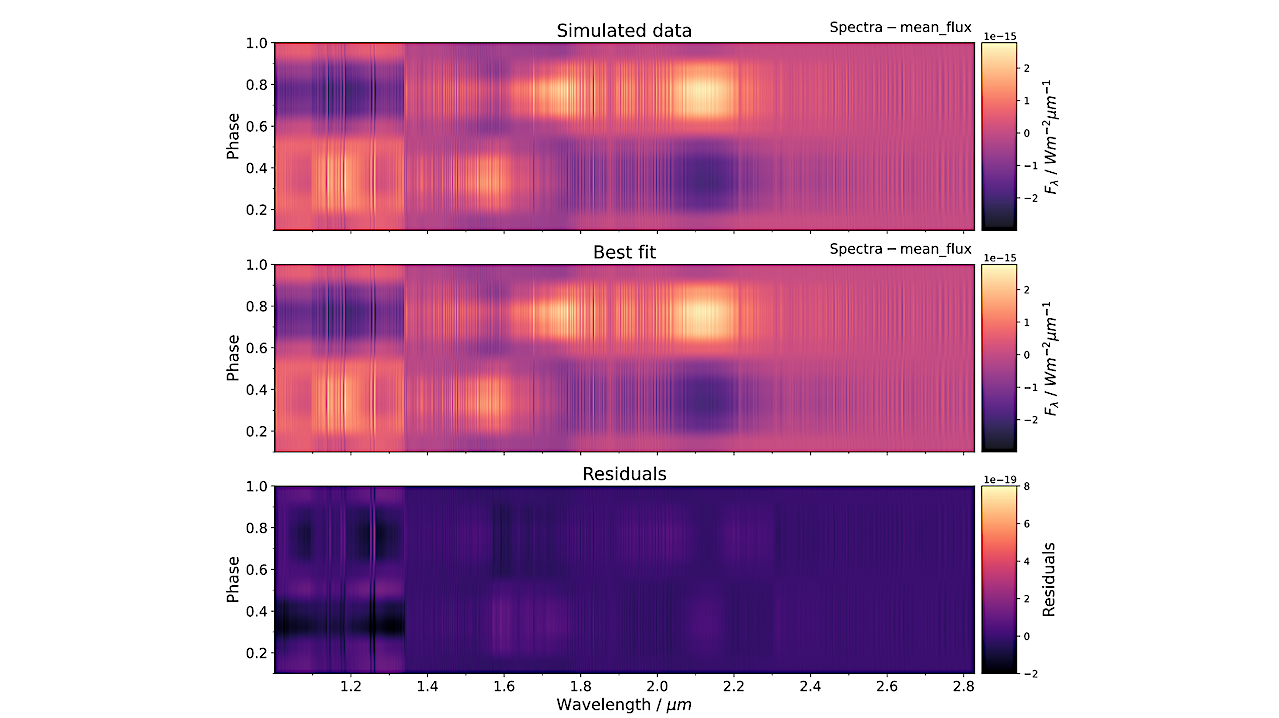
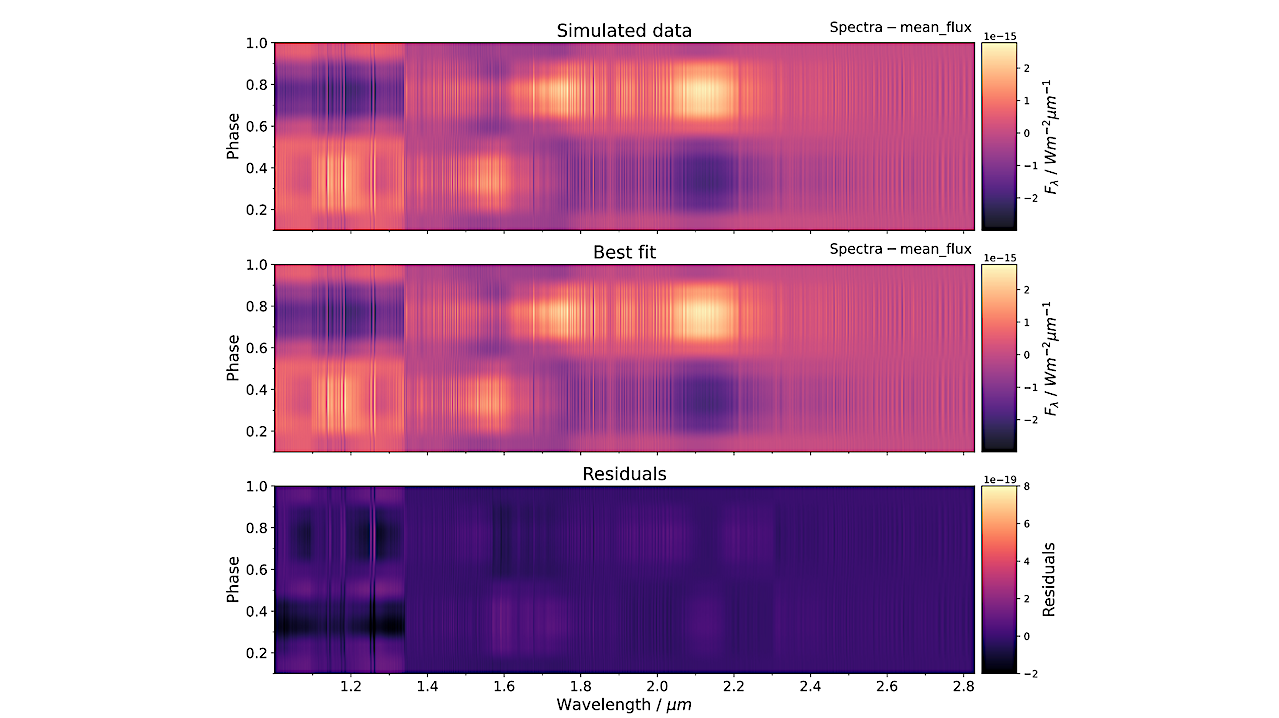
Top: Simulated time-series spectroscopy observation of a SIMP 0136-like brown dwarf for our Scenario 1. The difference between the each spectrum and time-averaged mean flux is shown at each phase to highlight the variability patterns. Center: the corresponding best-fit solution from the Tempawral atmospheric retrieval. Bottom: residuals between the simulated observations and the best-fit solution. — astro-ph.EP
Brown dwarfs and exoplanets are thought to host complex atmospheric phenomena such as clouds, storms, and chemical heterogeneity, akin to weather patterns on Earth. These features can produce pronounced spectral variability.
Time-variability monitoring provides a unique window into surface inhomogeneities that cannot be directly resolved with foreseeable imaging technology. Current time-series analysis techniques have provided qualitative constraints on variability mechanisms but lack the ability to quantitatively estimate the extent of variation on atmospheric properties.
We present Tempawral, the first data-driven time-resolved atmospheric retrieval framework that quantitatively retrieving variability in atmospheric parameters via an eigen-spectra inversion technique, leveraging the full spectra dataset.
We validate this method on simulated time-series spectra of a variable brown dwarf, demonstrating that it successfully recovers key variability drivers, including inhomogeneous cloud coverage, evolving chemical abundances, and changes in temperature structure. We further showcase the utility of Tempawral by applying it to JWST/NIRISS-SOSS time-series observations of a highly variable T2.5 brown dwarf.
The observed variability is best explained by a ∼300 K temperature perturbation near the 1-bar, accompanied by variations in the abundances of H2O, CO, FeH, as well as changes in the thickness of the iron cloud deck. This work provides a generalized framework for time-resolved atmospheric retrievals in the JWST era, enabling comprehensive interpretations of dynamic atmospheric processes in substellar objects.
Fei Wang, Ben Burningham, Stuart Littlefair, Etienne Artigau, Yuka Fujii, Jacqueline K. Faherty, Johanna M. Vos
Comments: Accepted in MNRAS
Subjects: Earth and Planetary Astrophysics (astro-ph.EP); Instrumentation and Methods for Astrophysics (astro-ph.IM); Solar and Stellar Astrophysics (astro-ph.SR)
Cite as: arXiv:2602.18984 [astro-ph.EP] (or arXiv:2602.18984v1 [astro-ph.EP] for this version)
https://doi.org/10.48550/arXiv.2602.18984
Focus to learn more
Submission history
From: Fei Wang
[v1] Sun, 22 Feb 2026 00:04:43 UTC (24,537 KB)
https://arxiv.org/abs/2602.18984
Astrobiology,










Related Posts

Stay Informed With the Latest & Most Important News
Previous Post
Next Post




Advertisement
-
 01Two Black Holes Observed Circling Each Other for the First Time
 -
 02From Polymerization-Enabled Folding and Assembly to Chemical Evolution: Key Processes for Emergence of Functional Polymers in the Origin of Life
 -
 03Astronomy 101: From the Sun and Moon to Wormholes and Warp Drive, Key Theories, Discoveries, and Facts about the Universe (The Adams 101 Series)
 -
 04True Anomaly hires former York Space executive as chief operating officer
 -
 05Φsat-2 begins science phase for AI Earth images
 -
 06Hurricane forecasters are losing 3 key satellites ahead of peak storm season − a meteorologist explains why it matters
 -
 07Binary star systems are complex astronomical objects − a new AI approach could pin down their properties quickly