
Now Reading: Template-Based Catalysis and the Emergence of Collectively Autocatalytic SystemsEntropy
-
01
Template-Based Catalysis and the Emergence of Collectively Autocatalytic SystemsEntropy

Template-Based Catalysis and the Emergence of Collectively Autocatalytic SystemsEntropy

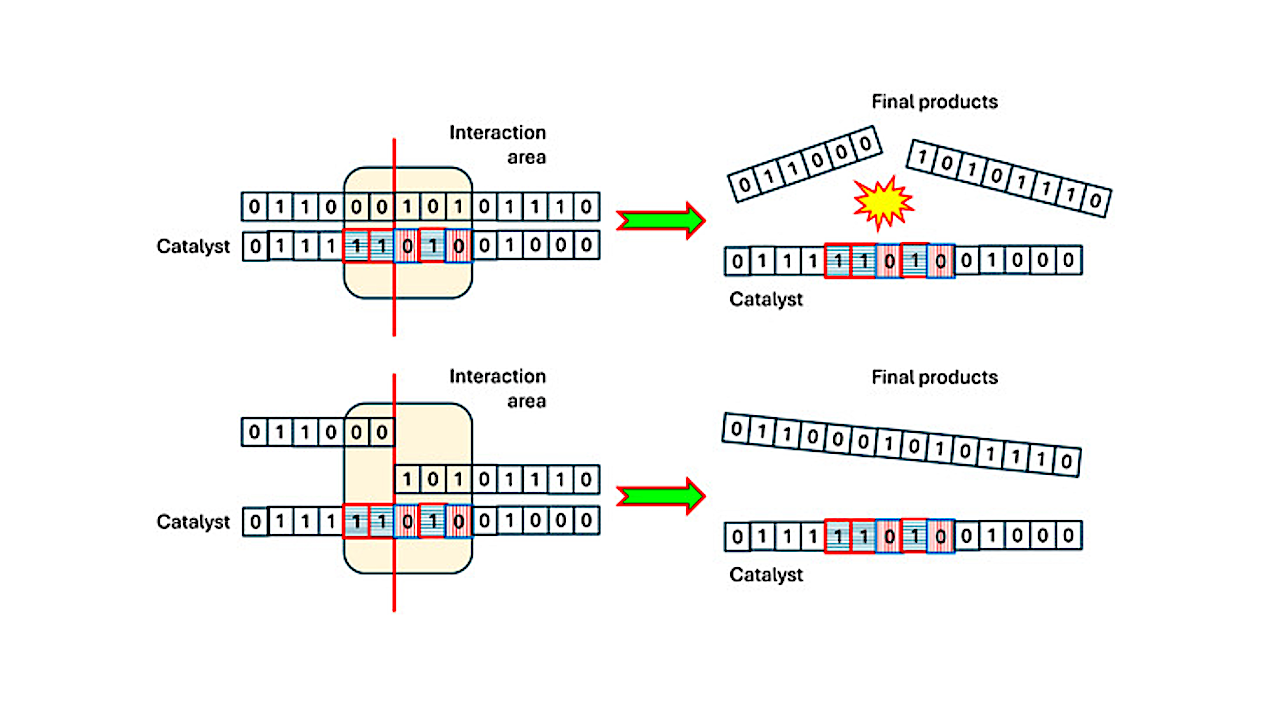

Template-based cleavage and condensation. (Top) cleavage. The catalyst contains an active site (shown as colored monomers, and highlighted by the ochre box) and a designated cleavage position (the vertical red line). A molecule is treated as a reactant when a segment within it is complementary to the catalyst’s active site; once this match is found, the molecule is split (the break is highlighted in the figure by a small “explosion”) at the cut position. (Bottom) condensation. The catalyst again features an active site and a suture position. A molecule qualifies as the first reactant if its ending segment complements the first portion of the active site, and another molecule serves as the second reactant if its starting segment complements the second portion of the active site. — Entropy
Mathematical and computational models, which have been successfully used in various fields of biology, are particularly relevant in studies on the origin of life, where wet experiments have not yet been able to obtain fully “living” entities from abiotic materials.
This paper investigates mathematical and computational models of interacting polymers in prebiotic environments to understand how molecular replication and protocell reproduction could emerge.
This study builds on the Binary Polymer Model (K-BPM), in which polymers are represented as binary strings that undergo catalyzed condensation and cleavage reactions, by introducing a biologically relevant variant (C-BPM), where catalytic activity depends on polymer structure.
The model is analyzed with respect to the formation of autocatalytic networks, formalized as Reflexive Autocatalytic Food-generated (RAF) sets, embedded in a protocell in order to simulate their dynamics. The results show clear differences between K-BPM and C-BPM models.
They also show that the existence of a RAF does not guarantee the survival of a population of protocells, although it may be possible when only a subset of the existing species partakes in the RAF, thus suggesting that small autocatalytic networks may have preceded the larger networks found in modern life.
Template-Based Catalysis and the Emergence of Collectively Autocatalytic Systems, Entropy (open access)
Astrobiology











Related Posts
Stay Informed With the Latest & Most Important News
Previous Post
Next Post



Advertisement
-
 01Two Black Holes Observed Circling Each Other for the First Time
 -
 02From Polymerization-Enabled Folding and Assembly to Chemical Evolution: Key Processes for Emergence of Functional Polymers in the Origin of Life
 -
 03Astronomy 101: From the Sun and Moon to Wormholes and Warp Drive, Key Theories, Discoveries, and Facts about the Universe (The Adams 101 Series)
 -
 04True Anomaly hires former York Space executive as chief operating officer
 -
 05Φsat-2 begins science phase for AI Earth images
 -
 06Hurricane forecasters are losing 3 key satellites ahead of peak storm season − a meteorologist explains why it matters
 -
 07Binary star systems are complex astronomical objects − a new AI approach could pin down their properties quickly