
Now Reading: The Chemical DNA Of The Magellanic Clouds VI. Origin And Evolution Of Neutron-capture Elements In The SMC
-
01
The Chemical DNA Of The Magellanic Clouds VI. Origin And Evolution Of Neutron-capture Elements In The SMC

The Chemical DNA Of The Magellanic Clouds VI. Origin And Evolution Of Neutron-capture Elements In The SMC

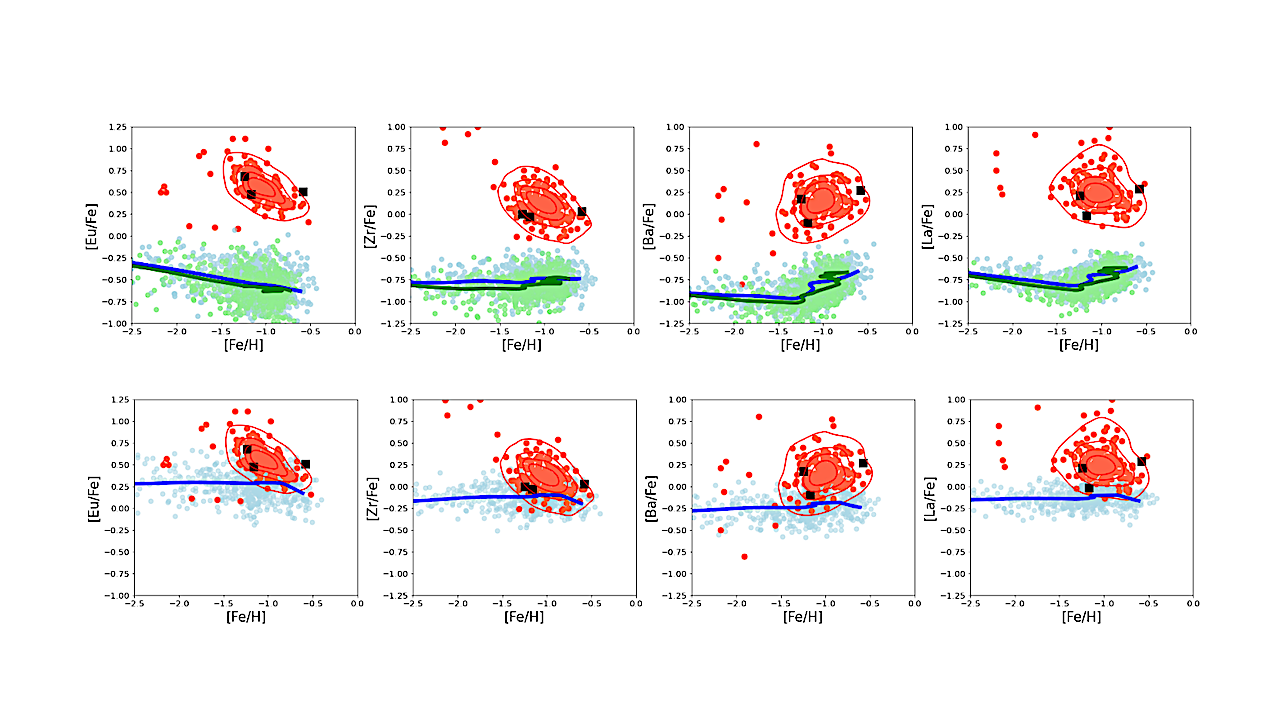
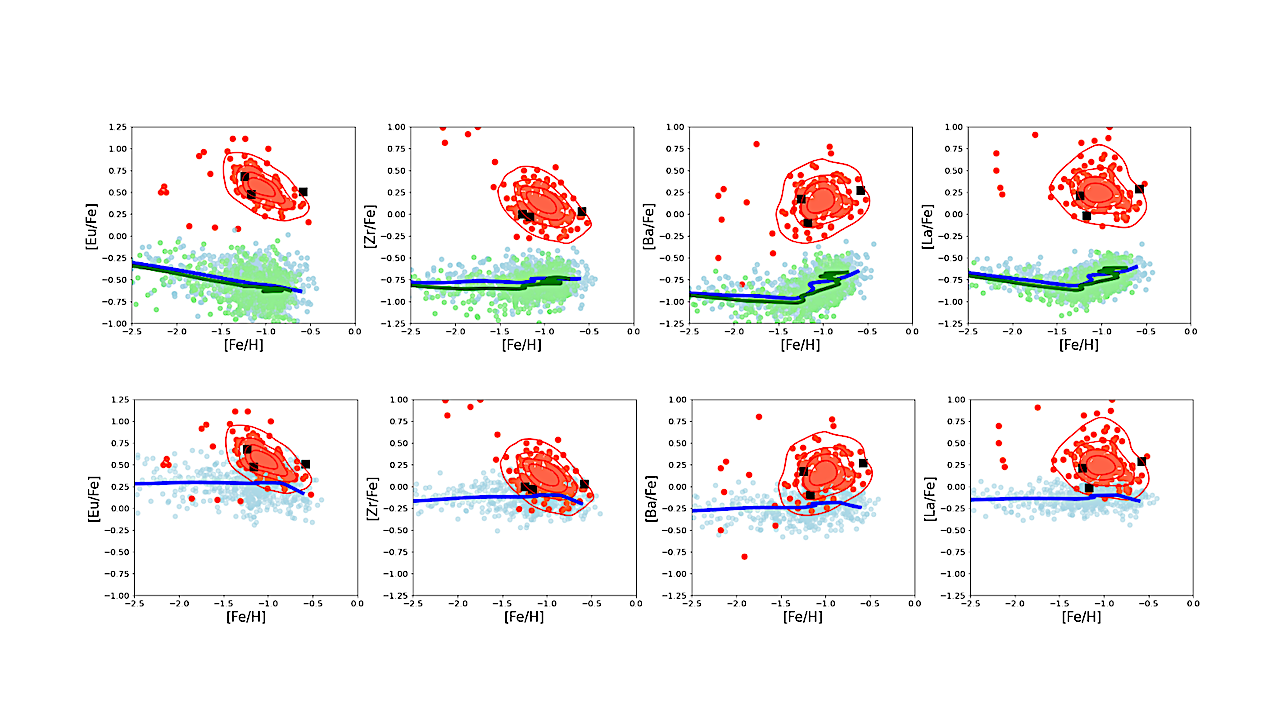
– [TOP] [X/Fe] vs. [Fe/H] for n-capture elements in the SMC. Abundance patterns are shown for Eu (leftmost panel), Zr (second leftmost) and Ba (second rightmost) and La (rightmost). Solid lines are genuine chemical evolution tracks for the reference models adopting Rubele et al. (2018) SFH (blue) and Massana et al. (2022) SFH (green), whereas shaded cyan and light-green regions are associated model predictions account for observational uncertainties (’synthetic models’). Data are from Anoardo et al. (2025, Eu) and Mucciarelli et al. (2023a, Zr, Ba, La) for SMC field stars (orange dots) and Mucciarelli et al. (2023b) for SMC GCs (black dots). Orange contour lines represent density lines of the observed stellar distributions in SMC field stars.
– [BOTTOM] [X/Fe] vs. [Fe/H] for n-capture elements for the model adopting Rubele et al. (2018) SFH with increased MNS r-process production at low-metallicity (see Eq. (4)). Blue solid lines and cyan shaded regions represent genuine chemical tracks and model predictions accounting for observational uncertainties (’synthetic model’), respectively. Data are as above. — astro-ph.GA
Context. In the context of galactic archaeology, the study of the Small Magellanic Cloud (SMC) is of crucial importance, as it represents a unique opportunity to study a nearby massive dwarf system. However, theoretical studies of the chemical evolution of this galaxy are strikingly lacking.
Aims. In this study, we investigate the chemical enrichment of the SMC galaxy. Besides alpha and Fe-peak elements, we devote particular attention to the evolution of neutron-capture elements with different origin, namely r-process (Eu), weak s-process (Zr) and main s-process (Ba, La).
Methods. We develop chemical evolution models that use as input the star formation histories obtained from colour-magnitude diagram fitting. We follow in detail the chemical feedback provided by a large variety of nucleosynthetic sources. Model predictions are compared with recent abundance measurements for the SMC.
Results. The developed framework reproduces well all the observables for elements up to the Fe-peak. The abundance patterns of n-capture elements are simultaneously reproduced only by assuming an enhanced contribution from the delayed r-process at low metallicity and a top-lighter IMF relative to the reference IMF by Kroupa (2001). In this way, both the observed very high plateau in [Eu/Fe] and the rising trends in [s-process/Fe] ratios can be reproduced by the models.
Conclusions. This study provides for the first time information on the evolution of several n-capture elements in a massive dwarf irregular galaxy, also providing insight on several ingredients driving galactic evolution. Moreover, this work provides a test-bed for further modelling of the SMC in the context of the numerous surveys that will target the Magellanic Clouds in the next years.
Marco Palla, Alessio Mucciarelli, Donatella Romano, Samuele Anoardo, Francesca Matteucci
Comments: 13 pages + appendices, 11 figures, 1 table. Resubmitted to A&A after minor revision
Subjects: Astrophysics of Galaxies (astro-ph.GA)
Cite as: arXiv:2603.17963 [astro-ph.GA] (or arXiv:2603.17963v1 [astro-ph.GA] for this version)
https://doi.org/10.48550/arXiv.2603.17963
Focus to learn more
Submission history
From: Marco Palla Dr.
[v1] Wed, 18 Mar 2026 17:32:12 UTC (2,167 KB)
https://arxiv.org/abs/2603.17963
Astrobiology,










Related Posts
Stay Informed With the Latest & Most Important News
Previous Post
Next Post


Advertisement
-
 01Two Black Holes Observed Circling Each Other for the First Time
 -
 02From Polymerization-Enabled Folding and Assembly to Chemical Evolution: Key Processes for Emergence of Functional Polymers in the Origin of Life
 -
 03Astronomy 101: From the Sun and Moon to Wormholes and Warp Drive, Key Theories, Discoveries, and Facts about the Universe (The Adams 101 Series)
 -
 04True Anomaly hires former York Space executive as chief operating officer
 -
 05Φsat-2 begins science phase for AI Earth images
 -
 06Hurricane forecasters are losing 3 key satellites ahead of peak storm season − a meteorologist explains why it matters
 -
 07Binary star systems are complex astronomical objects − a new AI approach could pin down their properties quickly