
Now Reading: The Dispersed Matter Planet Project Sample — Detection limits, Occurrence Rates and New Planets
-
01
The Dispersed Matter Planet Project Sample — Detection limits, Occurrence Rates and New Planets

The Dispersed Matter Planet Project Sample — Detection limits, Occurrence Rates and New Planets

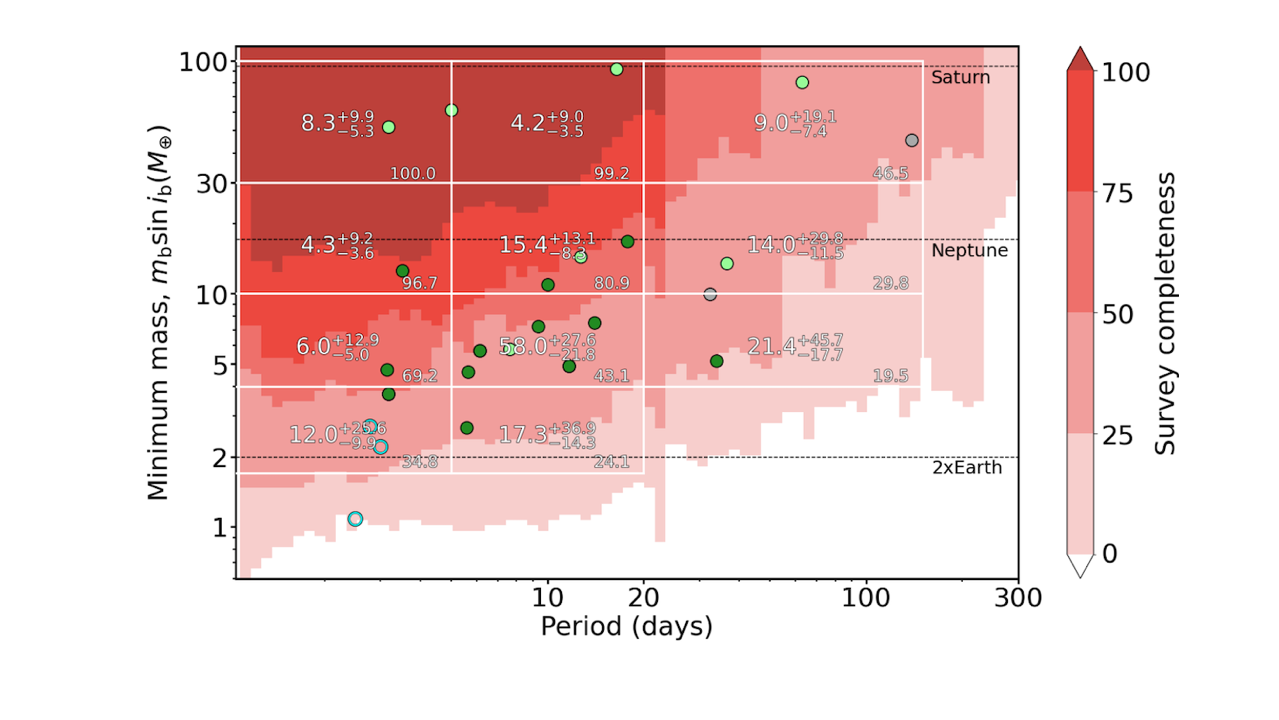
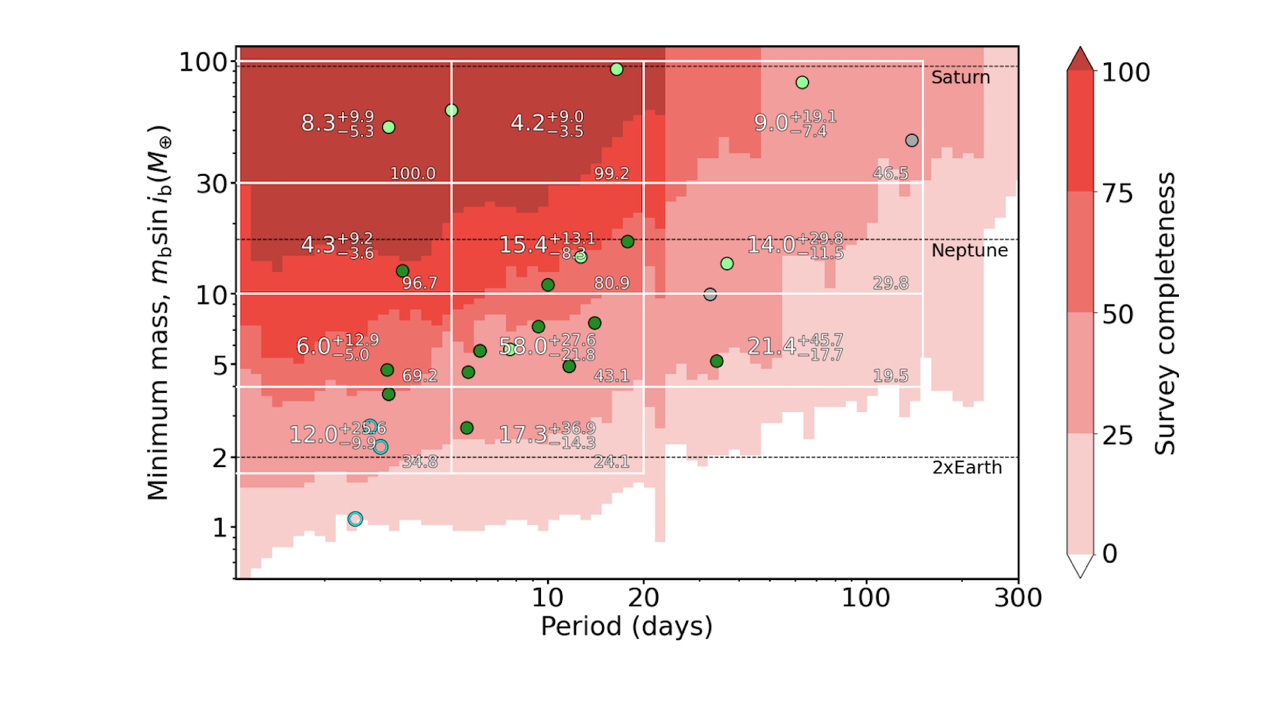
Completeness and planet abundance plot for the DMPP radial velocity survey of 24 targets with sub-basal activity, as a function of minimum mass and orbital period. The red contours indicate the completeness of the survey from 0% (white) to 100% (dark red) as in Figure 10 in Martin et al. (2019). The dark green circles show previously published planet signals present in our data, while the light green show signals found to pass our detection threshold in this work. Cyan open circles are the three candidate signals we identified with moderate statistical evidence, while the grey circles represent signals which we suspect arise from activity. The white lines delineate 11 boxes enclosing regions of parameter space within which we are able to constrain our planetary abundance. Box limits were chosen to be roughly equal in log space for short periods within our completeness, with mass limits on integer masses. The number in the centre of each box is a percentage indicating the planet abundance with its 1𝜎 uncertainty, or the 2𝜎 (95%) upper limit on abundance where no planet detection was made. The white values in the lower right of each box is its mean completeness as a percentage. — astro-ph.EP
DMPP is a radial-velocity survey that aims to detect planets around stars exhibiting anomalous activity signatures, consistent with the presence of close-in evaporating planets.
Here, we report the discovery of 7 new planetary signals in 5 different systems: DMPP-2c & d, HD67200/DMPP-6b & c, HD118006/DMPP-7b, HD191122/DMPP-8b, and HD200133/DMPP-9b. We update the orbital parameters of the DMPP-1, DMPP-2, and DMPP-3 systems, along with those of the planetary systems orbiting HD181433, HD39194, and HD89839.
We derive detection limits for all 24 targets in our sample with adequate observational coverage, and test the DMPP hypothesis by calculating the occurrence rates for planets in this configuration.
We find that the occurrence rates of planets in our sample with orbital periods shorter than 50 d and masses in the range 3-10 M⊕ are 83.0+27.1−24.4%, for 10-30 M⊕ are 27.0+15.0−11.2%, and for 30-100 M⊕ are 13.9+11.8−7.5%. This is significantly higher than the occurrence rates reported by other radial velocity surveys, providing strong support for the DMPP hypothesis.
Matthew R. Standing, John R. Barnes, Carole A. Haswell, Adam T. Stevenson, João P. Faria, Erwan Quintin, Zachary O. B. Ross, Luca Fossati, James S. Jenkins, Douglas Alves, Daniel Staab
Comments: 16 pages, 10 figures, accepted for publication in MNRAS. Appendix: 20 pages, 47 figures
Subjects: Earth and Planetary Astrophysics (astro-ph.EP); Instrumentation and Methods for Astrophysics (astro-ph.IM); Solar and Stellar Astrophysics (astro-ph.SR)
Cite as: arXiv:2602.18207 [astro-ph.EP] (or arXiv:2602.18207v1 [astro-ph.EP] for this version)
https://doi.org/10.48550/arXiv.2602.18207
Focus to learn more
Submission history
From: Matthew Standing
[v1] Fri, 20 Feb 2026 13:35:46 UTC (13,682 KB)
https://arxiv.org/abs/2602.18207
Astrobiology,










Related Posts
Stay Informed With the Latest & Most Important News
Previous Post
Next Post




Advertisement
-
 01Two Black Holes Observed Circling Each Other for the First Time
 -
 02From Polymerization-Enabled Folding and Assembly to Chemical Evolution: Key Processes for Emergence of Functional Polymers in the Origin of Life
 -
 03Astronomy 101: From the Sun and Moon to Wormholes and Warp Drive, Key Theories, Discoveries, and Facts about the Universe (The Adams 101 Series)
 -
 04True Anomaly hires former York Space executive as chief operating officer
 -
 05Φsat-2 begins science phase for AI Earth images
 -
 06Hurricane forecasters are losing 3 key satellites ahead of peak storm season − a meteorologist explains why it matters
 -
 07Binary star systems are complex astronomical objects − a new AI approach could pin down their properties quickly