
Now Reading: The Emergence Of Prebiotic Chemistry In The Interstellar Medium (ISM)
-
01
The Emergence Of Prebiotic Chemistry In The Interstellar Medium (ISM)


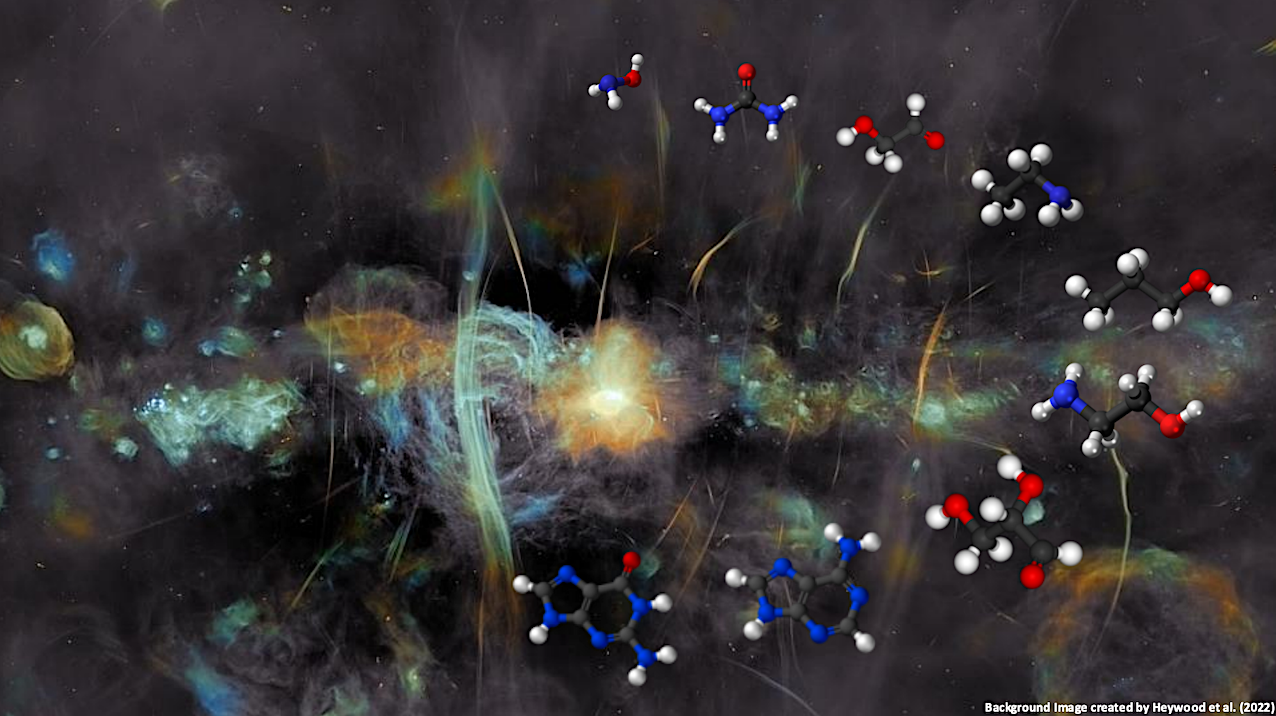
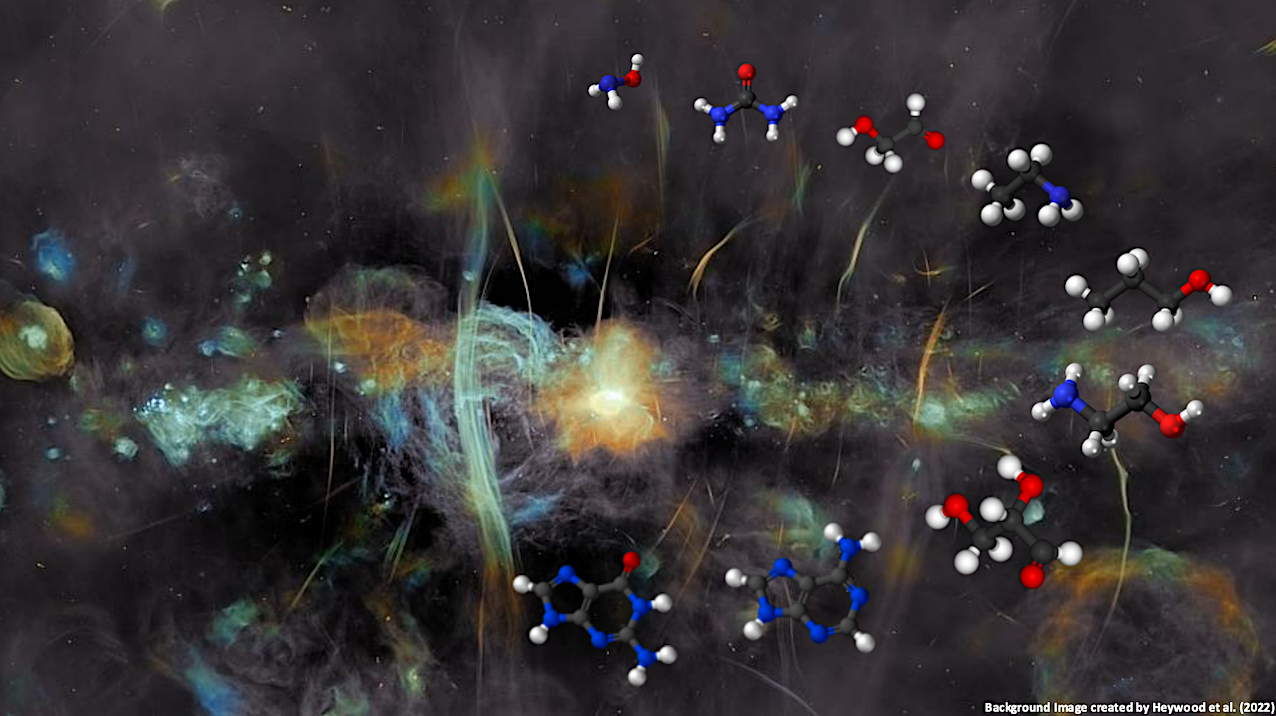
Graphical abstract — astro-ph.IM
Contrary to popular belief, the interstellar medium (ISM) is not empty; it is filled with atoms, dust particles, and molecules.
Some of these molecules may have been the very building blocks of life that, delivered to Earth via comets and meteorites, could have given rise to Life itself.
A large-area single-dish telescope with superb sensitivity, field-of-view and multi-band instruments will allow us to explore the limits of chemical complexity in the interstellar medium, across our Galaxy and in external galaxies, determining whether amino acids, sugars, or RNA/DNA nucleobases can form in space.
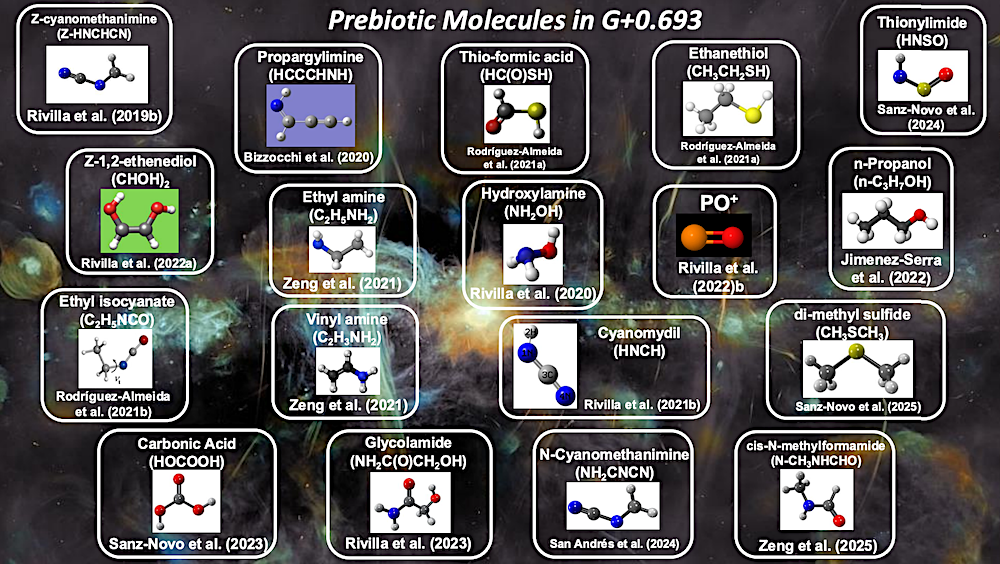
Prebiotic Molecules in G+0.693 — Sample of prebiotic molecules detected toward the Galactic Center cloud G+0.693 including precursors of ribonucleotides, amino acids, sugars, proto-proteins and proto-lipids (see recent review by Jiménez-Serra 2025). Background image: SARAO, Heywood et al. (2022) / J. C. Muñoz-Mateos. [ Glycolamide,Carbonic Acid, N-Cyanomethanimine, Thionylimide, Z-cyanomethanimine, Propargylimine, cis-N-methylformamide, di-methyl sulfide, Hydroxylamine, Thio-formic acid, Cyanomydil, Ethyl isocyanate, Ethanethiol, Ethyl amine, Vinyl amine, n-Propanol, Z-1,2-ethenediol, ]– astro-ph.EP
Izaskun Jimenez-Serra (1), Giuliana Cosentino (2), Francisco Montenegro-Montes (3), Laura Colzi (1), Victor M. Rivilla (1), Miguel Sanz-Novo (1), Marta Rey-Montejo (1), David San Andres (1), Sergio Martin (4), Shaoshan Zeng (5), Amelie Godard Palluet (1), Miguel A. Requena-Torres (6), German Molpeceres (7), Pamela Klassen (8), Doug Johnston (9), Francesco Fontani (10), Silvia Spezzano (11), Elena Redaelli (12), Juris Kalvans (13), Yuri Aikawa (14), Belen Tercero (15), Pablo de Vicente (15), Serena Viti (16), Emilio J. Cocinero (17), Aran Insausti (17) ((1) Center of Astrobiology (CAB, Spain), (2) Institute de Radioastronomie Millimetrique (IRAM, France), (3) Universidad Complutense de Madrid (UCM, Spain), (4) uropean Southern Observatory (ESO, Chile), (5) RIKEN (Japan), (6) Towson University (USA), (7) Instituto de Fisica Fundamental (IFF, Spain), (8) (UKRI STFC, UK), (9) NRC-Herzberg Institute (Canada), (10) Osservatorio di Arcetri (Italy), (11) Max Plank Institute for Extraterrestrial Physics (MPE, Germany), (12) ESO (Germany), (13) Venstpils University (Latvia), (14) University of Tokyo (Japan), (15) Observatorio de Yebes (OAN, Spain), (16) University of Leiden (The Netherlands), (17) UPV/Biofisika Institute (Spain))
Comments: This white paper was submitted to ESO Expanding Horizons in support of AtLAST
Subjects: Instrumentation and Methods for Astrophysics (astro-ph.IM); Earth and Planetary Astrophysics (astro-ph.EP); Astrophysics of Galaxies (astro-ph.GA); Solar and Stellar Astrophysics (astro-ph.SR)
Cite as: arXiv:2512.14772 [astro-ph.IM] (or arXiv:2512.14772v1 [astro-ph.IM] for this version)
https://doi.org/10.48550/arXiv.2512.14772
Focus to learn more
Submission history
From: Izaskun Jimenez-Serra
[v1] Tue, 16 Dec 2025 10:28:04 UTC (720 KB)
https://arxiv.org/abs/2512.14772
Astrobiology, Astrochemistry,










Related Posts
Stay Informed With the Latest & Most Important News
Previous Post
Next Post

Advertisement
-
 01Two Black Holes Observed Circling Each Other for the First Time
 -
 02From Polymerization-Enabled Folding and Assembly to Chemical Evolution: Key Processes for Emergence of Functional Polymers in the Origin of Life
 -
 03Astronomy 101: From the Sun and Moon to Wormholes and Warp Drive, Key Theories, Discoveries, and Facts about the Universe (The Adams 101 Series)
 -
 04True Anomaly hires former York Space executive as chief operating officer
 -
 05Φsat-2 begins science phase for AI Earth images
 -
 06Hurricane forecasters are losing 3 key satellites ahead of peak storm season − a meteorologist explains why it matters
 -
 07Binary star systems are complex astronomical objects − a new AI approach could pin down their properties quickly