
Now Reading: The Exploration Company in talks to acquire Orbex
-
01
The Exploration Company in talks to acquire Orbex



WASHINGTON — The Exploration Company is in talks to acquire Orbex, the U.K.-based small launch vehicle developer that has reportedly been in financial distress.
In a Jan. 21 statement, Orbex said it signed a letter of intent with Munich-based The Exploration Company (TEC) to explore a potential acquisition. The companies said details of any deal remain confidential and declined to discuss specifics, including the potential value of the transaction.
TEC is developing Nyx, a line of spacecraft to provide cargo delivery services to and from low Earth orbit, with longer-term ambitions to develop lunar spacecraft. Company officials said in June they were also studying a crewed version of Nyx.
Orbex, based in Scotland with propulsion development facilities in Denmark, has been working for several years on Prime, a small launch vehicle designed to place up to 200 kilograms into low Earth orbit. Prime has yet to attempt a first flight after years of delays.
“Orbex and TEC are complementary. We are working closely with the U.K. government to ensure that our combined business reinforces the U.K.’s launcher roadmap,” Hélène Huby, chief executive of TEC, said in a statement.
“We believe this opportunity plays to the strengths of both businesses and we look forward to sharing more when the time is right,” Orbex Chief Executive Phil Chambers said in the same statement.
Neither company publicized the letter of intent on their websites or social media channels. An Orbex spokesperson provided the statement only after being contacted by SpaceNews. TEC did not respond to a request for comment.
While the companies describe their capabilities as complementary, any combination would not be straightforward. Nyx is significantly heavier than what Prime is designed to launch. Orbex has previously announced plans for a larger rocket, called Proxima, but the status and capabilities of that vehicle remain unclear.
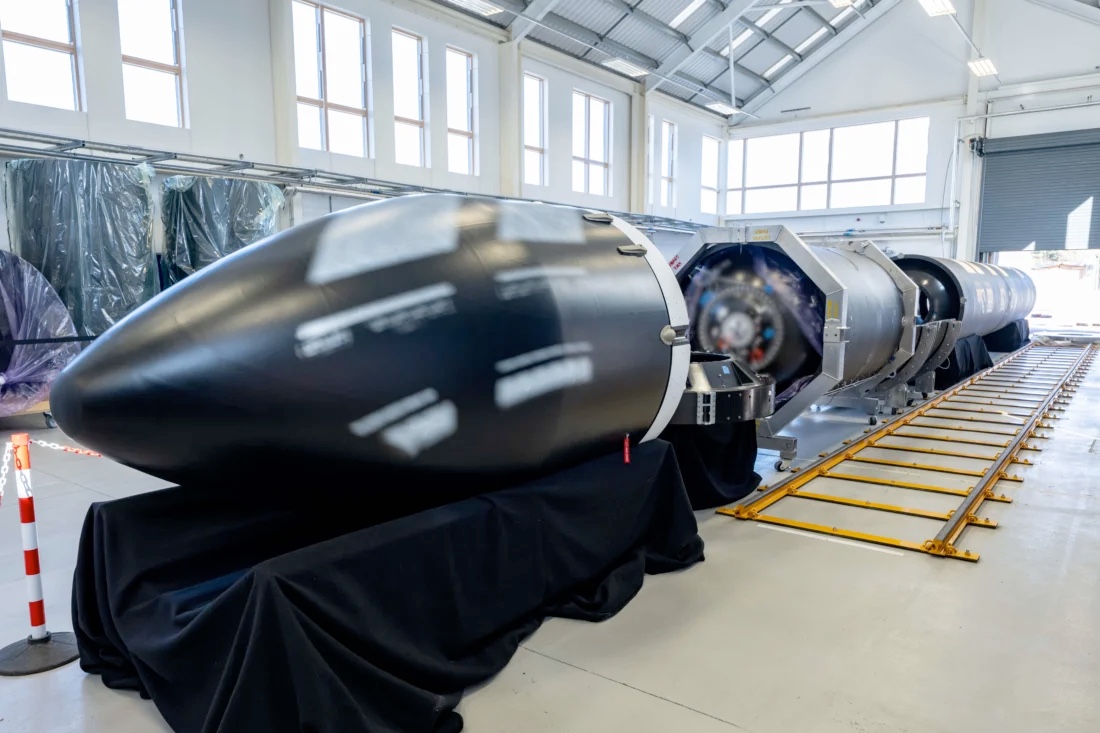
Orbex has provided few recent public updates on Prime’s development. In November, the company released an image of what it described as “launch vehicle hardware” for Prime, although it was unclear whether it was intended for flight or ground testing.
“We are preparing every element of the vehicle, with much of the hardware ready now, and the rest in production or test,” the company said, adding that a first launch was planned for 2026.
According to industry sources, Orbex has been struggling financially. It last raised 16.7 million pounds ($22.4 million) in an extension of a Series C round in April 2024, and efforts to raise a Series D round have so far been unsuccessful. That has reportedly led to layoffs at its propulsion facility in Denmark, with concerns that the site could close.
Those issues may have influenced the U.K. government’s decision to delay a funding decision for Orbex under the European Space Agency’s European Launcher Challenge. While the United Kingdom committed 144 million euros ($168 million) to the overall program, it allocated only 21.7 million euros to Orbex, the sole U.K.-based contender.
Orbex received 34.9 million euros in total subscriptions for the program, with the Czech Republic, Denmark, Germany and Portugal supplementing the U.K. contribution. The U.K. government provided 10 million euros to Rocket Factory Augsburg, a German company planning launches from SaxaVord Spaceport in the Shetland Islands, but left its remaining 112.3 million euros unallocated.
At a Jan. 8 ESA press conference, Toni Tolker-Nielsen, ESA’s director of space transportation, said the U.K. would need to decide soon how to allocate the remaining funds so ESA could award contracts to the five companies involved.
“There’s no contracts without the U.K. taking a decision to allocate this money to a specific project,” he said. “That should happen in the coming two to three months.”










Related Posts

Stay Informed With the Latest & Most Important News
Previous Post
Next Post



Advertisement
-
 01Two Black Holes Observed Circling Each Other for the First Time
 -
 02From Polymerization-Enabled Folding and Assembly to Chemical Evolution: Key Processes for Emergence of Functional Polymers in the Origin of Life
 -
 03Astronomy 101: From the Sun and Moon to Wormholes and Warp Drive, Key Theories, Discoveries, and Facts about the Universe (The Adams 101 Series)
 -
 04True Anomaly hires former York Space executive as chief operating officer
 -
 05Φsat-2 begins science phase for AI Earth images
 -
 06Hurricane forecasters are losing 3 key satellites ahead of peak storm season − a meteorologist explains why it matters
 -
 07Binary star systems are complex astronomical objects − a new AI approach could pin down their properties quickly