
Now Reading: The Future of Evolved Planetary Systems
-
01
The Future of Evolved Planetary Systems


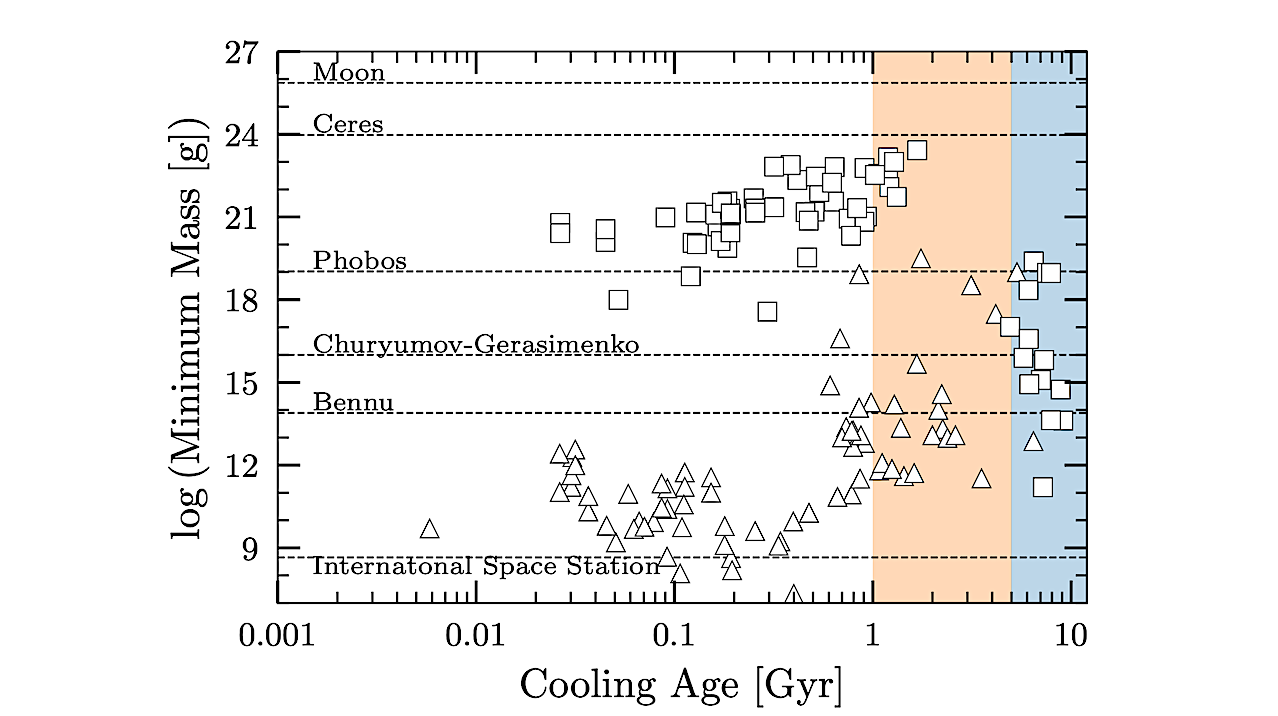
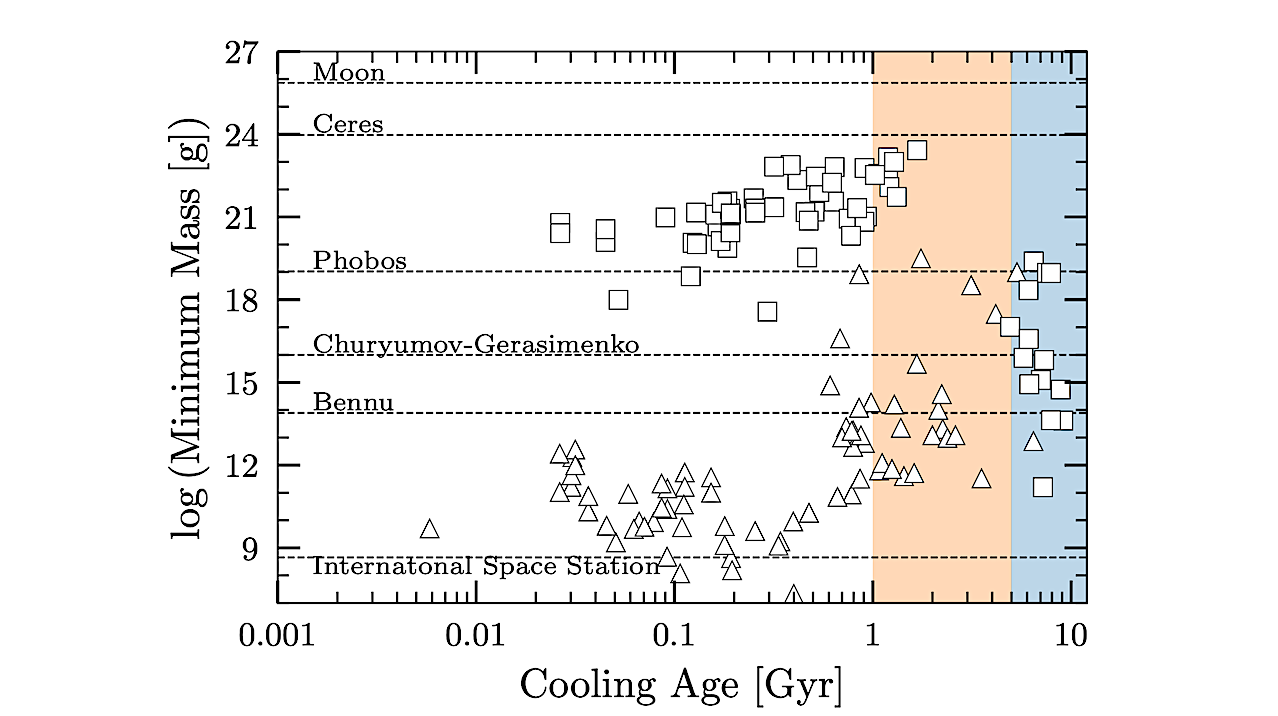
Minimum accreted masses inferred from the five most commonly detected elements (O, Mg, Si, Ca, Fe) as a function of white-dwarf cooling ages (i.e., the time since the white dwarf formed), for a subsample in Williams et al. (2024). Triangles and squares label white dwarfs with H- and He-dominated atmospheres, respectively. Dashed lines compare with the masses of Solar-system objects. The colored bands roughly define the cooling-age boundaries for a 0.6 M⊙ white dwarf at a distance of 100 pc when it possesses an apparent magnitude of Gaia G = 18, 20, and 23 mag; its ∼ 2 M⊙ progenitor would have a ∼ 2 Gyr pre-white dwarf age. The considered magnitude limits could be respectively reached by existing instruments on the 8-m Very Large Telescope (VLT), like UVES (R = 20 000), X-shooter (R = 10 000), and FORS2 (R = 1000), delivering a signal-tonoise ratio of S/N ≈ 10/pixel in optimal observing conditions with 2-hr exposures. — astro-ph.IM
Understanding the formation, evolution, and chemical diversity of exoplanets are now central areas of astrophysics research. White dwarfs provide a uniquely sensitive laboratory for studying the end stages of planetary-system evolution and for probing the bulk composition of both rocky and volatile-rich exoplanetary material.
In the 2030s new facilities will transform our ability to carry out industrial-scale astrophysics, leading to fundamental results and new challenges for the next decade.
By combining the volume of data surveyed by the ESA Gaia mission and Vera C. Rubin Observatory with the next-generation of spectroscopic facilities, the European Southern Observatory (ESO) community will be in a position to obtain an unbiased census of evolved planetary systems, constrain the composition of thousands of disrupted planetesimals, and connect these signatures to Galactic populations and stellar birth environments. Thus, it is now the time for assessing those challenges and preparing for the future.
This white paper outlines key science opportunities arising in the next decade and the technological requirements of future ESO facilities in enabling transformative discoveries in the 2040s. These future facilities will have to combine a number of features that are crucial for studying evolved planetary systems at white dwarfs, such as broad optical to near-infrared coverage, a high sensitivity at blue wavelengths, multi-resolution capability, massive multi-plexing, and time-domain reactivity.
Roberto Raddi (1), Anna F. Pala (2), Alberto Rebassa-Mansergas (1,3), Boris T. Gänsicke (4), Lientur Celedon (5), Tim Cunningham (6), Camila Damia Rincón (1), Aina Ferrer i Burjachs (1), Enrique García-Zamora (1), Nicola Pietro Gentile Fusillo (7), Joaquim Meza (5), Evelyn Puebla (5), Pablo Rodríguez-Gil (8,9), Snehalata Sahu (4), Alejandro Santos-García (1), Odette Toloza (5), Santiago Torres (1,3), Pier-Emmanuel Tremblay (4), Jan van Roestel (10), Murat Uzundag (11), Dimitri Veras (4,12,13), Jamie Williams (4) ((1) Universitat Politècnica de Catalunya, (2) European Southern Observatory, (3) Institut d’Estudis Espacials de Catalunya,(4) University of Warwick, (5) Universidad Técnica Federico Santa María, (6) CfA Harward and Smithsonian, (7), Università degli studi di Trieste, (8) Instituto de Astrofísica de Canarias, (9) Universidad de La Laguna, (10) Institute of Science and Technology Austria, (11) KU Leuven, (12) Centre for Exoplanets and Habitability, (13) Centre for Space Domain Awareness)
Comments: White paper submitted to the ESO call for the Expanding Horizons initiative: “Transforming Astronomy in the 2040s (5 pages, 2 figures)
Subjects: Instrumentation and Methods for Astrophysics (astro-ph.IM); Earth and Planetary Astrophysics (astro-ph.EP); Solar and Stellar Astrophysics (astro-ph.SR)
Cite as: arXiv:2512.14774 [astro-ph.IM] (or arXiv:2512.14774v1 [astro-ph.IM] for this version)
https://doi.org/10.48550/arXiv.2512.14774
Focus to learn more
Submission history
From: Roberto Raddi
[v1] Tue, 16 Dec 2025 11:21:25 UTC (418 KB)
https://arxiv.org/abs/2512.14774
Astrobiology,










Related Posts
Stay Informed With the Latest & Most Important News



Advertisement
-
 01Two Black Holes Observed Circling Each Other for the First Time
 -
 02From Polymerization-Enabled Folding and Assembly to Chemical Evolution: Key Processes for Emergence of Functional Polymers in the Origin of Life
 -
 03Astronomy 101: From the Sun and Moon to Wormholes and Warp Drive, Key Theories, Discoveries, and Facts about the Universe (The Adams 101 Series)
 -
 04True Anomaly hires former York Space executive as chief operating officer
 -
 05Φsat-2 begins science phase for AI Earth images
 -
 06Hurricane forecasters are losing 3 key satellites ahead of peak storm season − a meteorologist explains why it matters
 -
 07Binary star systems are complex astronomical objects − a new AI approach could pin down their properties quickly