
Now Reading: The GAPS Programme At The TNG: LXX. TOI-5734b: A Hot Sub-Neptune Orbiting A Relatively Young K Dwarf With An Earth-like Density
-
01
The GAPS Programme At The TNG: LXX. TOI-5734b: A Hot Sub-Neptune Orbiting A Relatively Young K Dwarf With An Earth-like Density

The GAPS Programme At The TNG: LXX. TOI-5734b: A Hot Sub-Neptune Orbiting A Relatively Young K Dwarf With An Earth-like Density

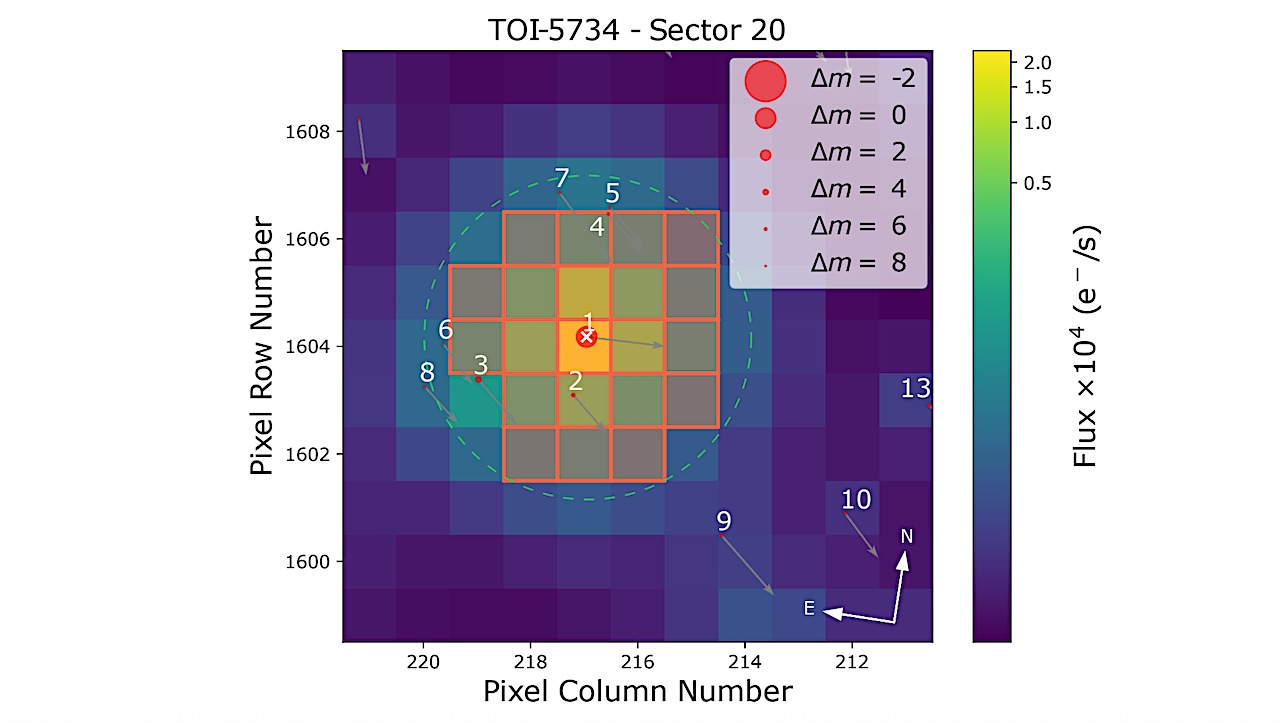
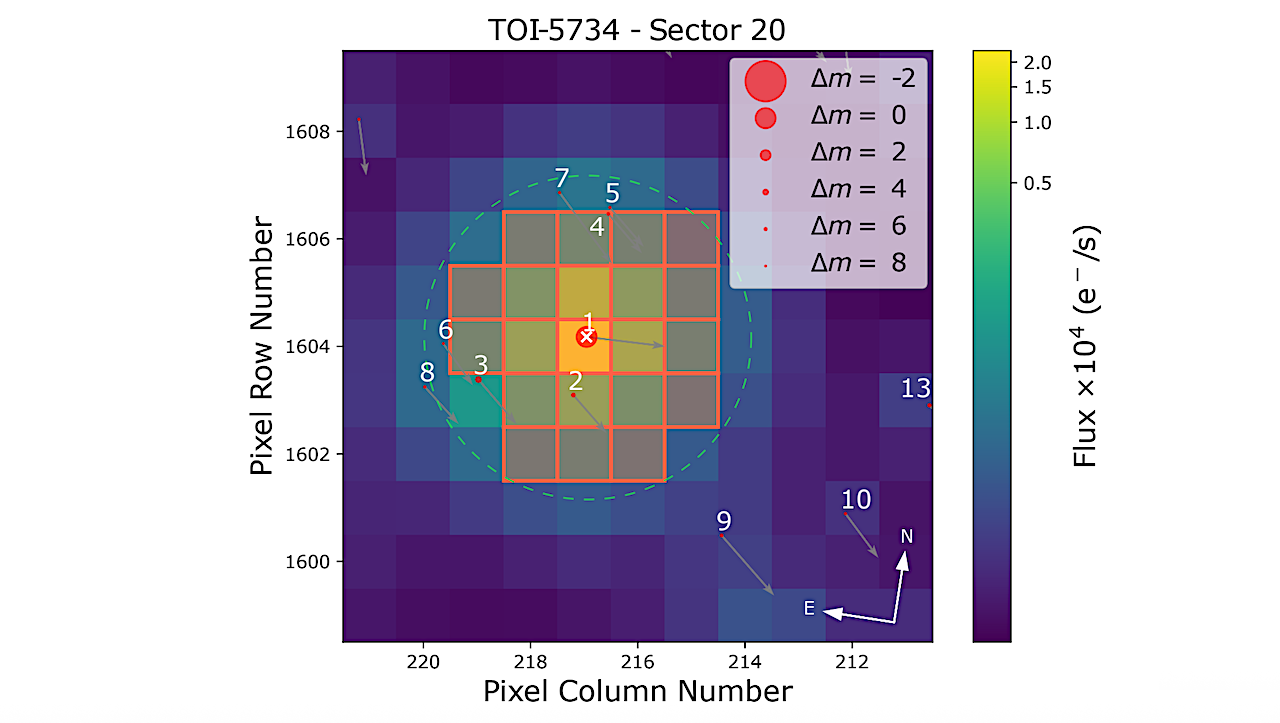
TESS target pixel file of Sector 20 of TOI-5734, which is marked with ‘1’. The other sources, extracted from the Gaia DR3 catalogue, have numbered circles of sizes proportional to the G-mag difference with our target. The colour bar shows the electron counts for each pixel. The orange squares represent the pixels used to construct the aperture photometry by the TESS pipeline. Grey arrows indicate the direction of the proper motions for all the plotted sources. The dashed green circle represents the reference three-pixel aperture to select the targets relevant for the dilution factor estimate. — astro-ph.EP
Increasing interest in young exoplanets is leading to a growing effort to understand the formation and evolutionary processes responsible for their different architectures. One interesting target is TOI-5734, a relatively young K3-K4 dwarf star (500+300−150 Myr) showing a transiting candidate in photometric observations followed up with high-resolution spectroscopic data.
Using Transiting Exoplanet Survey Satellite (TESS) photometry and High Accuracy Radial velocity Planet Searcher for the Northern hemisphere (HARPS-N) radial-velocity (RV) data, we aim to validate the presence of the companion TOI-5734b, measure its planetary mass, size, and its orbital parameters after having characterised its host star. We then aim to study its possible planetary composition and atmospheric evolution. By simultaneously modelling photometry and high-cadence RVs, we measured the radius, mass, and density of TOI-5734b precisely.
In particular, we employed Gaussian processes (GPs) with a flexible kernel to discriminate between the stellar activity of the young host and planetary signals. We confirmed the planetary nature of TOI-5734b and measured its orbital period (Pb∼6.18 d), radius (Rb=2.10+0.12−0.12 R⊕), and mass (Mb=9.1+2.6−2.6 M⊕).
By measuring its density (ρb=0.98+0.36−0.30 ρ⊕), we infer that TOI-5734b is close to having a rocky composition and an almost completely depleted primary envelope. Our results point toward the possibility of considering the target for atmospheric studies with present and future ground- and space-based facilities.
S. Filomeno, T. Trifonov, M. Damasso, M. Baratella, S. Benatti, K. Biazzo, K.A. Collins, R. Cosentino, S. Desidera, C. Di Maio, D. Locci, A. Maggio, L. Mancini, S. Messina, L. Naponiello, D. Nardiello, K. G. Stassun, F. Amadori, S. Antoniucci, F. Biassoni, A.S. Bonomo, L. Cabona, C.A. Clark, M. Gonzalez, A. F. Lanza, D.W. Latham, V. Lorenzi, L. Malavolta, G. Mantovan, M. Pedani, G. Scandariato, A. Shporer, A. Sozzetti, T. Zingales, D. Ciardi, M. Everett, M.B. Lund, H. Osborn, I. A. Strakhov, J. Villaseñor, D. Watanabe, A. Youngblood, R. Zambelli
Comments: 19 pages, 20 figures. Accepted for publication on A&A. Language editor corrected version. Abstract abridged
Subjects: Earth and Planetary Astrophysics (astro-ph.EP); Solar and Stellar Astrophysics (astro-ph.SR)
Cite as: arXiv:2602.18108 [astro-ph.EP] (or arXiv:2602.18108v1 [astro-ph.EP] for this version)
https://doi.org/10.48550/arXiv.2602.18108
Focus to learn more
Submission history
From: Simone Filomeno
[v1] Fri, 20 Feb 2026 09:55:35 UTC (5,530 KB)
https://arxiv.org/abs/2602.18108
Astrobiology,










Related Posts
Stay Informed With the Latest & Most Important News
Previous Post
Next Post



Advertisement
-
 01Two Black Holes Observed Circling Each Other for the First Time
 -
 02From Polymerization-Enabled Folding and Assembly to Chemical Evolution: Key Processes for Emergence of Functional Polymers in the Origin of Life
 -
 03Astronomy 101: From the Sun and Moon to Wormholes and Warp Drive, Key Theories, Discoveries, and Facts about the Universe (The Adams 101 Series)
 -
 04True Anomaly hires former York Space executive as chief operating officer
 -
 05Φsat-2 begins science phase for AI Earth images
 -
 06Hurricane forecasters are losing 3 key satellites ahead of peak storm season − a meteorologist explains why it matters
 -
 07Binary star systems are complex astronomical objects − a new AI approach could pin down their properties quickly