
Now Reading: The Hidden Viral Network: How Viruses Shape Microbial Adaptability and Biogeochemical Cycling in the Polyextreme Mars-Analog Qaidam Basin Desert
-
01
The Hidden Viral Network: How Viruses Shape Microbial Adaptability and Biogeochemical Cycling in the Polyextreme Mars-Analog Qaidam Basin Desert

The Hidden Viral Network: How Viruses Shape Microbial Adaptability and Biogeochemical Cycling in the Polyextreme Mars-Analog Qaidam Basin Desert

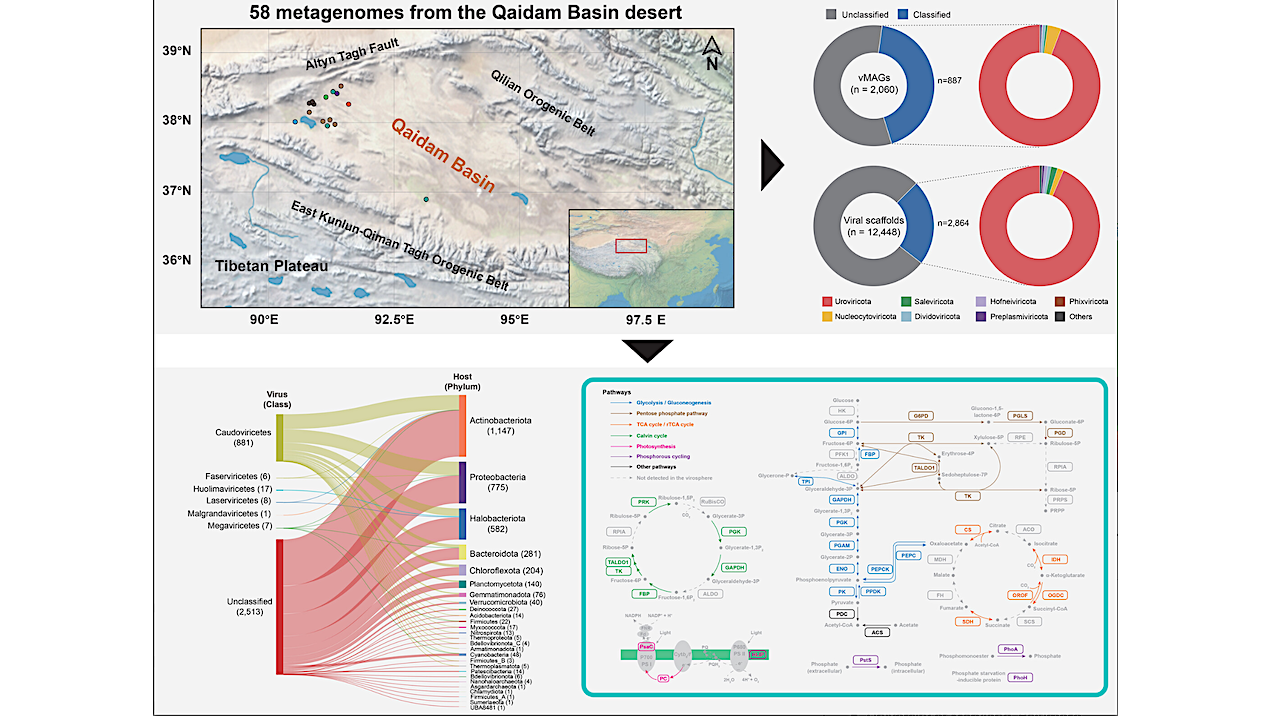
Graphical Abstract
Viruses play essential roles in shaping the structure and function of microbial communities, including those inhabiting extreme environments.
The Qaidam Basin is a unique Mars-analog desert characterised by hyperaridity, oligotrophy and high soil salinity. We hypothesise that viruses contribute to microbial adaptability and biogeochemical cycling through virus-host interactions in desert ecosystems.
Here, we investigated viral diversity, biogeography, life strategies and interactions with soil microbiomes across the Qaidam Basin. Soil properties, such as water content, pH and mineral assemblages, significantly influenced the distribution patterns of both viral and prokaryotic communities. Broad host range may confer fitness advantages for viruses in deserts where host biomass is limited.
Most viruses were characterised as lytic and infected dominant microbial phyla, supporting the “Kill-The-Winner” model, which suggests viral regulation in microbial community diversity and stability. We identified over 32,000 potential viral auxiliary metabolic genes (AMGs), including key genes involved in carbohydrate metabolism, carbon fixation, photosynthesis and phosphorus cycling. Moreover, AMGs related to the biosynthesis of antibiotics, pigments and alkaloids may enhance the adaptability of hosts under extreme conditions.
This study unveils the enigmatic virosphere of the Mars-analog Qaidam Basin and underscores the roles of viruses in promoting microbial adaptability and driving biogeochemical cycling.
Astrobiology,











Related Posts

Stay Informed With the Latest & Most Important News
Previous Post
Next Post

Advertisement
-
 01Two Black Holes Observed Circling Each Other for the First Time
 -
 02From Polymerization-Enabled Folding and Assembly to Chemical Evolution: Key Processes for Emergence of Functional Polymers in the Origin of Life
 -
 03Astronomy 101: From the Sun and Moon to Wormholes and Warp Drive, Key Theories, Discoveries, and Facts about the Universe (The Adams 101 Series)
 -
 04True Anomaly hires former York Space executive as chief operating officer
 -
 05Φsat-2 begins science phase for AI Earth images
 -
 06Hurricane forecasters are losing 3 key satellites ahead of peak storm season − a meteorologist explains why it matters
 -
 07Binary star systems are complex astronomical objects − a new AI approach could pin down their properties quickly