
Now Reading: The Influence Of Clouds And Deuterium-Burning On Brown Dwarf Habitable Zones
-
01
The Influence Of Clouds And Deuterium-Burning On Brown Dwarf Habitable Zones


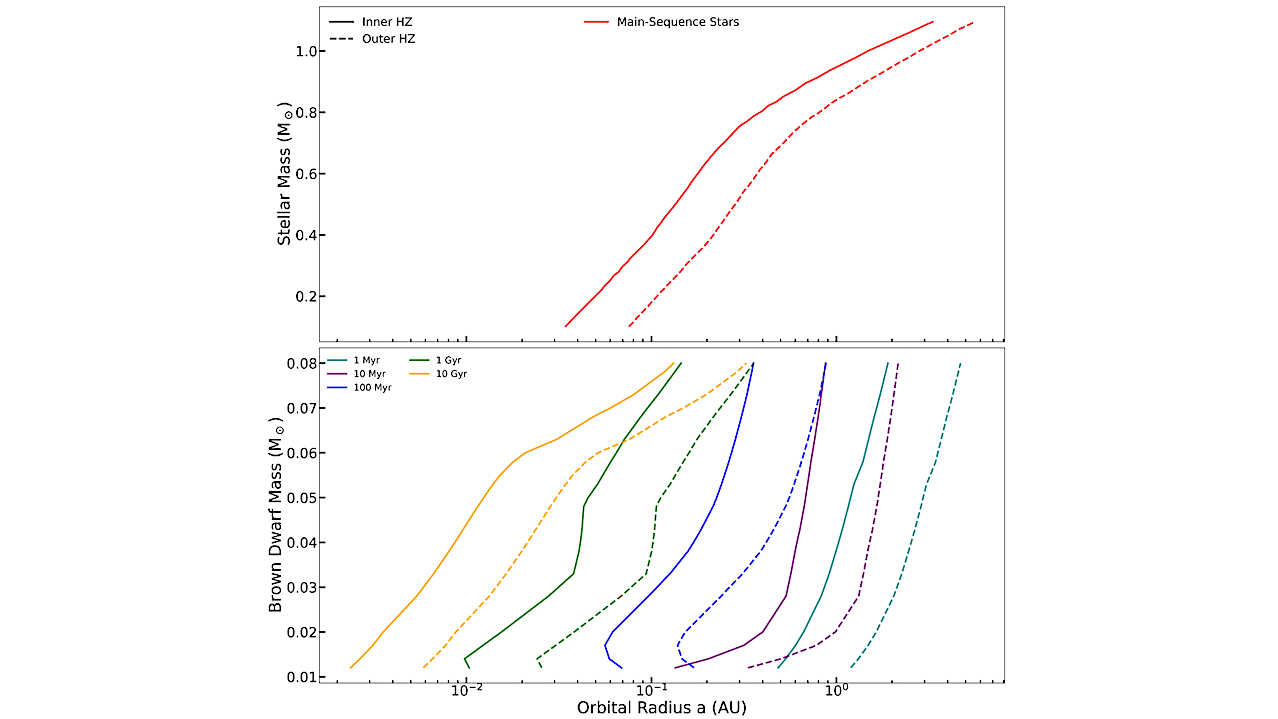
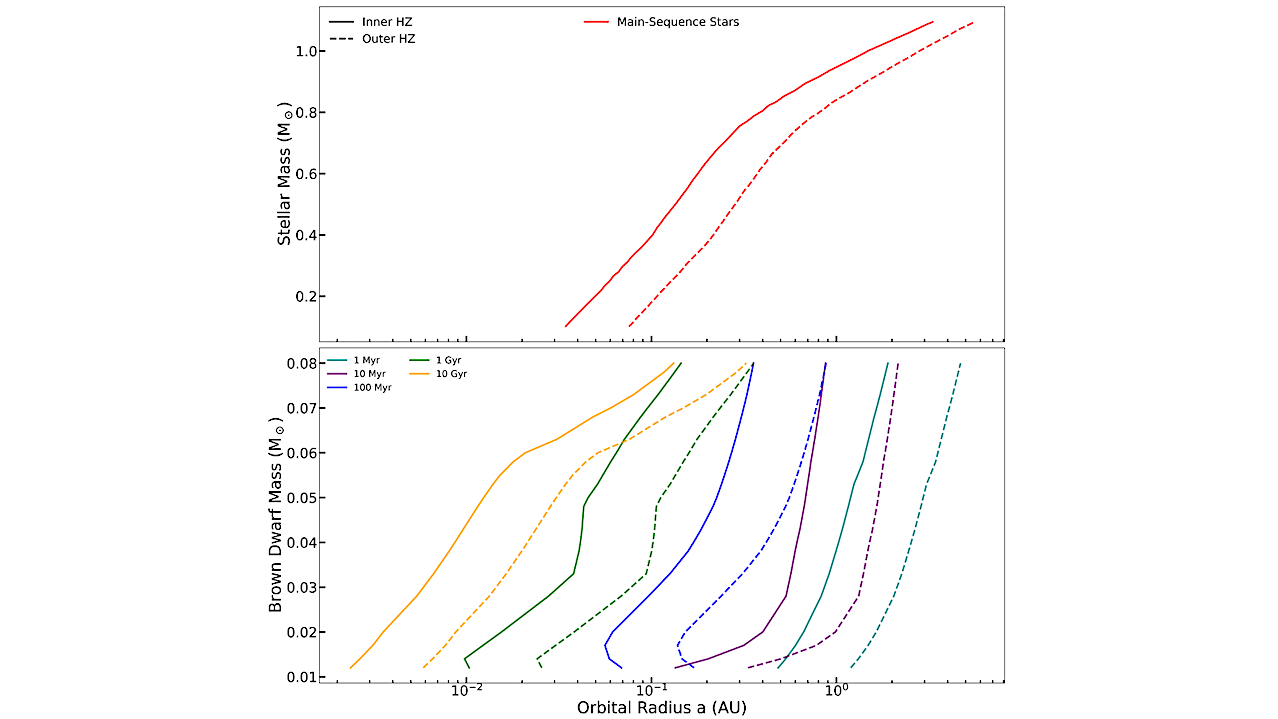
The top panel are the inner and outer HZ limits for main-sequence stars as a function of stellar mass, according to (R. K. Kopparapu et al. 2013). The bottom panel is the same but for cloudy evolution brown dwarfs. The solid lines are the inner HZ and the dashed lines are the outer HZ. The difference between objects at the hydrogen-burning threshold arises because R. K. Kopparapu et al. (2013) employed a full radiative–convective atmospheric model, whereas this study assumes a constant planetary Bond albedo of 0.25. All brown dwarfs have [M/H] = +0.0. — astro-ph.EP
To better understand the potential habitability of planets orbiting brown dwarfs, this work presents a new set of equilibrium temperature evolution tracks. Unlike most previous work that relied on analytic scaling relationships for brown dwarf luminosity evolution, we use the outputs of modern brown dwarf evolution models that account for the effects of deuterium burning, cloud formation and dissipation, and the most recent atmospheric opacities.
While clouds are present, brown dwarfs cool more slowly than if they did not have clouds, allowing orbiting planets to remain in the habitable zone for millions of years longer than previously estimated.
Similarly, we find that during the deuterium-burning phase of brown dwarfs, which also slows the evolution, planets at the same orbital radius but orbiting brown dwarfs of different masses can remain in the habitable zone for the same duration, creating deuterium “sweet spots” for habitability around brown dwarfs near the deuterium-burning limit.
For example, at 0.01 AU a planet orbiting both a 0.012 solar mass and a 0.020 solar mass brown dwarf stays in the habitable zone for ~170 – 180 Myr because deuterium burning more strongly affects the cooling of lower-mass brown dwarfs. The size of the effect decreases with decreasing orbital radius, with larger orbital radii having a more pronounced deuterium burning influence.
These effects are absent from the analytic cooling approximations used in prior studies of substellar habitable zones and are revealed by our application of modern substellar evolution models.
Kayla J. Smith, Mark S. Marley
Comments: Accepted 2026 March 5 for publication in ApJ. 15 pages, 10 figures, 1 table
Subjects: Earth and Planetary Astrophysics (astro-ph.EP)
Cite as: arXiv:2603.09068 [astro-ph.EP] (or arXiv:2603.09068v1 [astro-ph.EP] for this version)
https://doi.org/10.48550/arXiv.2603.09068
Focus to learn more
Submission history
From: Kayla Smith
[v1] Tue, 10 Mar 2026 01:25:36 UTC (15,257 KB)
https://arxiv.org/abs/2603.09068
Astrobiology, exoplanet,











Related Posts
Stay Informed With the Latest & Most Important News


Advertisement
-
 01Two Black Holes Observed Circling Each Other for the First Time
 -
 02From Polymerization-Enabled Folding and Assembly to Chemical Evolution: Key Processes for Emergence of Functional Polymers in the Origin of Life
 -
 03Astronomy 101: From the Sun and Moon to Wormholes and Warp Drive, Key Theories, Discoveries, and Facts about the Universe (The Adams 101 Series)
 -
 04True Anomaly hires former York Space executive as chief operating officer
 -
 05Φsat-2 begins science phase for AI Earth images
 -
 06Hurricane forecasters are losing 3 key satellites ahead of peak storm season − a meteorologist explains why it matters
 -
 07Binary star systems are complex astronomical objects − a new AI approach could pin down their properties quickly