
Now Reading: The James Webb Space Telescope just found the oldest supernova ever seen
-
01
The James Webb Space Telescope just found the oldest supernova ever seen


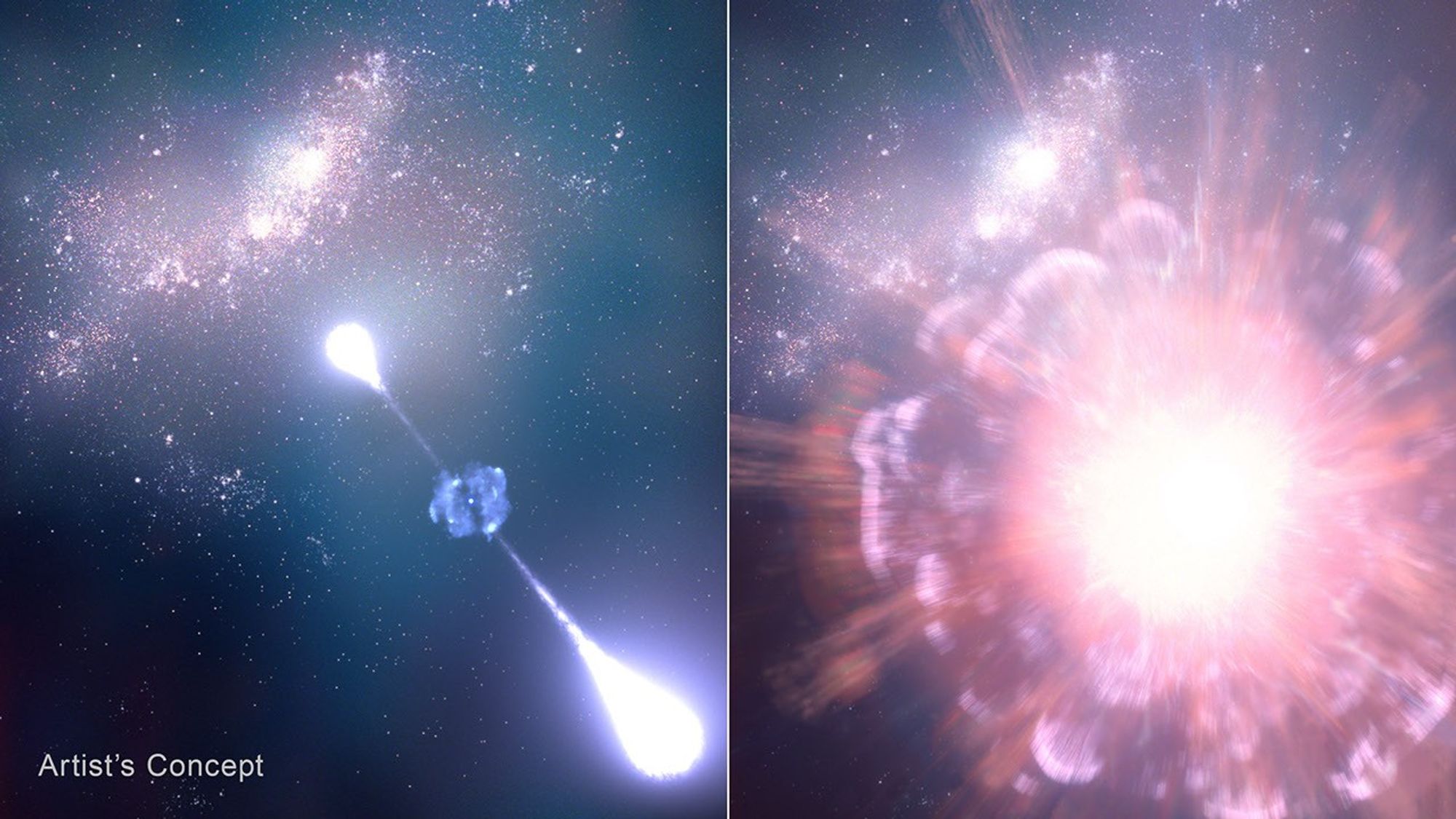
The light of the oldest supernova ever seen, dating back 13 billion years to just 730 million years after the Big Bang, has been captured by the James Webb Space Telescope.
The supernova was accompanied by a powerful gamma-ray burst (GRB), signifying the destruction of a massive star and possibly the birth of a stellar-mass black hole.
The story begins on March 14, when the French–Chinese SVOM (Space-based multi-band astronomical Variable Objects Monitor) satellite detected a blast of gamma rays from somewhere in deep space. Ninety minutes later, NASA’s Neil Gehrels Swift Observatory detected the same event but in X-rays, enabling astronomers to pinpoint where on the sky the GRB, designated GRB 250314A, had occurred.
Eleven hours after Swift’s detection, the Nordic Optical Telescope, which is 2.6-meter (8.5 feet) telescope on La Palma in the Canary Islands, detected the faint glimmer of light from the GRB’s afterglow as material ejected by the dying star smashed into circumstellar gas. Finally, four hours after that, the Very Large Telescope in Chile got in on the act and confirmed the redshift of the GRB afterglow to be a huge 7.3, meaning that we are seeing an event that happened 13 billion years ago.
Yet the expansion of space that redshifted the afterglow also creates the illusion of slowing down processes. Rather than the supernova reaching peak brightness in a matter of days or a few weeks, from our point of view, relative to this distant stellar explosion that detonated so long ago only for its light to be traveling through space all this time, it would reach peak brightness three-and-a-half months later.
Armed with this knowledge, Levan led a team to request what’s known as Director’s discretionary time on the James Webb Space Telescope (JWST). With that granted, they were ready for July 1, when JWST used its Near-Infrared Camera to detect the light of the supernova that accompanied the GRB.
“Only Webb could directly show that this light is from a supernova — a collapsing massive star,” said Levan. “This observation also demonstrates that we can use Webb to find individual stars when the universe was only 5% of its current age.”
The JWST was even able to detect the supernova’s host galaxy. Despite that galaxy appearing smudged over just a handful of pixels, astronomers are still able to discern something about the supernova’s galactic environment.

“Webb’s observations indicate that this distant galaxy is similar to other galaxies that existed at the same time,” said Emeric Le Floc’h at CEA Paris-Saclay in France, who is a member of Levan’s team.
The supernova’s spectrum also looks remarkably similar to modern-day supernova explosions, and that the mass of the star that exploded was not atypical of massive stars today. However, upon closer inspection it is likely that there will be differences, given that the supernova exploded in an era where there was a much lower abundance of heavy elements. More data will be needed to tease these details out of the supernova’s spectrum.
Nevertheless, the supernova is a record breaker — the most distant supernova ever seen, and one of only a few GRB detected (without anyone seeing their supernova explosion) from that first billion years. Previously, the oldest supernova seen (also by the JWST) blew up 1.8 billion years after the Big Bang. It’s safe to say that this new redshift 7.3 supernova has well and truly smashed that record.
The findings were published in December in the journal Astronomy & Astrophysics.










Related Posts

Stay Informed With the Latest & Most Important News
Previous Post
Next Post
Advertisement
-
 01Two Black Holes Observed Circling Each Other for the First Time
 -
 02From Polymerization-Enabled Folding and Assembly to Chemical Evolution: Key Processes for Emergence of Functional Polymers in the Origin of Life
 -
 03Astronomy 101: From the Sun and Moon to Wormholes and Warp Drive, Key Theories, Discoveries, and Facts about the Universe (The Adams 101 Series)
 -
 04True Anomaly hires former York Space executive as chief operating officer
 -
 05Φsat-2 begins science phase for AI Earth images
 -
 06Hurricane forecasters are losing 3 key satellites ahead of peak storm season − a meteorologist explains why it matters
 -
 07Binary star systems are complex astronomical objects − a new AI approach could pin down their properties quickly