
Now Reading: The JWST Early Release Science Program for Direct Observations of Exoplanetary Systems. VIII. Molecular Mapping Performance With JWST/MIRI MRS: VHS 1256 b As A Case Study
-
01
The JWST Early Release Science Program for Direct Observations of Exoplanetary Systems. VIII. Molecular Mapping Performance With JWST/MIRI MRS: VHS 1256 b As A Case Study

The JWST Early Release Science Program for Direct Observations of Exoplanetary Systems. VIII. Molecular Mapping Performance With JWST/MIRI MRS: VHS 1256 b As A Case Study

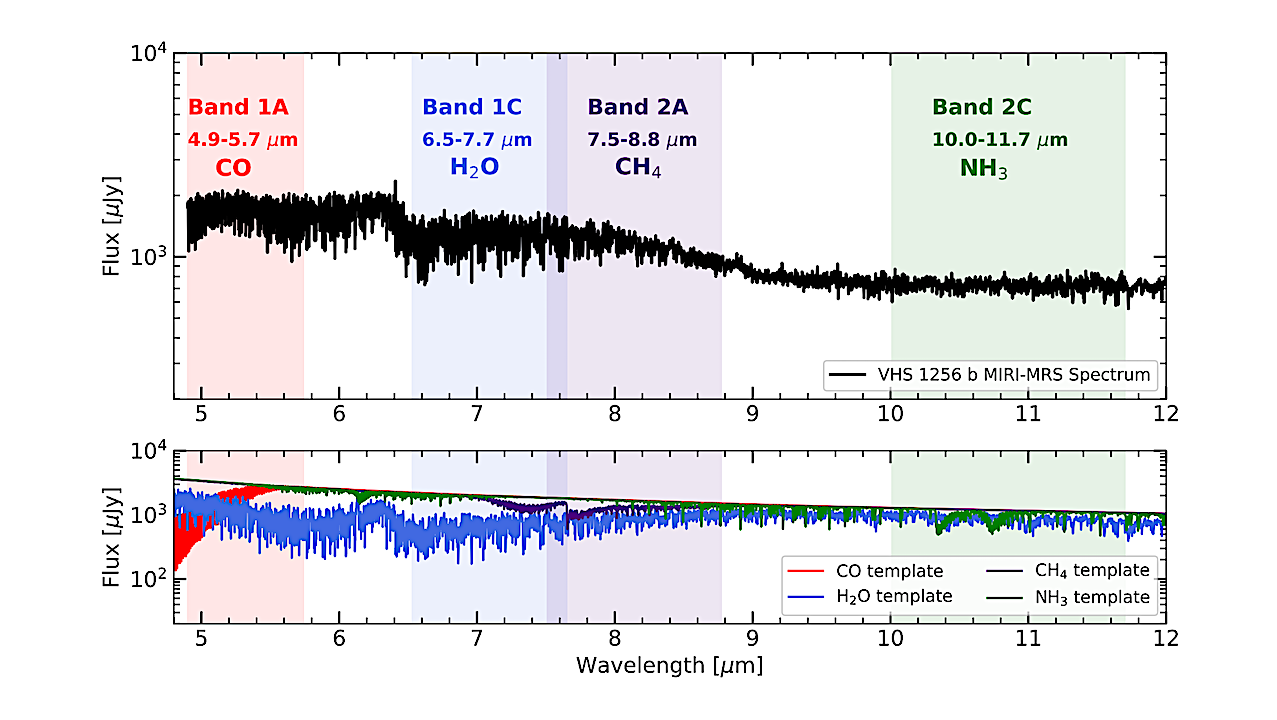
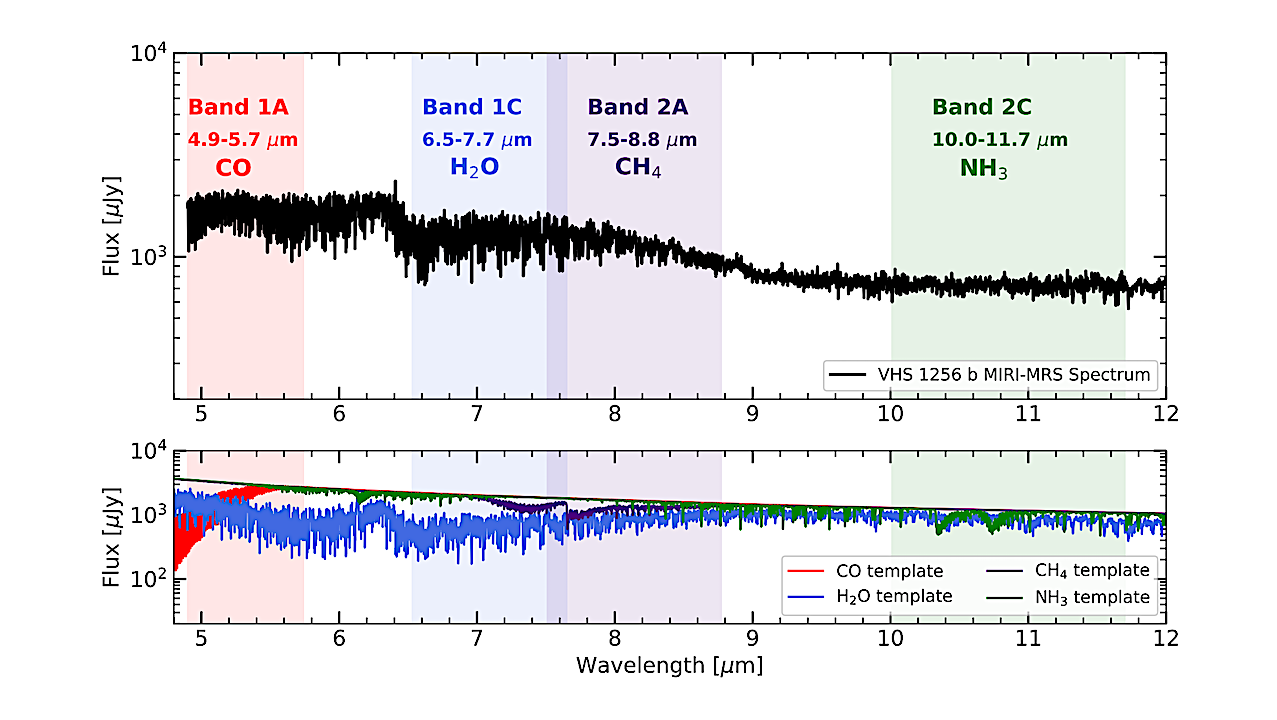
Top: MIRI-MRS spectra of VHS 1256 b, with the spectral regions used for molecular detection highlighted for each species. Bottom: Corresponding Exo-REM molecular templates for the detected molecules, showing both the highlighted bands and the specific spectral features that were identified in the observations through cross-correlation. — astro-ph.EP
VHS 1256 b was the first planetary-mass companion to be observed with the James Webb Space Telescope’s Mid-Infrared Instrument (JWST/MIRI) using the Medium-Resolution Spectrometer (MRS).
The MRS provides high-quality integral-field spectral data in the mid-infrared (IR) wavelengths from 4.9 to 18 um. This dataset serves as a testbed for applying cross-correlation techniques to characterize exoplanet atmospheres.
We implement the so-called molecular mapping approach, which consists of performing a spectral cross-correlation between each spectral pixel and atmospheric model templates.
We compare these results with those obtained from cross-correlation of the extracted spectrum. Using a self-consistent Exo-REM atmospheric model grid, we constrain the temperature, surface gravity, C/O ratio, and metallicity, finding values consistent with those obtained from other analysis methods. We detect CO (S/N ∼ 25) and H2O (S/N ∼ 76), with tentative detections of NH3 and CH4 (S/N∼ 3). We test cross-correlation to measure trace-species abundances and isotopic ratios.
We measure a volume mixing ratio of [NH3] =-5.73^{+0.15}_{-0.14} and an isotopic ratio 12C/13C=77.8+13−10, both consistent with free-chemistry retrievals. The derived NH3 volume mixing ratio, combined with the measured temperature and radius, is consistent with VHS 1256 b having a mass above the deuterium-burning limit.
These results demonstrate the diagnostic power of mid-IR spectroscopy and highlight cross-correlation as a robust method for characterizing directly imaged exoplanets, even in future higher-contrast regimes where spectral extraction becomes challenging. Future MIRI MRS observations across a wider range of temperatures and masses will further expand our understanding of planetary atmospheric chemistry.
Mathilde Mâlin, Anthony Boccaletti, Benjamin Charnay, Laurent Pueyo, Alexis Bidot, Polychronis Patapis, Sasha Hinkley, Simon Petrus, Niall Whiteford, Marshall Perrin, Beth A. Biller, Gabriele Cugno, Thayne Currie, Camilla Danielski, Thomas Henning, Kielan K. W. Hoch, Markus Janson, Jens Kammerer, Elisabeth C Matthews, Evert Nasedkin, Paulina Palma-Bifani, Isabel Rebollido, Matthias Samland, Andrew Skemer, Jordan M. Stone, Genaro Suárez, Ben J. Sutlieff, Motohide Tamura, Christopher A. Theissen, Johanna M. Vos, Zhoujian Zhang, Alice Zurlo
Comments: Accepted in ApJ. Part of an ApJ Focus Issue from the ERS
Subjects: Earth and Planetary Astrophysics (astro-ph.EP); Instrumentation and Methods for Astrophysics (astro-ph.IM)
Cite as: arXiv:2603.13543 [astro-ph.EP] (or arXiv:2603.13543v1 [astro-ph.EP] for this version)
https://doi.org/10.48550/arXiv.2603.13543
Focus to learn more
Submission history
From: Mathilde Mâlin
[v1] Fri, 13 Mar 2026 19:29:38 UTC (2,782 KB)
https://arxiv.org/abs/2603.13543
Astrobiology, Astrochemistry,










Related Posts
Stay Informed With the Latest & Most Important News
Previous Post
Next Post
Advertisement
-
 01Two Black Holes Observed Circling Each Other for the First Time
 -
 02From Polymerization-Enabled Folding and Assembly to Chemical Evolution: Key Processes for Emergence of Functional Polymers in the Origin of Life
 -
 03Astronomy 101: From the Sun and Moon to Wormholes and Warp Drive, Key Theories, Discoveries, and Facts about the Universe (The Adams 101 Series)
 -
 04True Anomaly hires former York Space executive as chief operating officer
 -
 05Φsat-2 begins science phase for AI Earth images
 -
 06Hurricane forecasters are losing 3 key satellites ahead of peak storm season − a meteorologist explains why it matters
 -
 07Binary star systems are complex astronomical objects − a new AI approach could pin down their properties quickly