
Now Reading: The JWST Search For Earth-Luna Analogs: Upper Limits On Exomoons And Refined Ephemerides For TOI 700 d And e
-
01
The JWST Search For Earth-Luna Analogs: Upper Limits On Exomoons And Refined Ephemerides For TOI 700 d And e

The JWST Search For Earth-Luna Analogs: Upper Limits On Exomoons And Refined Ephemerides For TOI 700 d And e

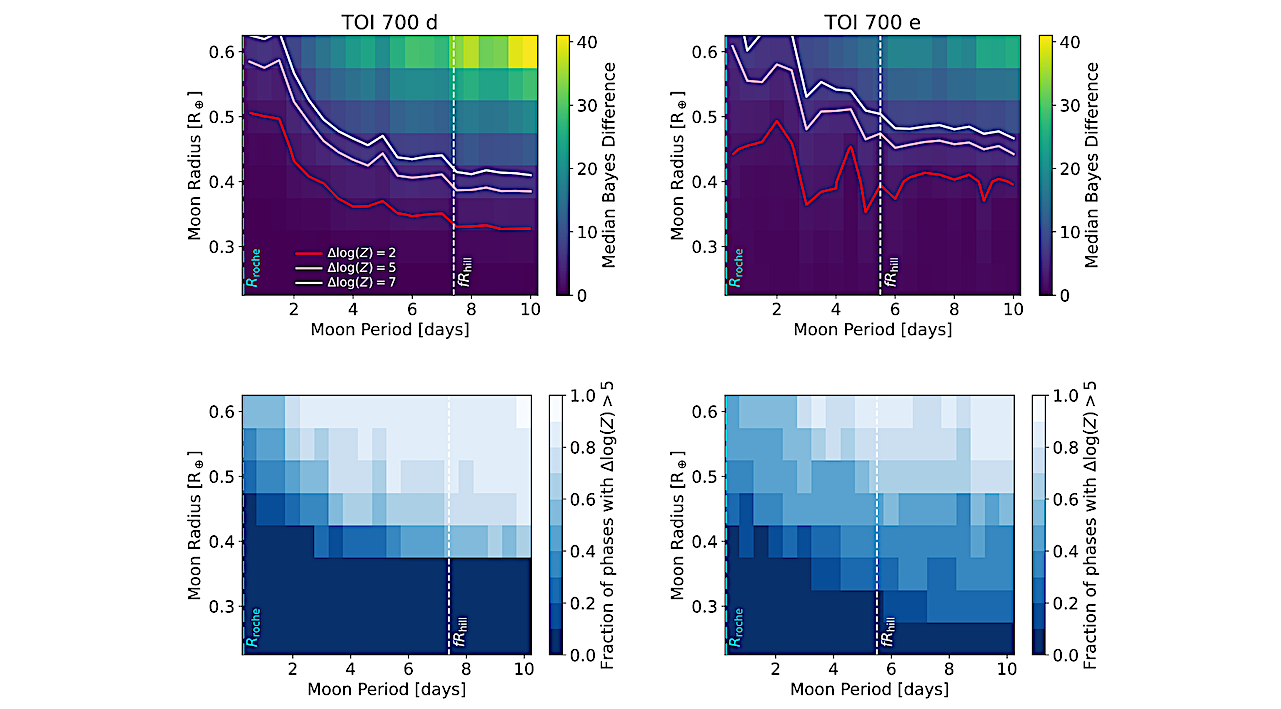
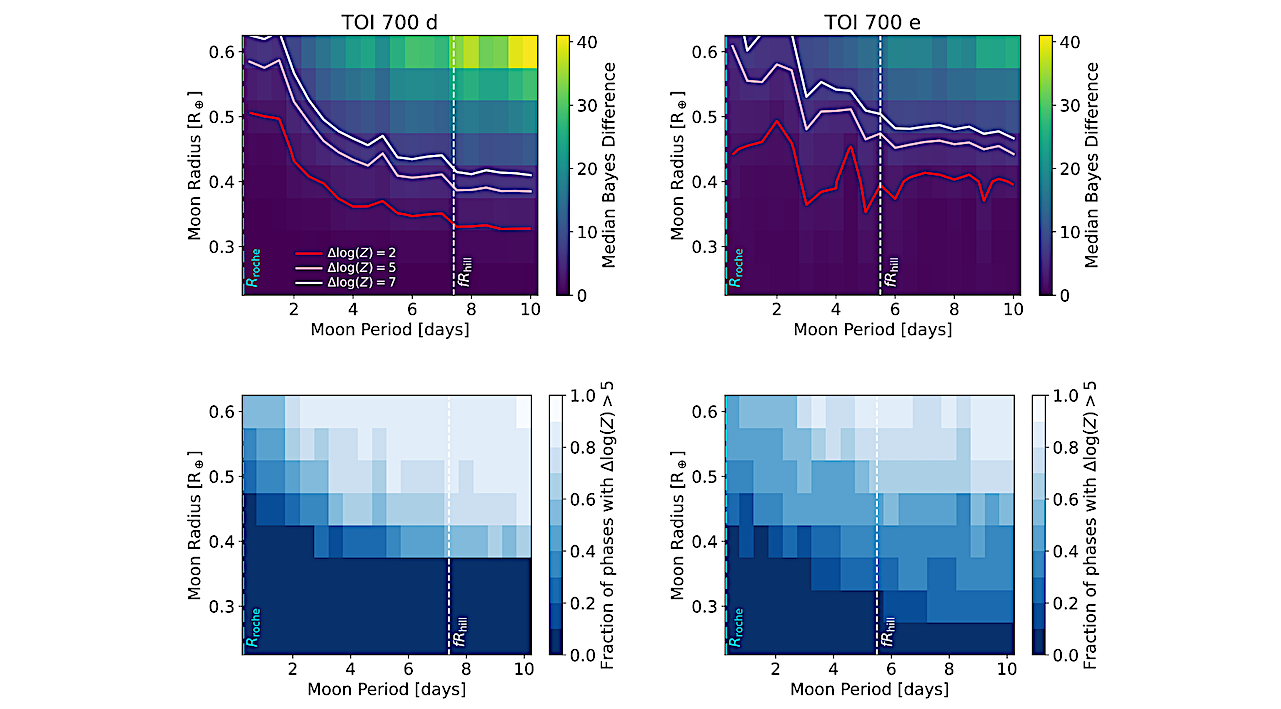
The left plots show the results of our injection and recovery test into our JWST observation of TOI 700 d, and the right for e. The Roche limit and f times the Hill radius are noted, where f = 0.4895 (R. C. Domingos et al. 2006); these lines bound the region in which a prograde satellite is expected to be dynamically stable. In the upper panels, the heatmap provides the Bayes difference between the planet-only and planet+moon models, taking the median of the results across the 100 injections. The red solid line indicates the ∆ log(Z) = 2 contour, the pink ∆ log(Z) = 5, and the white ∆ log(Z) = 7 (corresponding to 7.4:1, 148:1, and 1097:1 odds in favor of the planet+moon model, respectively). In the lower panels, we plot the fraction of the 100 phases that yield ∆ log(Z) > 5. These plots illustrate that there are certain phases at which it is particularly challenging to differentiate a moon from a larger planet-only solution given the noise present in our data. It is also challenging to detect a moon whose period is less than 2 days, as the shape changes at ingress and egress become more subtle than the noise in our light curves. — astro-ph.EP
While no conclusive detections of exomoons have been reported to date, planet formation theories predict that satellites should be a common outcome of the collisional dynamics in early extrasolar systems.
Such satellites have the potential to unlock new avenues to learn about exoplanet systems, speaking to topics of habitability, tidal heating, planet formation, late-stage growth, planetary compositions, and more. Here we describe the results of our JWST program to search for Luna-analog exomoons around the rocky, habitable-zone M-dwarf planets TOI 700 d and e.
We refine the ephemerides of both worlds, providing an order-of-magnitude improvement in period precision and a factor of 2-3 improvement in planetary radii. We identify a strong correlated noise signal with a timescale of 16±4 minutes and an amplitude of 46±4 ppm; similar signals have been observed in previous JWST analyses of other stars and have been ascribed to stellar granulation.
This noise source inflates our error by a factor of 4 relative to photon-noise expectations in 10-minute bins and limits our sensitivity to moons: we determine that our observations are sensitive mainly to moons larger than Ganymede on periods longer than 2 days (i.e., moons larger than our solar system’s natural satellites).
If this noise could be corrected, we would be sensitive to Luna-analog moons. Future work to address this noise source will thus be critical for detecting exomoons in stellar transits, as well as for all other science cases that hope to take advantage of JWST white-light curves in the photon-noise limit.
Emily K. Pass, David Charbonneau, Andrew Vanderburg, Jacob L. Bean
Comments: Submitted to ApJ; 16 pages, 11 figures, 2 tables
Subjects: Earth and Planetary Astrophysics (astro-ph.EP); Solar and Stellar Astrophysics (astro-ph.SR)
Cite as: arXiv:2604.05235 [astro-ph.EP] (or arXiv:2604.05235v1 [astro-ph.EP] for this version)
https://doi.org/10.48550/arXiv.2604.05235
Focus to learn more
Submission history
From: Emily Pass
[v1] Mon, 6 Apr 2026 22:59:36 UTC (2,032 KB)
https://arxiv.org/abs/2604.05235
Astrobiology, exoplanet,










Related Posts
Stay Informed With the Latest & Most Important News
Previous Post
Next Post
Advertisement
-
 01Two Black Holes Observed Circling Each Other for the First Time
 -
 02From Polymerization-Enabled Folding and Assembly to Chemical Evolution: Key Processes for Emergence of Functional Polymers in the Origin of Life
 -
 03Astronomy 101: From the Sun and Moon to Wormholes and Warp Drive, Key Theories, Discoveries, and Facts about the Universe (The Adams 101 Series)
 -
 04True Anomaly hires former York Space executive as chief operating officer
 -
 05Φsat-2 begins science phase for AI Earth images
 -
 06Hurricane forecasters are losing 3 key satellites ahead of peak storm season − a meteorologist explains why it matters
 -
 07Binary star systems are complex astronomical objects − a new AI approach could pin down their properties quickly