
Now Reading: The moon, AI and the high-stakes decisions shaping space’s future
-
01
The moon, AI and the high-stakes decisions shaping space’s future


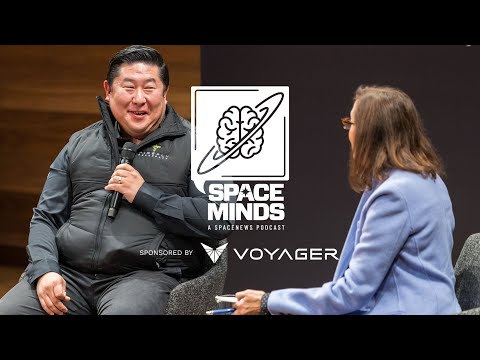

In this special episode of Space Minds, our show is split into two segments from SpaceNews’ annual Icon Awards.
In our first segment, SpaceNews correspondent Debra Werner sits down with Jason Kim, CEO of Firefly Aerospace, to discuss the company’s Blue Ghost Mission 1 — an award-winning lunar landing that delivered multiple NASA payloads to the moon and marked a major milestone for commercial lunar exploration.
In the second segment, senior staff writer Jeff Foust moderates a panel discussion with several other award recipients, bringing together leaders from policy, science, and technology. The conversation features Casey Dreier of The Planetary Society, JPL Fellow Steve Chien, Ubotica Technologies co-founder Aubrey Dunne, and NASA’s Roger Hunter, exploring themes ranging from artificial intelligence in space operations to the evolving policy landscape shaping the future of exploration.
sponsored by

Starlab Space is a US-led global joint venture and partner network that is ensuring a continued human presence in low-earth orbit. Led by Voyager Technologies, Starlab is the most advanced commercial space station under development, bringing together decades of ISS experience, Al-enabled design and global partnerships into a platform designed to scale science and industry in space. From manufacturing and life sciences to defense applications and international collaboration, Starlab is built for real work, real discovery and real continuity, providing a seamless transition from the International Space Station to the new commercial space station era.
Show notes and transcript
Click here for Notes and Transcript
Time Markers
00:00 – Episode introduction
01:13 – Jason Kim, firefly Aerospace chat
08:45 – Jeff Foust panel introduction
11:12 – Casey Dreier on space policy advocacy and budget challenges
16:00 – Aubrey Dunne and Steve Chien on AI-driven dynamic targeting in space
20:51 – Roger Hunter on NASA’s Starling mission and autonomous swarms
23:29 – Casey Dreier – An update on the budget process
27:56 – Steve Chien & Aubrey Dunne – Commercial and scientific applications of onboard AI
31:19 – The future of space policy, AI, and exploration
Segment 1 Transcript – Jason Kim Conversation
This transcript has been edited-for-clarity.
Debra Werner – Hello, Jason.
Jason Kim – It’s great to be here. Very, very thankful for this honor. I bet half of the whole Firefly 13 in-person team is here. And it’s really awesome to be with all these great people. I mean, Bill Nye, Science Guy — he’s probably just walked out of his Porsche doing like 360s — and then you’ve got Bird Dog, General Purdy, you don’t get to see him too often. And then you’ve got Matt Anderson, who’s going to do great things for the nation and the world. Johnny Dyer — man, I was with you. Man, I didn’t do too well in that class either.
And then you’ve got people like Ray — I’m going to get this right — Jayawardana. You’ve got Ray Allensworth, and you’ve got Jordan and Farah and Alan and Joe and Annie and Trina. I get to work with those great people all the time. And of course, you and Jeff Foust and Sandra and Jason — you get to see all everywhere. We don’t have very much time.
Debra Werner – So if anybody doesn’t know Jason Kim, I’m going to give you in one minute what ChatGPT would tell you without hallucinating.
After the Air Force Academy, he worked in Air Force space superiority and reconnaissance. He is an electrical engineer and an MBA who has worked at Northrop Grumman, Raytheon. He was the CEO of Millennium Space and is now Firefly CEO for a little over a year.
So will you tell us a little bit about the highs and lows of that year? Because it’s been quite a year.
Jason Kim – Yeah, I mean, I wouldn’t have it any other way. I mean, we landed on the Moon on March second. That’s Texas Independence Day. So for all the Texans in the room, I mean, that was incredible.
I mean, I don’t know who can’t get excited about the Moon. Just think — 365 days ago, I had to tell investors why we’re going to the Moon. Now no one can shut up about it. Everybody wants to go to the Moon, right? Even the next NASA administrator — hopefully he wants to go to the Moon over and over again. We’re happy to do that for them.
And so that was historic. I mean, we took 10 NASA payloads up there, did a bunch of experiments like GPS on the Moon, drilled the longest into the actual surface of the Moon, took some temperatures — it just goes on and on — 120 gigabytes of data.
So in the last hour that the team let go, it was all autonomous operations and doing hazard navigation and avoiding boulder one, boulder two, crater number three, and then landing one meter away from the new target. So it was a bullseye. Whoever said that — Mike Gruss — it was a bullseye.
So very proud of the team for doing that. A lot of passion in this team. A lot of rehearsals, long nights, sacrifices that they did. So I’m very proud of them.
And then I didn’t think they could top that, but they did. We went IPO in August, and it was crazy, because it was the biggest space IPO, but it was also one of the top 10 industrials in history. We were up there with UPS, where we went in one price and then actually went up two more times. So it was pretty historic, now that we’re processing it right now.
So those were some great moments. But you know, we go through challenges too in this industry. Anybody that doesn’t, I feel sorry for them, because they’re not learning, they’re not getting back up. And that’s what makes great companies.
We had a combustion event at our Texas site for our stage one for flight seven. And once we found out it wasn’t a design problem, it was a process problem, we immediately took action. We implemented corrective measures and even had a one-day stand-down for production integration and test.
We really took that moment and said, “Hey, how can we improve in all these different procedures?” And we’re a better company for that.
So now the path forward — second stage is already at Vandenberg. We’re getting the first stage from the production line pulled forward, and that’s getting ready to ship. Then we’ve got to do a wet dress and a hot fire test. And between the end of the year and early first quarter is when we’ll be able to launch, based on range availability.
So I’m confident in the design. I’m confident in our team and their passion to succeed and do it safely and reliably. That was kind of a challenge that we grew from.
And then the crazy thing is, we’re just getting started. Landing on the Moon, launching several times, building an even bigger reusable rocket, and then putting some orbiters up there — we’re just getting started.
Debra Werner – So what do you see ahead for 2026? It sounds like there will be an Alpha launch.
Jason Kim – Yeah, several Alpha launches is what we’re looking forward to. We’re going to do a lot of integration and test of our Eclipse rocket, because we want to get to that first launch — the inaugural launch.
That’s a big rocket. It’s 200 feet tall, 15 feet in diameter. We’re getting all the flight engines through their qualification, and those are going to start getting integrated.
So really excited about that. I’m very grateful for the companies ahead of us that have done reusable launch. It gives us a lot of motivation to do the same thing.
We’re really looking forward to that. Someday, more lunar lander missions. We’re going to go to the far side of the Moon, and it’s going to be a really sick mission, because it’s a 22-foot stack lunar lander.
It’s got probably a Nobel Prize–nominated quality sensor on it. It’s going to go look into deep space and look for our signals from the dark ages.
But then it’s got an orbiter. That orbiter is going to drop off the lunar lander and a European Space Agency satellite called Lunar Pathfinder. Then it’s going to start orbiting and take lunar mapping imaging at very high resolution, and we’re going to sell that data commercially.
So talk about growing the ecosystem — there are a lot of game-changing things that we’re going to do on that Blue Ghost 2 mission.
Debra Werner – So a lot coming up. You also recently acquired SciTech, so in our last minute — why did you do that?
Jason Kim – Well, I think we were pretty transparent about our vision. We think that even before all these other CEOs were talking about servers in space, we were thinking of that decades ago.
If you think about what space can do for humanity, we think we can process more in space, connect all that data, get it to the user wherever they are, with low latency.
So when you look at something like SciTech — all these servers in space, all these servers on the ground — what good are they without the software? SciTech has over 45 years of software applications they’ve developed, a whole library of algorithms they can mix and match like Lego blocks and apply to things like missile warning and missile tracking. That’s what they’re doing for the Space Force.
Joe Purdy calls me and says, “Hey, don’t screw it up,” right? That’s the kind of stuff they do for a living. It’s a $600 million FORGE program. It’s a no-fail program. They’re using AI to help the user in the room — the operator room — to force-multiply themselves to keep us safe at night. That’s what SciTech does.
But there are also synergies. All of our hardware solutions — rockets, reusable rockets, orbiters, lunar landers — they all need software. So we just acquired a software company that has 500 employees, 40 percent of them software developers, and they can help us with our own software as well.
Debra Werner – So thank you so much for talking to us today, and thank you everyone for joining us tonight. That concludes our program. Congratulations to all the winners.
Segment 2 Transcript – Panel Conversation
This transcript has been edited-for-clarity.
Jeff Foust – Good evening. First of all, congratulations to all the winners up here on the stage, all the other winners in the audience. Thanks to the Bloomberg Center for the wonderful venue that’s hosting us here tonight.
So what we do here with this panel is give the winners an opportunity to talk a little bit about their areas of work, dive into a little bit greater detail, and also maybe look at some cross-cutting issues.
You’ll notice we have a bit of an eclectic panel up here — technology and policy — but I think this really combines two of probably the biggest overarching issues or trends in space in 2025. One is the growing adoption of automation and artificial intelligence technologies in space operations to allow spacecraft to do more things on their own without intervention from people on the ground.
Whether that’s coordinating maneuvers to prevent close approaches, determining whether and how to collect data, or even how to analyze data — in other words, making spacecraft smarter.
The other trend is certainly the policy upheavals we’ve seen in the last year with changes in administrations, budget proposals, proposed cancellations, and how the space community — space advocates, people in industry — have mobilized to respond to those. You could consider that making policymakers smarter. I’m not sure which is harder: making the spacecraft smarter or the policymakers smarter.
But Casey, we’ll start with you. As Mike mentioned in the award description, you’ve compiled a tremendous amount of data resources about a lot of these policy issues, and you’re a tremendous resource for those of us who are reporting on it. But that information is a means to an end. The end is advocacy.
So maybe you can talk a little bit about how you’re using those resources to reach out to policymakers and shape things like the budget negotiations that are ongoing.
Casey Dreier – Thanks, Jeff, and thank you again for the honor of being here, and the other nominees. And of course, I have to acknowledge my colleague Jack Corral. Even though it’s an individual achievement, this has not happened without my great colleague Jack and my other colleagues at the Society.
I think what the data-driven approach does is that, strangely enough, in this business there’s tons of data floating around, so to speak. The problem is that a lot of it just isn’t compiled or presented in a way that’s useful. That’s a fundamental problem.
To connect this more broadly, AI has been a helpful way to integrate, categorize, and help me code a lot of this stuff. These new tools, mixed with massive data sets, bring this into sudden relevance.
Being able to present situations like, “This isn’t just a normal proposed budget cut — this is extraordinary,” and not just me saying that, but showing the numbers and actual percentages, showing that this has never been proposed at this degree before — that gets people listening. That gets our members and the public listening, and it gets policymakers listening.
This isn’t a discussion of tweaking numbers. This is a wholesale fundamental change, primarily for the worse, for various types of things that don’t have commercial systems ready to stand in. There’s no private option for space science.
Being able to back that up with numbers and appeal to objectivity and historical context has been very powerful, and packaging it in a way people can use themselves has empowered others. That’s really what’s driven a lot of our work.
Jeff Foust – And how has that been implemented? For example, you had a Day of Action on Capitol Hill a couple months ago. What’s been the effect of that advocacy in shaping the ongoing budget debates?
Casey Dreier – Unfortunately, yes, we still live in this period of limbo. But one thing that was remarkable — and I don’t have numbers for this — is that we had nearly 300 people. They all paid their own way to Washington. These aren’t people who are going to get contracts if this happens.
They came because they care. That was twice the most people we’ve ever had through a Day of Action. It’s very likely the most people who have ever come to Washington to talk about space science in history for an advocacy event.
That’s extraordinary. These are people who don’t have professional stakes — they care because space science matters. It gives access to the sublime. When you look at images from Hubble or vistas on Mars, it’s not just technology or workforce — it’s something more profound about us as Americans.
That’s resonating. We saw bipartisan rejection of the proposed cuts. We’ve seen commitments like EXOMars and OSIRIS-APEX continue. I’m not ready to say I’m optimistic, but I’m less pessimistic than I was six months ago.
Jeff Foust – Steve and Aubrey, dynamic targeting sounds like common sense — don’t take pictures where it’s cloudy — but what made this possible?
Aubrey Dunne – There were quite a lot of challenges. We deployed something that, to our knowledge, had never been done before on a small spacecraft. Timing was key.
We had between 60 and 90 seconds to capture a look-ahead image, process it with AI onboard, identify cloudy regions, and then reorient the spacecraft to capture the least cloudy region.
Power was also a huge constraint. We operated the AI system at about three watts. That required careful selection of algorithms and hardware.
The team solving this was very small — four or five engineers — but built on a much larger ecosystem that enabled AI onboard in the first place. Ultimately, this is about maximizing the value return of imagery.
Steve Chien – One thing I’ll add is that we did similar things almost 20 years ago, but the difference now is computing power. We’re seeing response times drop from hours to seconds.
Every spacecraft in the future will have some version of this. I worked on the Rosetta mission, where we had to plan observations weeks in advance. With this technology, you can see a plume, track it, and respond in real time. That’s a complete game-changer.
Jeff Foust – Roger, Starling has evolved beyond its original mission. What’s it doing now?
Roger Hunter – We extended the mission to December 2026. While processing star-tracker data, we discovered we could see other spacecraft, debris, and rocket bodies.
We’re now exploring navigation without GPS by using other space objects as beacons. We’re also using software-defined radios to track low-power transmitters on Earth to study animal migration patterns affected by climate change.
We’re merging optical and RF data to build a better picture of what’s happening in low Earth orbit. All of this is informing what the next generation swarm will look like.
Jeff Foust – And what might that next generation look like?
Roger Hunter – We want to go to cislunar space and planetary space. We want to deploy swarms that provide navigation, communications, timing, and space situational awareness at the Moon.
Everywhere humans go, we bring infrastructure. Swarms can provide that rapidly.
Jeff Foust – Casey, where do things stand right now in the budget process?
Casey Dreier – As of about five o’clock, we’re still under a continuing resolution. House and Senate top lines match, but allocations differ. The Senate keeps science roughly flat; the House is lower but still better than the White House proposal.
NASA isn’t what’s holding this up. Space science enjoys broad bipartisan support. The challenge is the broader political context.
Once you shut off a spacecraft, you don’t get it back. So keeping missions running is critical. Again, less pessimistic than before.
Jeff Foust – Steve and Aubrey, what’s next for this technology?
Steve Chien – There’s strong commercial interest, especially in avoiding clouds. We’ve launched an initiative called FAME. Our goal is to deploy AI on 60 spacecraft in three years.
Aubrey Dunne – We’re focused on proactive operations — satellites acting as agents looking for specific features. If they don’t see anything of interest, they return nothing.
Maritime situational awareness is a key use case. It’s about returning information, not just data.
Jeff Foust – In our final minute, what are you most looking forward to in the next year?
Roger Hunter – People should watch AI in space. In the next year, you’ll see things you wouldn’t have imagined.
Aubrey Dunne – AI-driven tip-and-cue and the FAME project — the world’s largest federated AI experiment in space.
Casey Dreier – I hope for more sanity in policy, and more time to build tools that bring clarity rather than putting out fires.
Jeff Foust – I think that illustrates how these areas overlap. Please give the panelists a round of applause.
About Space Minds
Space Minds is a new audio and video podcast from SpaceNews that focuses on the inspiring leaders, technologies and exciting opportunities in space.
The weekly podcast features compelling interviews with scientists, founders and experts who love to talk about space, covers the news that has enthusiasts daydreaming, and engages with listeners. Join David Ariosto, Mike Gruss and journalists from the SpaceNews team for new episodes every Thursday.
Watch a new episode every Thursday on SpaceNews.com and on our YouTube, Spotify and Apple channels.
Be the first to know when new episodes drop! Enter your email, and we’ll make sure you get exclusive access to each episode as soon as it goes live!
Space Minds Podcast
“*” indicates required fields
Note: By registering, you consent to receive communications from SpaceNews and our partners.










Related Posts
Stay Informed With the Latest & Most Important News
Previous Post
Next Post


Advertisement
-
 01Two Black Holes Observed Circling Each Other for the First Time
 -
 02From Polymerization-Enabled Folding and Assembly to Chemical Evolution: Key Processes for Emergence of Functional Polymers in the Origin of Life
 -
 03Astronomy 101: From the Sun and Moon to Wormholes and Warp Drive, Key Theories, Discoveries, and Facts about the Universe (The Adams 101 Series)
 -
 04True Anomaly hires former York Space executive as chief operating officer
 -
 05Φsat-2 begins science phase for AI Earth images
 -
 06Hurricane forecasters are losing 3 key satellites ahead of peak storm season − a meteorologist explains why it matters
 -
 07Binary star systems are complex astronomical objects − a new AI approach could pin down their properties quickly