
Now Reading: The most recent volcanoes on Mars were surprisingly active
-
01
The most recent volcanoes on Mars were surprisingly active


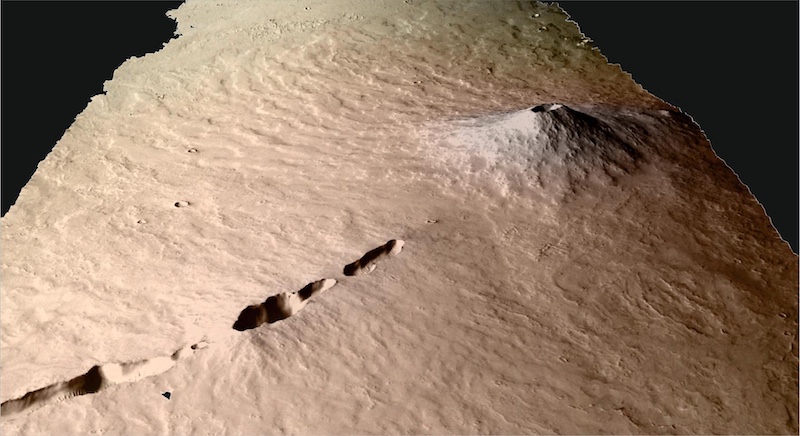

- Mars has many volcanoes, just like Earth. Earth’s volcanoes are still active. Those on Mars, though, have been extinct or dormant for millions of years. But how active were they?
- Using data taken from orbit around Mars, scientists have been able to analyze the minerals from the Pavonis Mons volcanic system.
- The most recent volcanoes on Mars were more active and complex than previously thought, the analysis shows. The volcanoes erupted many times, fed by long-lasting magma systems below the surface.
EarthSky’s 2026 lunar calendar is available now. Get yours today! Makes a great gift.
Mars’ most recent active volcanoes
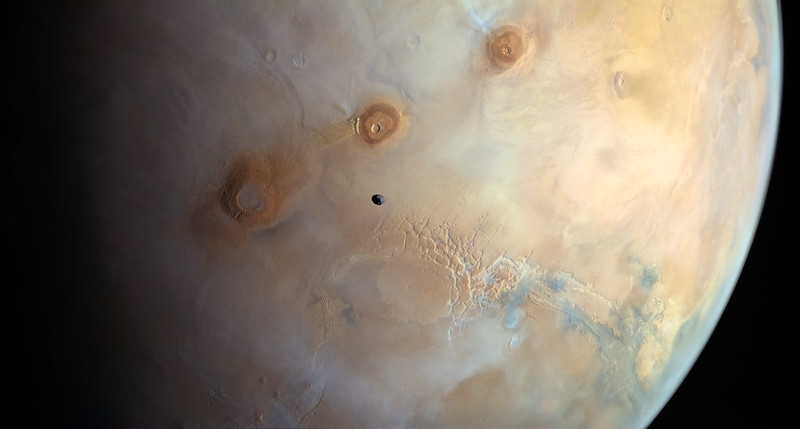
Mars is well-known for its many volcanoes, including the largest one in the solar system, Olympus Mons. On February 11, 2026, a new study from researchers in Poland, the U.S. and the U.K., said the most recent volcanic systems on Mars were more complex and active than previously thought. Instead of just single, short eruptions, there were long-lasting and complex magma systems that fed the volcanoes.
The new evidence comes from high-resolution morphological observations and mineral analyses from spacecraft in orbit. The study focused on a volcanic system south of Pavonis Mons, another of Mars’ largest volcanoes.
The researchers published their peer-reviewed findings in the journal Geology on January 29, 2026.
Recent volcanoes on Mars more active than 1st thought
In the study, the researchers combined detailed surface maps of Pavonis Mons with orbital mineral data. By doing so, they could trace back the volcanic history of this area. Since each eruptive phase preserved a distinct mineral signature, this allowed scientists to trace how the magma changed through time. First author Bartosz Pieterek at Adam Mickiewicz University in Poland said:
Our results show that even during Mars’ most recent volcanic period, magma systems beneath the surface remained active and complex. The volcano did not erupt just once; it evolved over time as conditions in the subsurface changed.


Mars’ “Young” Volcanoes Were More Complex Than Scientists Once Thoughtastrobiology.com/2026/02/mars… #astrobiology #mars #astrogeology
— Astrobiology (@astrobiology.bsky.social) 2026-02-12T20:40:19.275Z
Multiple phases of eruptions
Although extinct or dormant now, the Pavonis Mons volcanic system experienced multiple eruptions. Over time, it transitioned from early fissure-fed lava emplacement to point-source activity that produced cone-forming vents.
The mineral signatures of each eruptive phase provided important clues, as Pieterek noted:
These mineral differences tell us that the magma itself was evolving. This likely reflects changes in how deep the magma originated and how long it was stored beneath the surface before erupting.
Volcanoes on Mars were diverse
In 2024, another study showed Martian volcanoes in general were more diverse than previously known. This was despite Mars lacking plate tectonics.
That research suggested Mars’ volcanoes, when active, were driven by vertical tectonics. That is, the crust shifted up and down instead of sideways.
Overall, these studies illustrate how geologically active Mars was billions of years ago, even though the processes might be different in some ways from Earth. And while Mars’ volcanoes are no longer erupting, there is growing evidence for some residual volcanic activity still occurring underground today. Evidence for this comes from NASA’s InSight lander, which detected thousands of marsquakes, the equivalent of earthquakes.
Bottom line: Scientists used orbital data to study minerals from volcanoes on Mars. They found recent volcanoes on Mars were more complex than they expected, with ongoing eruptions fed by long-lived magma systems.
Source: Spectral evidence for magmatic differentiation within a Martian plumbing system
Via The Geological Society of America
Read more: New study reveals hidden Mars volcano near NASA rover
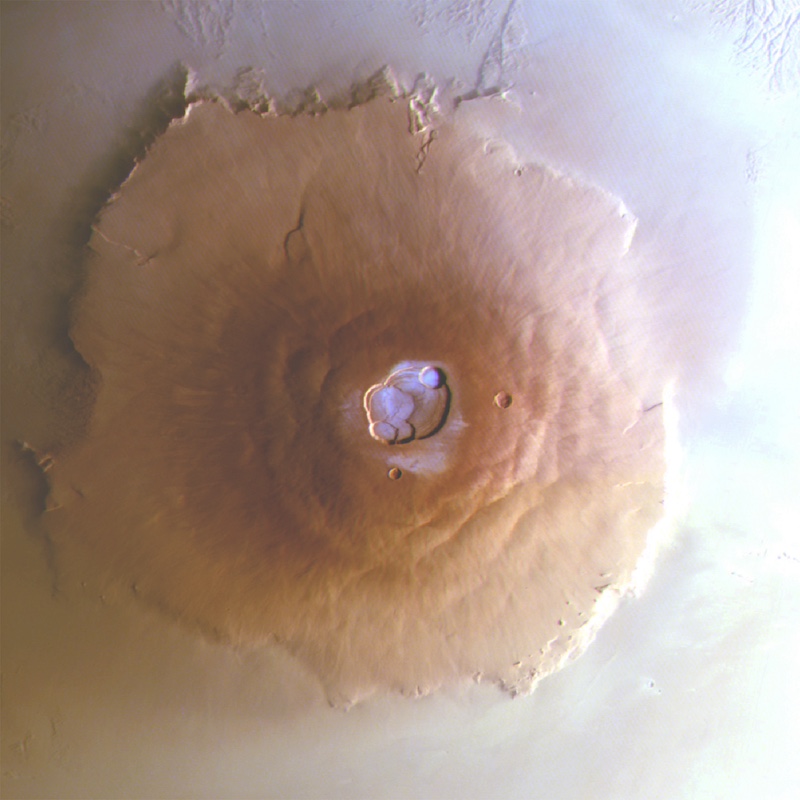
Read more: Spotted! Water frost on Mars volcanoes for 1st time
The post The most recent volcanoes on Mars were surprisingly active first appeared on EarthSky.










Related Posts

Stay Informed With the Latest & Most Important News
Previous Post
Next Post




Advertisement
-
 01Two Black Holes Observed Circling Each Other for the First Time
 -
 02From Polymerization-Enabled Folding and Assembly to Chemical Evolution: Key Processes for Emergence of Functional Polymers in the Origin of Life
 -
 03Astronomy 101: From the Sun and Moon to Wormholes and Warp Drive, Key Theories, Discoveries, and Facts about the Universe (The Adams 101 Series)
 -
 04True Anomaly hires former York Space executive as chief operating officer
 -
 05Φsat-2 begins science phase for AI Earth images
 -
 06Hurricane forecasters are losing 3 key satellites ahead of peak storm season − a meteorologist explains why it matters
 -
 07Binary star systems are complex astronomical objects − a new AI approach could pin down their properties quickly