
Now Reading: The Nancy Grace Roman Space Telescope is now complete!
-
01
The Nancy Grace Roman Space Telescope is now complete!


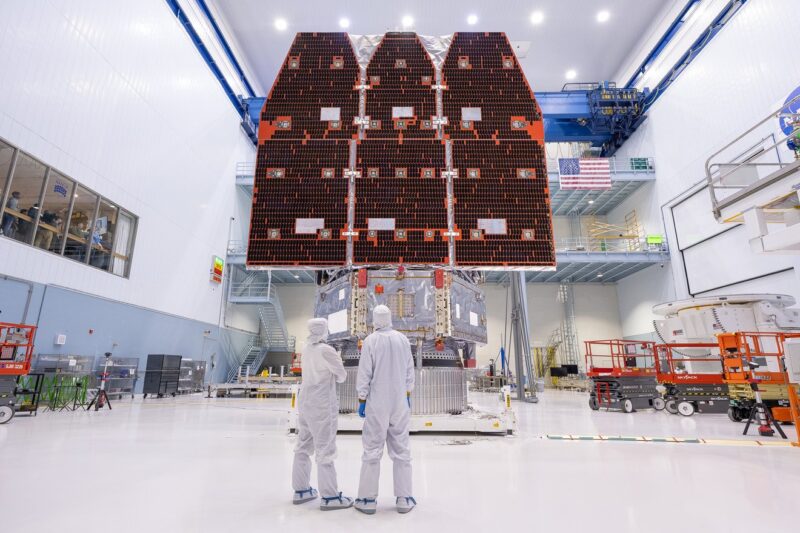
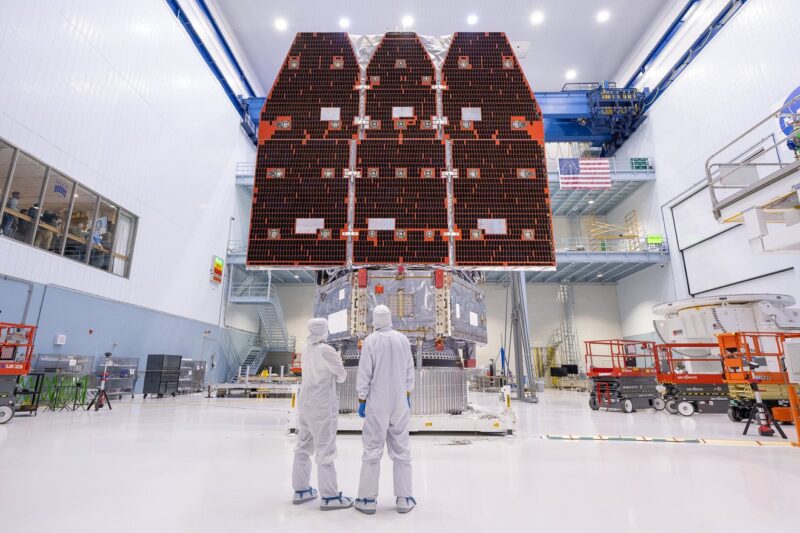
The Nancy Grace Roman Space Telescope is now complete
NASA said on December 4, 2025, that the construction of the Nancy Grace Roman Space Telescope is now complete! Teams joined the last two major segments together at the Goddard Space Flight Center in Maryland on November 25, 2025. This telescope will make infrared observations of the universe, including planets around other stars to billions of far-flung galaxies.
And perhaps the best news is that the space telescope, once slated for launch “sometime in 2027,” is now set to launch by May 2027, and maybe as early as fall 2026! Next up for the telescope is testing at Goddard, before it moves to the launch site at Kennedy Space Center in Florida in summer 2026.
Julie McEnery, Roman’s senior project scientist at NASA Goddard, said:
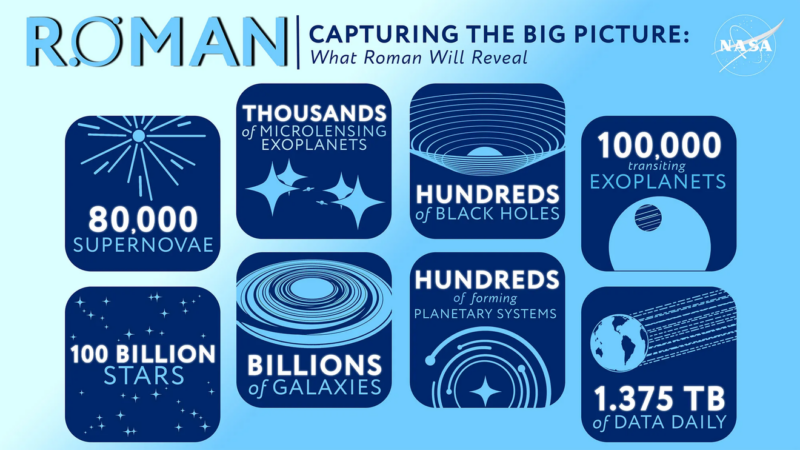
With Roman’s construction complete, we are poised at the brink of unfathomable scientific discovery. In the mission’s first five years, it’s expected to unveil more than 100,000 distant worlds, hundreds of millions of stars, and billions of galaxies. We stand to learn a tremendous amount of new information about the universe very rapidly after Roman launches.
Meet the Nancy Grace Roman space telescope
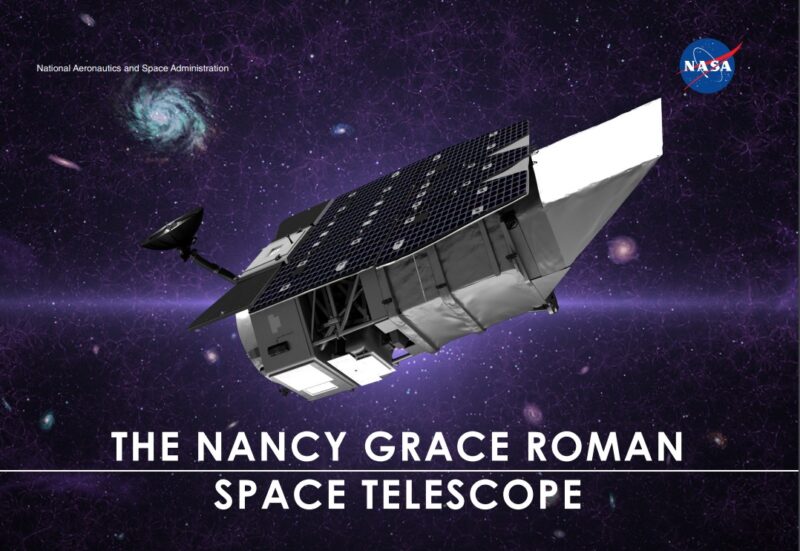
Remember what astronomical images were like before we had the Hubble space telescope? Hubble was the first large optical telescope to be launched into space, above Earth’s obscuring atmosphere. And it fundamentally changed our view of the cosmos. Astronomers say the Nancy Grace Roman space telescope will do that, too, giving us a view of the universe we’ve never had before. The telescope will have a primary mirror of 2.4 meters in diameter (7.9 feet). That’s the same size as Hubble. But a single image from the Nancy Grace Roman space telescope will equal the detail from 100 Hubble images.
Scientists expect the telescope to answer fundamental questions about distant planets orbiting stars in our Milky Way galaxy, about the dark energy we haven’t yet detected directly but believe makes up a substantial portion of our cosmos … and about what astronomers call the cosmic dawn.
The telescope’s Wide Field Instrument, its primary instrument, will have a field of view 100 times greater than Hubble’s infrared instrument. Roman’s large field of view means it can capture more sky in less time. The Wide Field Instrument will scan the Milky Way for exoplanets, or planets orbiting distant stars. Over the past 30 years, since the early 1990s until now, we’ve discovered more than 5,000 exoplanets. The Nancy Grace Roman space telescope is expected to increase that number to some 100,000 exoplanets in the coming five to 10 years.
Roman’s other instrument is the Coronagraph Instrument. The Coronagraph Instrument will perform high contrast imaging and spectroscopy to gather more knowledge of individual exoplanets. More on the coronagraph below.
Interview with Néstor Espinoza
Watch this 52-second clip of astronomer Néstor Espinoza of the Space Telescope Science Institute talking with EarthSky’s Deborah Byrd. Néstor told us this telescope should increase the number of known exoplanets – or planets orbiting distant suns – from 5,000 now to 100,000 in just 5 years!
The Roman telescope’s 100,000 new exoplanets
The Roman space telescope will survey our galaxy, taking observations every 15 minutes for more than a year. What a mass of data it’ll collect in just that first year! The data will enable astronomers to track the brightness changes in stars, which could lead to discoveries of exoplanets, rogue planets, isolated black holes and more.
So how will the Roman space telescope find its 100,000 exoplanets? With the aid of the Roman Coronagraph, the first active coronagraph to fly in space. NASA said:
The Roman Coronagraph will advance scientists’ ability to directly image planets and disks around other stars. Coronagraphs work by blocking light from a bright object, like a star, so that the observer can more easily see a faint object, like a planet [next to the bright object].
The Roman Coronagraph is designed to detect planets 100 million times fainter than their stars, or 100 to 1,000 times better than existing space-based coronagraphs.
The Roman Coronagraph will be capable of directly imaging reflected starlight from a planet akin to Jupiter in size, temperature and distance from its parent star.
The Roman telescope and the cosmic dawn
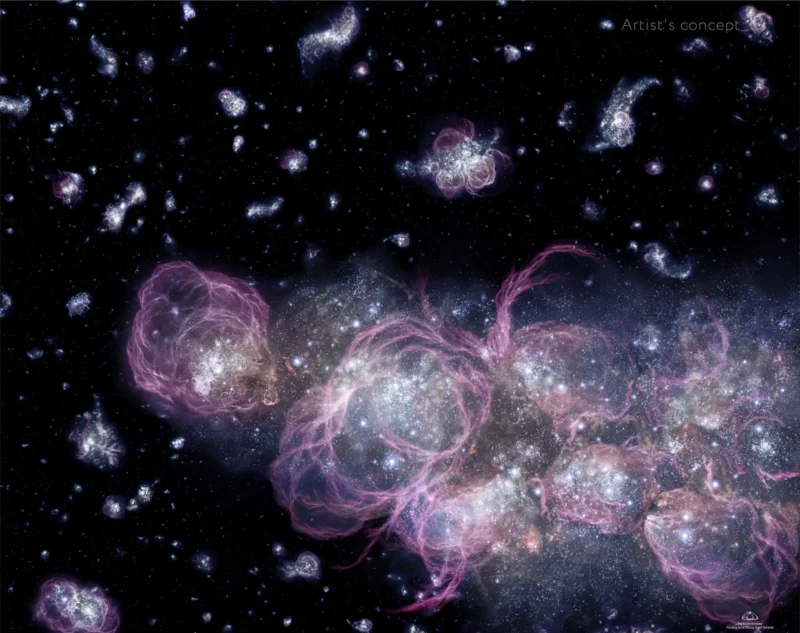
After the Big Bang that set our universe into motion, the cosmos was dark for some 380,000 to 200 million years. Yes, dark. Even though stars had already begun to shine, neutral atoms would absorb their light, leaving the cosmos in a kind of obscuring fog. Then neutral atoms began to break apart, and the fog began to lift. The light of stars broke through and began traveling throughout space. Astronomers call this transition from dark to light the cosmic dawn. Takahiro Morishita of Caltech said:
Roman will excel at finding the building blocks of cosmic structures like galaxy clusters that later form. It will quickly identify the densest regions, where more ‘fog’ is being cleared, making Roman a key mission to probe early galaxy evolution and the cosmic dawn.
Roman’s wide field of view will help determine how common quasars are and whether certain types of galaxies played a larger role in clearing the fog. It will also look for “cosmic daybreakers” that illuminated our universe.
The Roman space telescope and dark energy
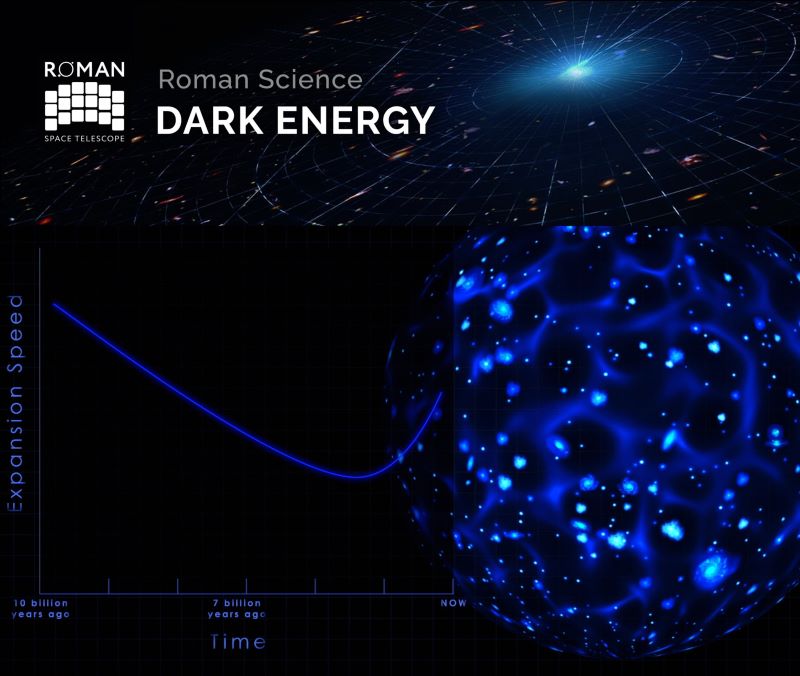
Dark energy is a mysterious force that makes up about 68% of the total energy content of our universe. Dark energy is responsible for the acceleration of our expanding universe. Roman will help astronomers understand just what dark energy is by taking a closer look at how the universe has evolved. Roman’s wide field will allow us a bigger picture of the universe. Mapping the distribution of matter and measuring distant supernovae will help show how dark energy might have changed over time.
Who was Nancy Grace Roman?
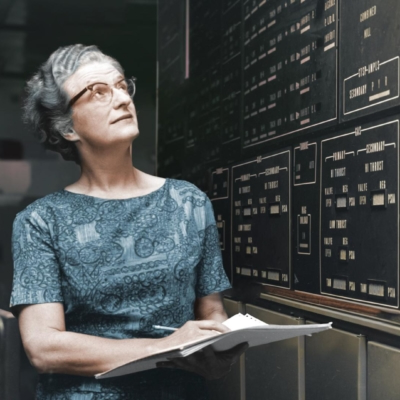
Nancy Grace Roman has the honorary title of Mother of the Hubble Space Telescope. Born in 1925, Roman became one of the few female astronomers in a male-dominated science. Among other accomplishments, she became the first female executive at NASA and NASA’s first Chief of Astronomy. She earned her nickname by helping get the Hubble Space Telescope approved by Congress. Roman was most excited for Hubble’s discoveries on dark energy. The telescope that will now bear Roman’s name will increase our understanding of:
… dark energy, the universe, and our place in it.
Read more about Nancy Grace Roman
Bottom line: The Nancy Grace Roman Space Telescope is now complete! The infrared space telescope could launch as early as fall 2026.
The post The Nancy Grace Roman Space Telescope is now complete! first appeared on EarthSky.










Related Posts

Stay Informed With the Latest & Most Important News



Advertisement
-
 01Two Black Holes Observed Circling Each Other for the First Time
 -
 02From Polymerization-Enabled Folding and Assembly to Chemical Evolution: Key Processes for Emergence of Functional Polymers in the Origin of Life
 -
 03Astronomy 101: From the Sun and Moon to Wormholes and Warp Drive, Key Theories, Discoveries, and Facts about the Universe (The Adams 101 Series)
 -
 04True Anomaly hires former York Space executive as chief operating officer
 -
 05Φsat-2 begins science phase for AI Earth images
 -
 06Hurricane forecasters are losing 3 key satellites ahead of peak storm season − a meteorologist explains why it matters
 -
 07Binary star systems are complex astronomical objects − a new AI approach could pin down their properties quickly