
Now Reading: The next steps in the quest for full rocket reusability
-
01
The next steps in the quest for full rocket reusability


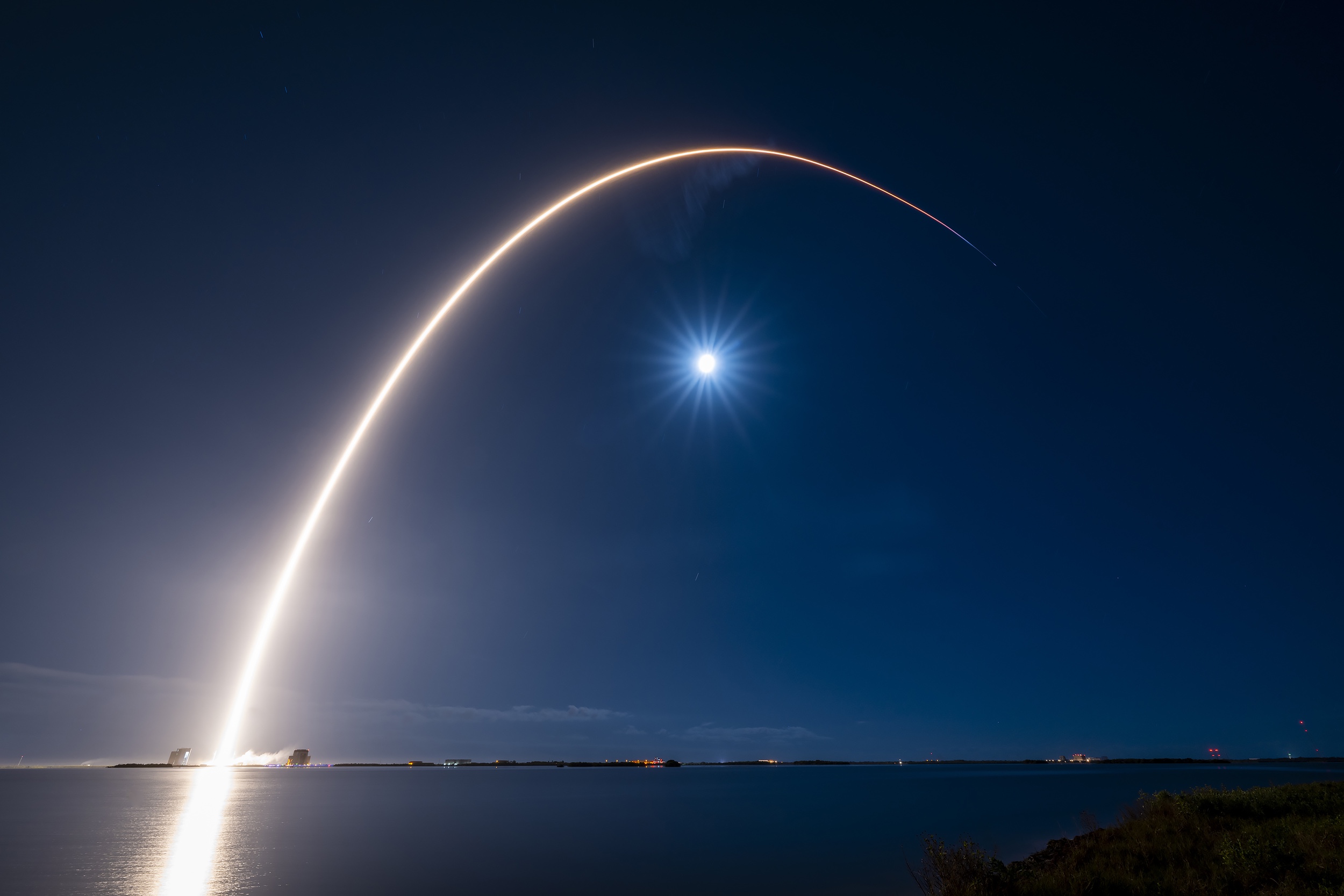

When a Falcon 9 lifted off from Vandenberg Space Force Base in California late Nov. 16, it did something that was unprecedented a decade ago but unremarkable today: it landed the first stage, in this case on a pad next to where it lifted off.
SpaceX noted that the launch, carrying the Sentinel-6B Earth science satellite, was the 500th reflight of an orbital booster, something no other company has achieved. In the reusability race, the score is SpaceX 500, Everyone Else 0.
The rest of the world, though, will soon get on the scoreboard. Blue Origin became the second company to land an orbital-class booster three days earlier, when a New Glenn first stage touched down on the company’s ship Jacklyn in the Atlantic Ocean. It was the vehicle’s second flight.
Blue Origin CEO Dave Limp said in an interview that the first stage may be refurbished and reused for the next New Glenn launch, in early 2026. That will depend on both how long it takes to turn the booster around as well as when the next booster will be completed. “It’s a bit of a tossup on which one we use next,” he said.
Others will follow. Several Chinese companies are preparing test flights of vehicles whose boosters are intended to land and be reused, often using approaches very similar to SpaceX. Rocket Lab is finishing development of Neutron. The company expects Neutron’s first stage to also be reused, although the company doesn’t plan to recover the stage on its inaugural flight in 2026.
With booster reuse on the verge of becoming widespread, the focus now is on something that has looked as improbable as landing a booster: reusing the entire launch vehicle. This is again an area that SpaceX has taken the lead in with its massive Starship vehicle.
“Starship is truly meant to be a rapidly reusable vehicle,” Kiko Donchev, vice president of launch at SpaceX, said during the Economist Space Summit in Orlando on Nov. 5.
Once fully up and running, he said it could cut the cost of launching a payload by a factor of 100 while increasing the tonnage launched by a similar magnitude.
“That is how you take a leap in what’s going to happen in low Earth orbit, on the moon and eventually on Mars,” he said.
Starship, though, is still in development. While several test flights have reused the Super Heavy booster, it has yet to reuse, or even recover intact, the Starship upper stage. That could happen early next year once SpaceX starts flying the upgraded version 3.
This time, though, the gap between SpaceX and other launch providers won’t span a decade. Stoke Space, a startup, is working on Nova, a vehicle whose two stages are designed for reuse. It is far smaller than Starship — its payload capacity is several tons, compared to Starship’s 100 tons — but could be flying as soon as next year.
Stoke Space CEO Andy Lapsa, who followed Donchev on stage at the Economist conference, made similar comments on the importance of full reusability. “The reason rapid reusability is so important is because, first of all, it fundamentally changes the economics of launch,” he said.
“Almost equally important is that it fundamentally changes the availability you have to get to orbit,” he added, avoiding current limits like the production of single-use upper stages. “Once you start reusing the second stage, you completely remove that constraint.”
If full reusability can achieve the visions that SpaceX and Stoke Space are dreaming of, it could enable new markets that once seemed economically unfeasible, from microgravity manufacturing to space-based solar power. “That’s the moment when, I think, you’ll see commercialization of space really start to scale,” Lapsa said.
It’s unlikely those two companies will have the field to themselves. Blue Origin, for example, has been studying a reusable second stage for New Glenn under an effort called Project Jarvis.
In this second round of the reusability race, it seems unlikely SpaceX will rush out to a 500-launch lead.
This article first appeared in the December 2025 issue of SpaceNews Magazine.










Related Posts

Stay Informed With the Latest & Most Important News
Previous Post
Next Post





Advertisement
-
 01Two Black Holes Observed Circling Each Other for the First Time
 -
 02From Polymerization-Enabled Folding and Assembly to Chemical Evolution: Key Processes for Emergence of Functional Polymers in the Origin of Life
 -
 03Astronomy 101: From the Sun and Moon to Wormholes and Warp Drive, Key Theories, Discoveries, and Facts about the Universe (The Adams 101 Series)
 -
 04True Anomaly hires former York Space executive as chief operating officer
 -
 05Φsat-2 begins science phase for AI Earth images
 -
 06Hurricane forecasters are losing 3 key satellites ahead of peak storm season − a meteorologist explains why it matters
 -
 07Binary star systems are complex astronomical objects − a new AI approach could pin down their properties quickly