
Now Reading: The Ocean Worlds Science Case For The Pollux Spectropolarimeter
-
01
The Ocean Worlds Science Case For The Pollux Spectropolarimeter


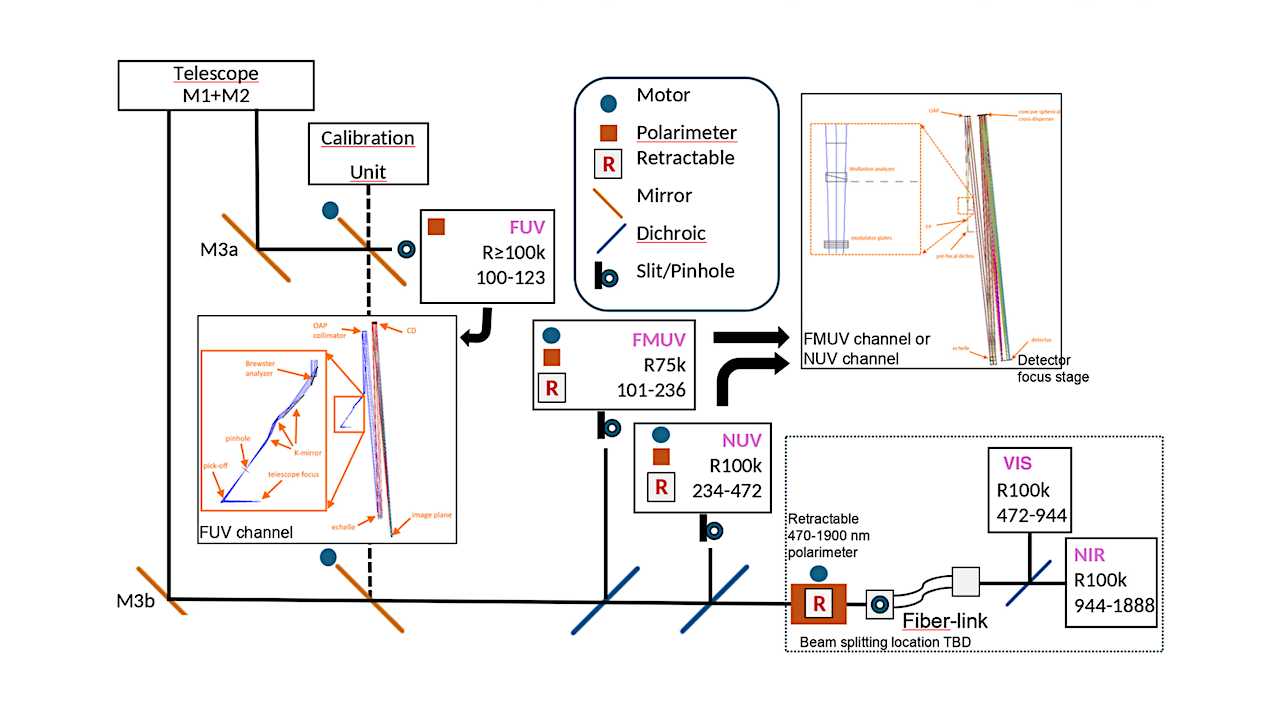

Pollux instrument concept schematic diagram. — astro-ph.IM
Pollux is a candidate European instrument contribution to the Habitable Worlds Observatory (HWO), designed to advance our understanding of the formation and evolution of cosmic structures in the universe, and specifically search signs of life on extrasolar planets.
This high-resolution spectrograph (R > 40,000) with polarimetric capabilities offers nearly continuous and simultaneous coverage from the FUV (∼100 nm) to the NIR (∼1.9 micron), making it a versatile tool for a wide range of scientific investigations from solar system studies to cosmology.
Several Solar System ocean worlds have been the focal point of the scientific community to understand the conditions of their internal saline oceans, as well as the possible emergence of life beyond Earth.
The ocean world science case will leverage Pollux’s UV spectropolarimetric capabilities to investigate surface reflectance and composition, characterize airglow emissions in the environments of giant-planet moons, as well as constrain the microphysical properties of atmospheric aerosols.
Vincent Hue, Bilal Benmahi, Mathieu Barthelemy, Tracy M. Becker, Jean-Claude Bouret, Richard J. Cartwright, Jean-Yves Chaufray, Luca Fossati, Gabriel Giono, Olivier Poch, Ujjwal Raut, Lorenz Roth
Comments: 9 pages, 4 figures, contribution to the Pollux science case for the Habitable Worlds Observatory (HWO)
Subjects: Instrumentation and Methods for Astrophysics (astro-ph.IM); Earth and Planetary Astrophysics (astro-ph.EP)
Cite as: arXiv:2603.11112 [astro-ph.IM] (or arXiv:2603.11112v1 [astro-ph.IM] for this version)
https://doi.org/10.48550/arXiv.2603.11112
Focus to learn more
Submission history
From: Vincent Hue
[v1] Wed, 11 Mar 2026 12:00:08 UTC (1,838 KB)
https://arxiv.org/abs/2603.11112
Astrobiology, Astrochemistry, Exoplanet,










Related Posts
Stay Informed With the Latest & Most Important News

Advertisement
-
 01Two Black Holes Observed Circling Each Other for the First Time
 -
 02From Polymerization-Enabled Folding and Assembly to Chemical Evolution: Key Processes for Emergence of Functional Polymers in the Origin of Life
 -
 03Astronomy 101: From the Sun and Moon to Wormholes and Warp Drive, Key Theories, Discoveries, and Facts about the Universe (The Adams 101 Series)
 -
 04True Anomaly hires former York Space executive as chief operating officer
 -
 05Φsat-2 begins science phase for AI Earth images
 -
 06Hurricane forecasters are losing 3 key satellites ahead of peak storm season − a meteorologist explains why it matters
 -
 07Binary star systems are complex astronomical objects − a new AI approach could pin down their properties quickly