
Now Reading: The Radius Cliff is a Waterfall: Explaining Sub-Neptune Exoplanets With Steam Worlds
-
01
The Radius Cliff is a Waterfall: Explaining Sub-Neptune Exoplanets With Steam Worlds

The Radius Cliff is a Waterfall: Explaining Sub-Neptune Exoplanets With Steam Worlds

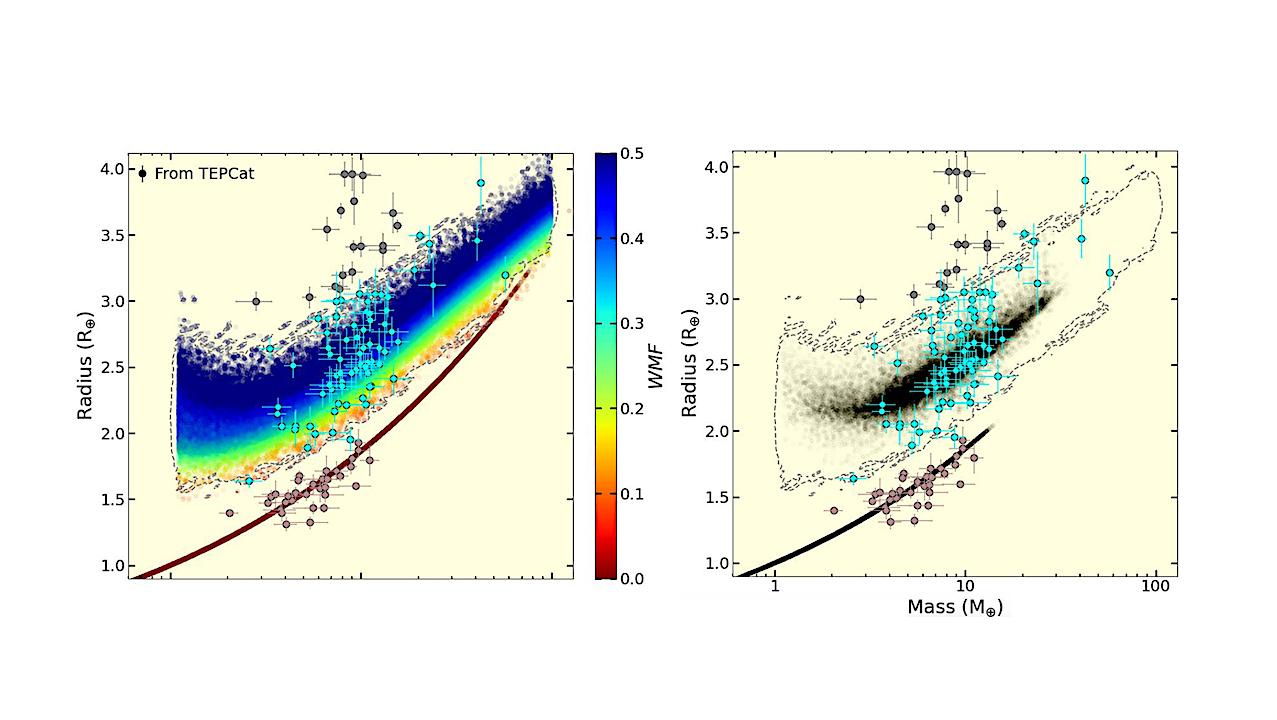
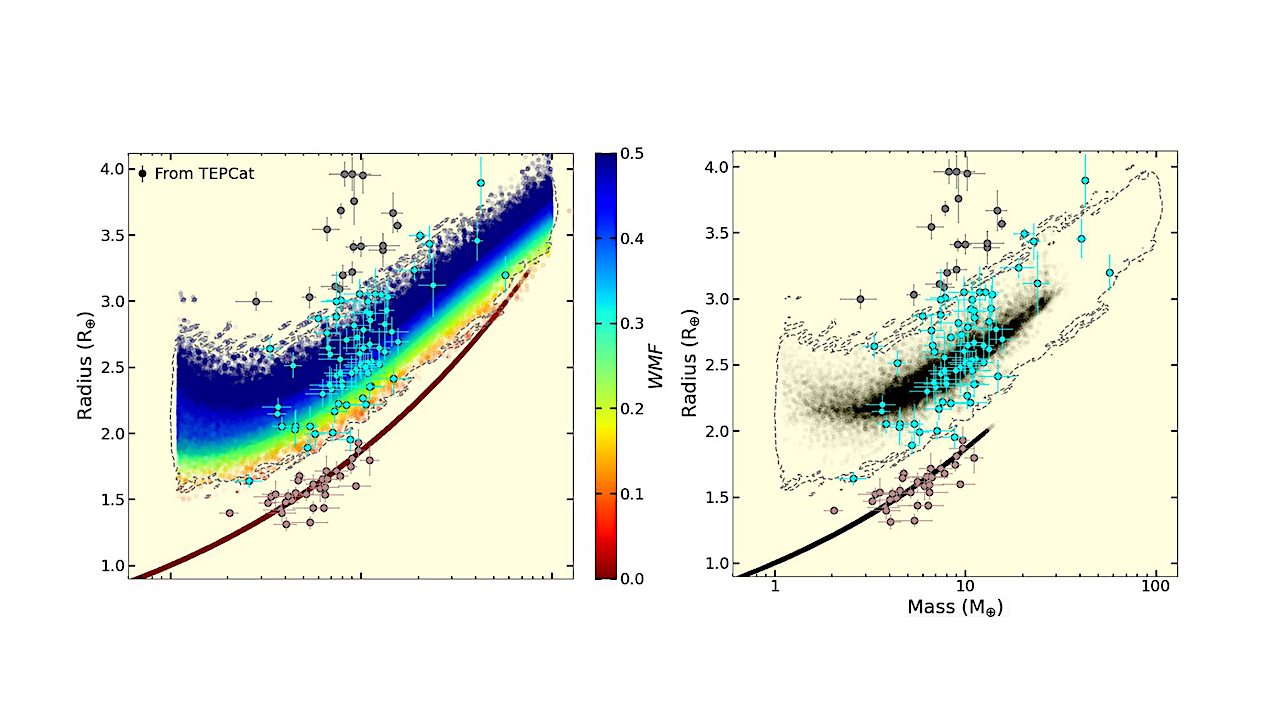
Mass–radius distribution of planets from Model I compared with the observed planets around G-type host stars from the TEPCat catalog Southworth (2011). Top: Weighted mass–radius distribution of simulated rocky planets and water worlds, shown with a color map of water mass fraction (WMF). Bottom: The same weighted distribution shown without the WMF color map, with weight contours highlighted to illustrate regions of higher model likelihood and observational completeness. The model broadly agrees with the observed distribution for planets smaller than ∼ 3 R⊕ in regions of high weights but fails to explain planets larger than ∼ 3 R⊕, suggesting the presence of a H/He-rich population, comprising ∼ 15% of the full TEPCat sample and ∼ 20% of the TEPCat sub-Neptunes. — astro-ph.EP
The demographics of Kepler planets provide a key testbed for models of planet formation and evolution, particularly for explaining the radius valley separating super-Earths and sub-Neptunes.
A primordial interpretation based on differences in bulk densities — where rocky and water-rich planets form via migration pathways — offers an alternative to atmospheric loss scenarios. Updated interior structure models of water worlds with adiabatic steam atmospheres reproduce the observed valley near ∼2 R⊕ more accurately.
Furthermore, migration models from our Genesis library suggest that these formation pathways can also account for the distinct period distributions of super-Earths and sub-Neptunes, as well as the emergence of the hot Neptune desert. Motivated by this, we develop a Bayesian hierarchical mixture model for close-in Kepler planets (P<100 days), combining rocky planets and water worlds without H/He envelopes.
The inferred mass distributions of rocky and water-rich planets peak at ∼2.6 M⊕ and ∼7 M⊕, respectively, with the water mass fraction of water worlds peaking at ∼41%. Water worlds provide a good representation of the Kepler sub-Neptune population, with the radius cliff emerging as a “waterfall” — a sharp decline in their occurrence. However, our mass-radius analysis shows that water worlds alone cannot explain planets with R≳3 R⊕, implying that at least ∼20% of sub-Neptunes in the sample are enriched in H/He gas.
Aritra Chakrabarty, Gijs D. Mulders, Artyom Aguichine, Natalie Batalha
Comments: 22 pages, 9 figures, accepted for publication in ApJ
Subjects: Earth and Planetary Astrophysics (astro-ph.EP); Solar and Stellar Astrophysics (astro-ph.SR)
Cite as: arXiv:2602.11923 [astro-ph.EP] (or arXiv:2602.11923v1 [astro-ph.EP] for this version)
https://doi.org/10.48550/arXiv.2602.11923
Focus to learn more
Submission history
From: Aritra Chakrabarty
[v1] Thu, 12 Feb 2026 13:23:00 UTC (1,276 KB)
https://arxiv.org/abs/2602.11923
Astrobiology, exoplanet,











Related Posts
Stay Informed With the Latest & Most Important News




Advertisement
-
 01Two Black Holes Observed Circling Each Other for the First Time
 -
 02From Polymerization-Enabled Folding and Assembly to Chemical Evolution: Key Processes for Emergence of Functional Polymers in the Origin of Life
 -
 03Astronomy 101: From the Sun and Moon to Wormholes and Warp Drive, Key Theories, Discoveries, and Facts about the Universe (The Adams 101 Series)
 -
 04True Anomaly hires former York Space executive as chief operating officer
 -
 05Φsat-2 begins science phase for AI Earth images
 -
 06Hurricane forecasters are losing 3 key satellites ahead of peak storm season − a meteorologist explains why it matters
 -
 07Binary star systems are complex astronomical objects − a new AI approach could pin down their properties quickly