
Now Reading: The SPHEREx Ices Investigation: An Overview
-
01
The SPHEREx Ices Investigation: An Overview


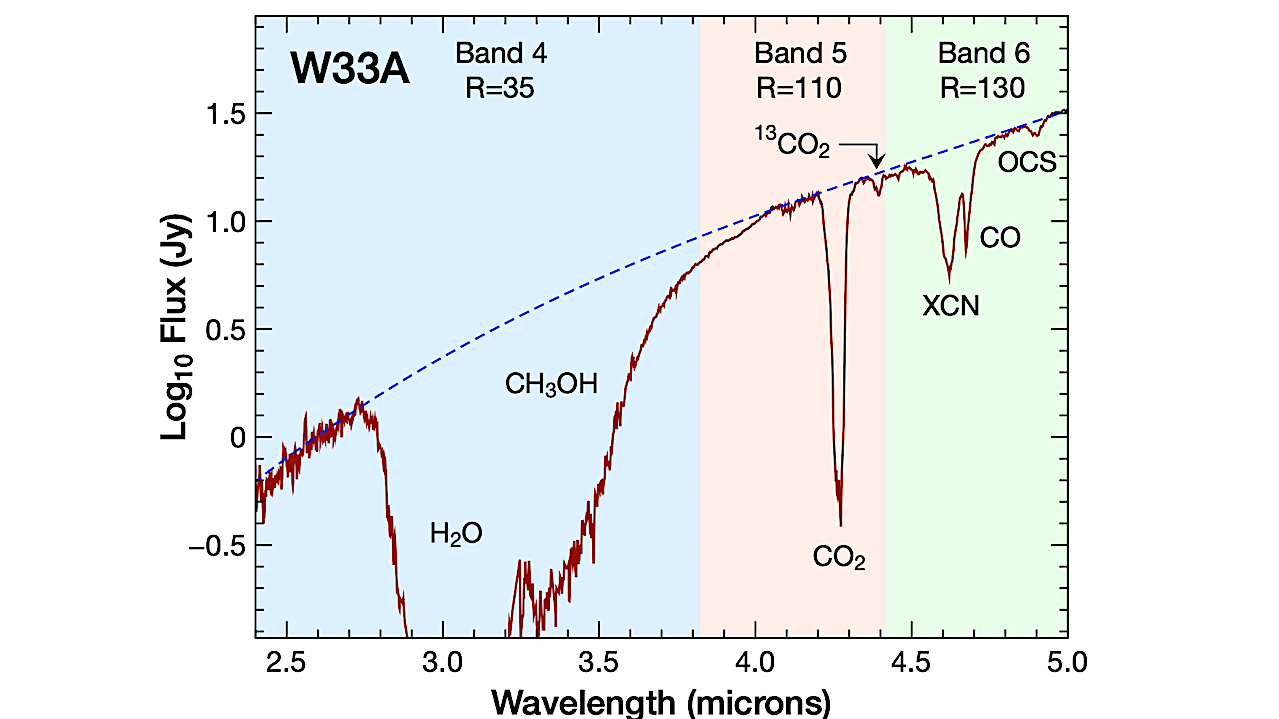
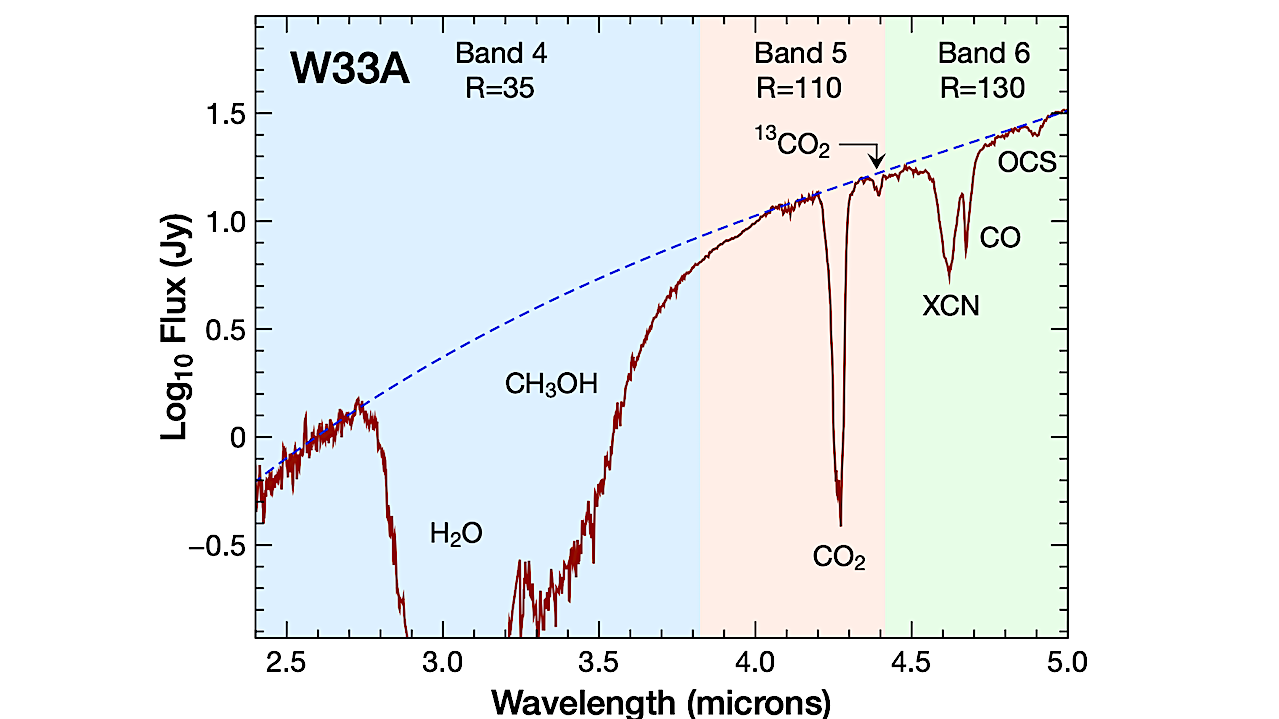
ISO Short Wavelength Spectrometer (SWS) spectrum of the Galactic source, W33A, an extremely embedded high-mass young stellar object (Gibb et al. 2004). This source exhibits strong ice absorption features due to H2O, CH3OH, CO2, XCN, CO, and weaker 13CO2 and OCS features. Also shown are the SPHEREx Bands 4, 5, and 6, along with their respective spectral resolving powers, λ/∆λ (see Table 1). — astro-ph.GA
SPHEREx is a NASA mission designed to perform an all-sky spectroscopic survey in the 0.75 – 5 μm wavelength range. Its primary science objectives are to investigate: (1) inflationary cosmology, (2) the history of galaxy formation, and (3) the abundance of molecular ices – critical for prebiotic chemistry – found on the surfaces of interstellar dust grains within planet-forming regions.
This paper focuses on the third theme, the SPHEREx Ices investigation, for which SPHEREx is conducting a spectroscopic survey of nearly ten million preselected sources throughout the Milky Way and Magellanic Clouds to characterize their ice absorption features.
By selecting targets based on infrared color, spatial isolation, and brightness, the Ices Investigation secures high-signal-to-noise spectra across a broad range of astrophysical environments that are relatively free of spectral contamination. Rather than attempting to decompose each spectrum into its individual ice components, the Ices Investigation prioritizes accurate measurements of the integrated optical depths of key molecular ice absorption features.
This approach enables statistically powerful correlation studies between ice abundances and environmental parameters – including extinction, temperature, gas composition, radiation field strength, cosmic ray flux, and star formation activity. The data pipeline developed for this purpose incorporates machine learning for continuum estimation, drawing on both SPHEREx and ancillary datasets.
Ultimately, the expansive spectral archive produced by SPHEREx, combined with targeted follow-up from facilities like JWST, will transform our understanding of Galactic ice formation, evolution, abundance and their inheritance into planetary systems and prebiotic inventories.
Gary J. Melnick, Joseph L. Hora, Matthew L. N. Ashby, Volker Tolls, Jaeyeong Kim, Carey M. Lisse, Roberta Paladini, Michael W. Werner, Jeong-Eun Lee, Young-Jun Kim, Miju Kang, Yun-Ting Cheng, James J. Bock, Brendan P. Crill, Ari Cukierman, Olivier Dore, Andreas Faisst, Howard Hui, Woong-Seob Jeong, Chul-Hwan Kim, Ho-Gyu Lee, Jae-Joon Lee, Daniel Masters, Chi H. Nguyen, Jinyoung Noh, Ji Yeon Seok, Soung-Chul Yang, Yujin Yang, Michael Zemcov
Comments: 19 pages, 6 figures, 1 table, Accepted to the Astrophysical Journal March 16, 2026
Subjects: Astrophysics of Galaxies (astro-ph.GA); Instrumentation and Methods for Astrophysics (astro-ph.IM); Solar and Stellar Astrophysics (astro-ph.SR)
Cite as: arXiv:2603.22135 [astro-ph.GA](or arXiv:2603.22135v1 [astro-ph.GA] for this version)
https://doi.org/10.48550/arXiv.2603.22135
Focus to learn more
Submission history
From: Volker Tolls
[v1] Mon, 23 Mar 2026 15:59:42 UTC (33,556 KB)
https://arxiv.org/abs/2603.22135
Astrobiology, Astrochemistry,










Related Posts

Stay Informed With the Latest & Most Important News
Previous Post
Next Post




Advertisement
-
 01Two Black Holes Observed Circling Each Other for the First Time
 -
 02From Polymerization-Enabled Folding and Assembly to Chemical Evolution: Key Processes for Emergence of Functional Polymers in the Origin of Life
 -
 03Astronomy 101: From the Sun and Moon to Wormholes and Warp Drive, Key Theories, Discoveries, and Facts about the Universe (The Adams 101 Series)
 -
 04True Anomaly hires former York Space executive as chief operating officer
 -
 05Φsat-2 begins science phase for AI Earth images
 -
 06Hurricane forecasters are losing 3 key satellites ahead of peak storm season − a meteorologist explains why it matters
 -
 07Binary star systems are complex astronomical objects − a new AI approach could pin down their properties quickly