
Now Reading: The SPIRou Legacy Survey: Detection Of A Nearby World Orbiting In The Habitable Zone Of Gl725B
-
01
The SPIRou Legacy Survey: Detection Of A Nearby World Orbiting In The Habitable Zone Of Gl725B

The SPIRou Legacy Survey: Detection Of A Nearby World Orbiting In The Habitable Zone Of Gl725B

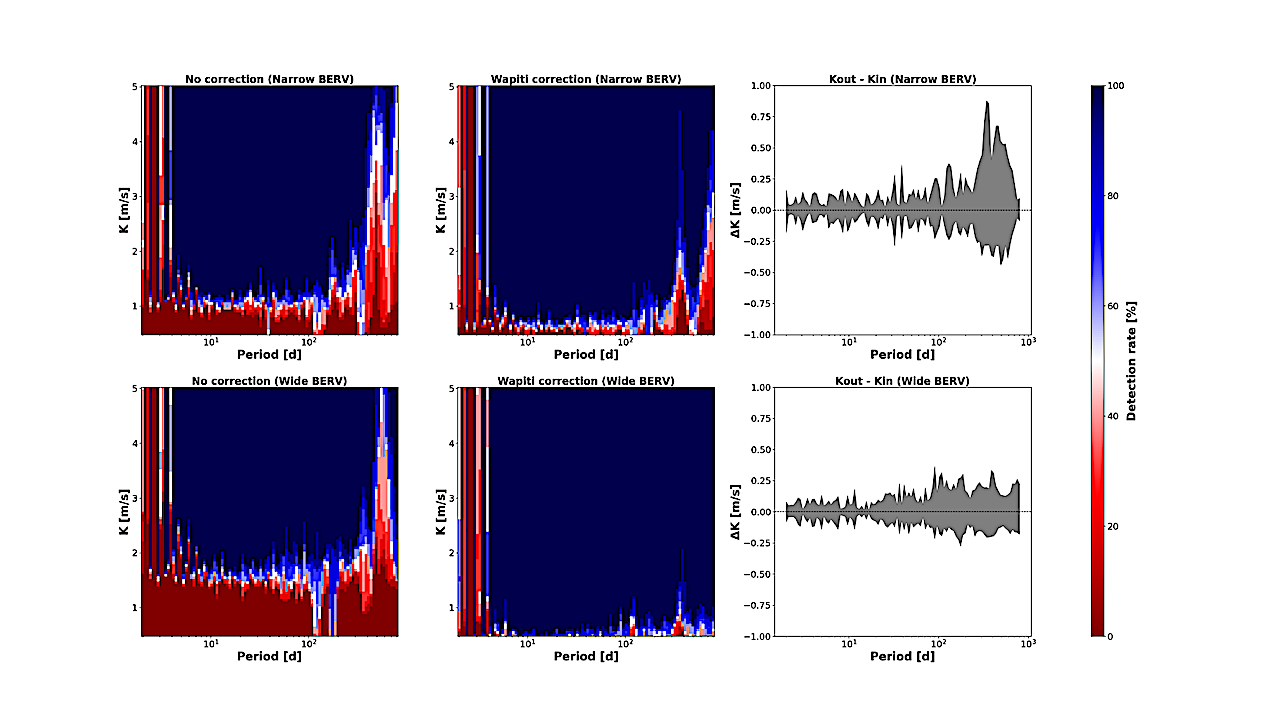
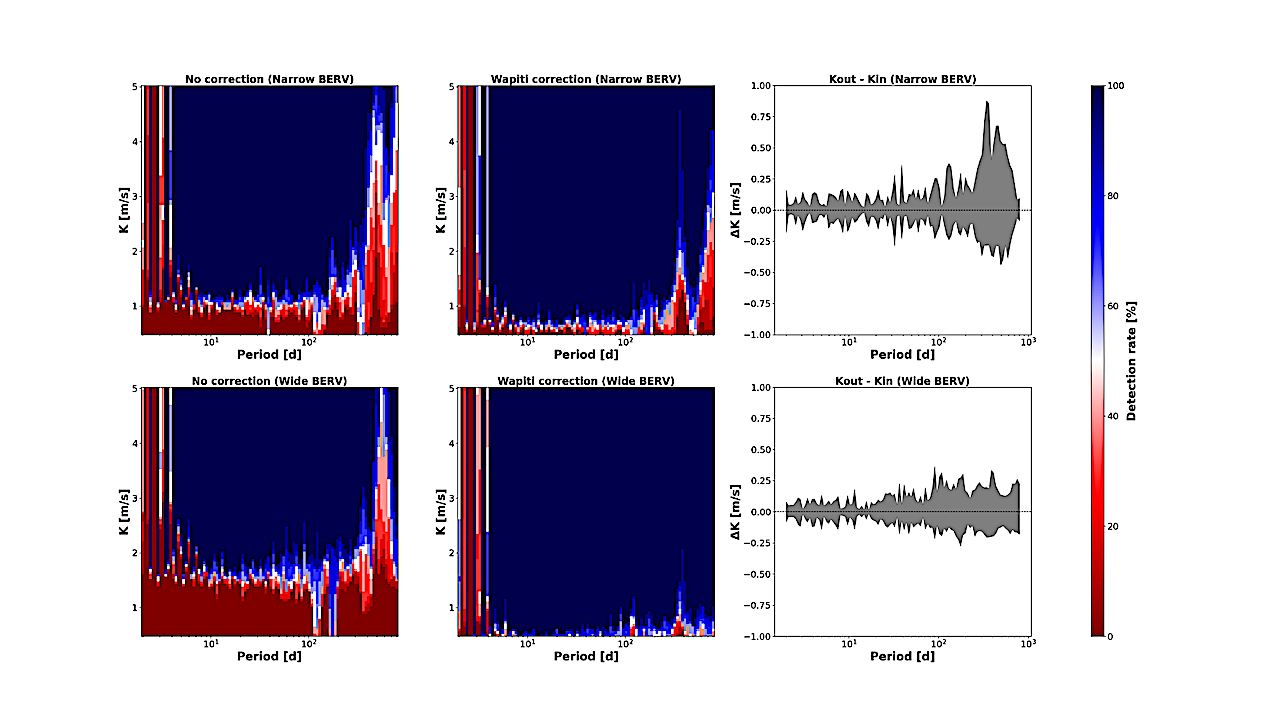
Left: Detection maps showing the percentage of recovered injected signals as a function of period and semi-amplitude for the narrow and wide BERV coverages. Middle: Same detection tests after applying the wapiti correction. Right: Difference between the recovered and injected K values (∆K = Kout − Kin) at 1 m·s −1 , with the shaded area indicating one standard deviation. The color bar indicates the detection rate in percent. — astro-ph.EP
M dwarfs are prime targets in the search for exoplanets because of their prevalence and because low-mass planets can be better detected with radial velocity (RV) methods. In particular, the near-infrared (NIR) spectral domain offers an increased RV sensitivity and potentially reduced stellar activity signals. However precise NIR RV measurements can be strongly affected by telluric absorption lines from the Earth’s atmosphere.
We searched for planets orbiting Gl 725 B, a nearby late-M dwarf at 3.5 pc, using high-precision SPIRou RV observations. We assessed the impact of telluric contamination and evaluated the performance of the weighted principal component analysis reconstruction method (WAPITI), designed to mitigate these systematics and improve planet detectability.
Using synthetic and observational SPIRou data, we simulated telluric effects on RVs under varying barycentric Earth radial velocity (BERV) conditions and applied WAPITI to correct line-by-line RVs. The method was tested through injection-recovery experiments and applied to real SPIRou observations of Gl 725 B.
WAPITI efficiently corrects telluric contamination in simulated and real datasets, enhancing the detectability and accuracy of planetary signals. We identify a two-planet system around Gl 725 B composed of a candidate inner planet (Gl 725 Bb) with a period of 4.765±0.004 days and semi-amplitude 1.4±0.3 m.s−1, and a confirmed outer planet (Gl 725 Bc) with a period of 37.90±0.17 days and semi-amplitude 1.7±0.3 m.s−1.
Their minimum masses are 1.5±0.4 and 3.5±0.7 M⊕, respectively, and the outer planet lies in the habitable zone. Using a multi-dimensional Gaussian process framework to model stellar activity, we also recover a stellar rotation period of 105.1±3.3 days.
The SPIRou Legacy Survey: Detection Of A Nearby World Orbiting In The Habitable Zone Of Gl725B Achieved By Correcting Strong Telluric Contamination In Near-infrared Radial Velocities With WAPITI
M. Ould-Elhkim, C. Moutou, J.-F. Donati, P. Cortés-Zuleta, X. Delfosse, É. Artigau, C. Cadieux, P. Charpentier, A. Carmona, I. Boisse, C. Reylé, E. Gaidos, R. Cloutier, G. Hébrard, L. Arnold, J.-D. do Nascimento Jr., N. J. Cook, R. Doyon
Comments: Published in A&A
Subjects: Earth and Planetary Astrophysics (astro-ph.EP); Instrumentation and Methods for Astrophysics (astro-ph.IM)
Cite as: arXiv:2601.22815 [astro-ph.EP] (or arXiv:2601.22815v1 [astro-ph.EP] for this version)
https://doi.org/10.48550/arXiv.2601.22815
Focus to learn more
Related DOI:
https://doi.org/10.1051/0004-6361/202555469
Focus to learn more
Submission history
From: Merwan Ould-Elhkim Mr.
[v1] Fri, 30 Jan 2026 10:40:43 UTC (26,533 KB)
https://arxiv.org/abs/2601.22815
Astrobiology,










Related Posts


Stay Informed With the Latest & Most Important News



Advertisement
-
 01Two Black Holes Observed Circling Each Other for the First Time
 -
 02From Polymerization-Enabled Folding and Assembly to Chemical Evolution: Key Processes for Emergence of Functional Polymers in the Origin of Life
 -
 03Astronomy 101: From the Sun and Moon to Wormholes and Warp Drive, Key Theories, Discoveries, and Facts about the Universe (The Adams 101 Series)
 -
 04True Anomaly hires former York Space executive as chief operating officer
 -
 05Φsat-2 begins science phase for AI Earth images
 -
 06Hurricane forecasters are losing 3 key satellites ahead of peak storm season − a meteorologist explains why it matters
 -
 07Binary star systems are complex astronomical objects − a new AI approach could pin down their properties quickly