
Now Reading: The Third Option: Color Phase Curves to Characterize the Atmospheres of Temperate Rocky Exoplanets
-
01
The Third Option: Color Phase Curves to Characterize the Atmospheres of Temperate Rocky Exoplanets

The Third Option: Color Phase Curves to Characterize the Atmospheres of Temperate Rocky Exoplanets

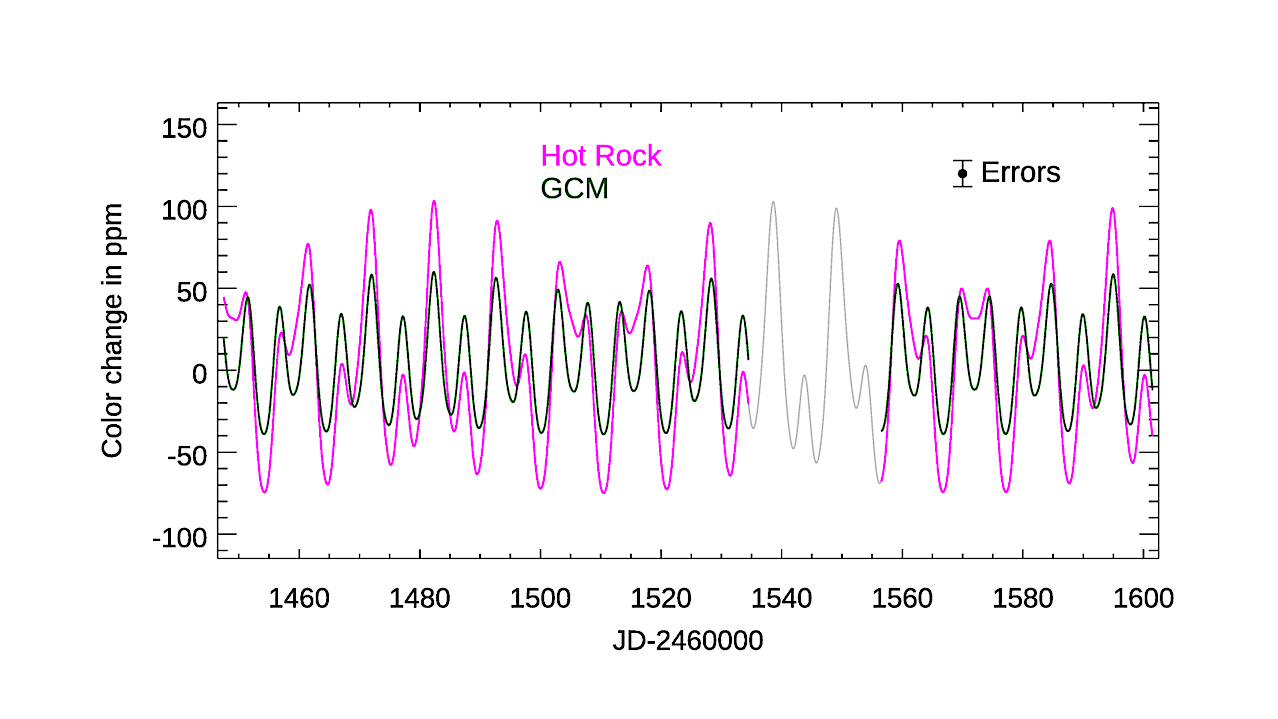
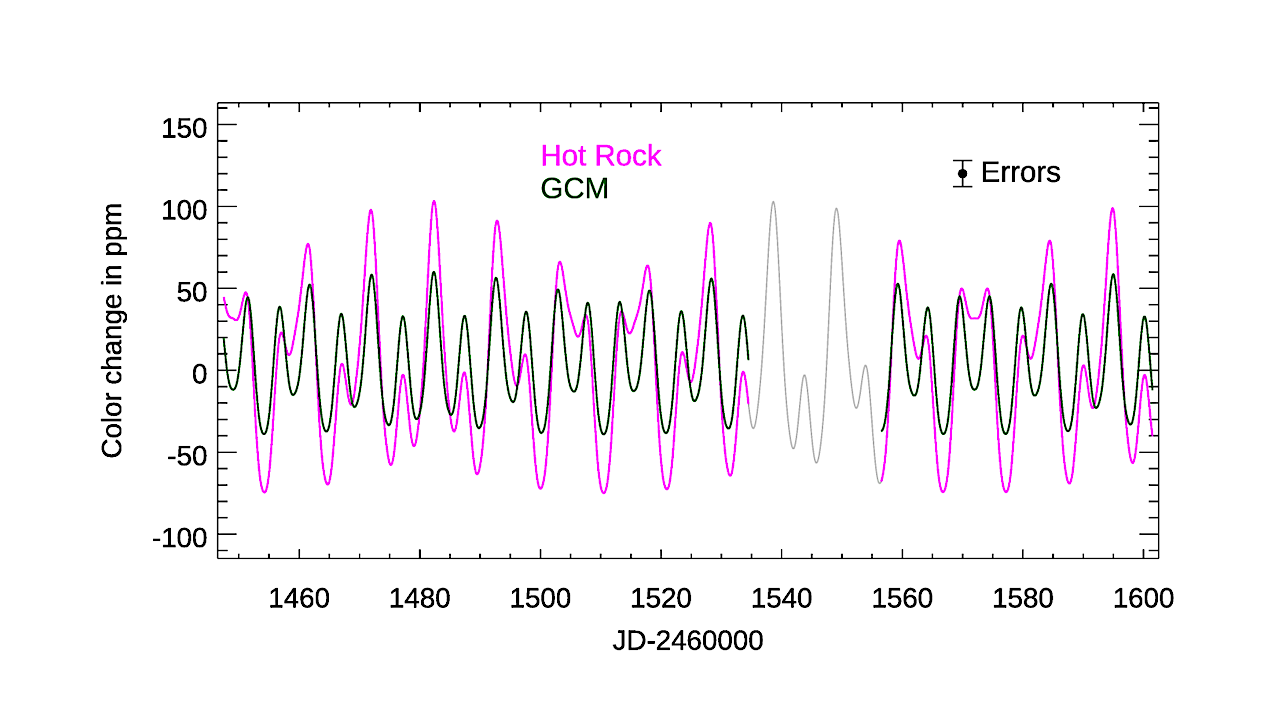
Color phase curves (CPCs) for the sum of planets ’b’ and ’d’ in the Proxima Centauri system. The CPC is the ratio of the flux in the 21 µm to 12.8 µm JWST/MIRI filters, normalized to the stellar flux, with the median value subtracted from the normalized ratio. The CPCs are the sum of both planets, and are shown here for the 2027 visibility period for JWST (lighter when not visible). Two cases are shown: using a hot rock model for ’b’, and a GCM (see text). Planet ’d’ is modeled as a hot rock in both cases.
Detecting and characterizing the atmospheres of rocky exoplanets has proven to be challenging for JWST. Transit spectroscopy of the TRAPPIST-1 planets has been impacted by the effects of spots and faculae on the host star.
Secondary eclipses have detected hot rocks, but evidence for atmospheres has been difficult to obtain. However, there is a third option that we call color phase curves. This method will apply to synchronously rotating non-transiting planets as well as transiting planets.
A color phase curve uses photometry at a long-IR wavelength near the peak of the planetary thermal emission (e.g., 21 microns) divided by photometry at a shorter wavelength where the star dominates more strongly (e.g., 12 microns).
We avoid wavelengths having potentially strong molecular absorption (e.g., 15 microns) to minimize degeneracies in the color phase curve, and we aim to detect and characterize the planetary atmosphere via its longitudinal heat transfer. The ratio of two wavelengths observed nearly simultaneously is designed to isolate thermal emission from the planet, discriminate against the star, and largely cancel instrumental systematic effects.
Moreover, we show that invoking mass-radius relations, and using self-consistent physical models, will permit the longitudinal heat transfer to be measured independent of the orbital inclination. Radial velocity surveys are detecting many new exoplanets, including temperate rocky worlds with Earth-like masses. Most of those planets will not transit, but color phase curves have the potential to detect and characterize their atmospheres.
Drake Deming, Andrew Lincowski, Laura Kreidberg, Miles Currie, Jean-Michel Desert, Guangwei Fu, Jacob Lustig-Yaeger, Victoria Meadows, Ignas Snellen
Comments: 14 pages, 6 figures, submission to The Open Journal of Astrophysics
Subjects: Earth and Planetary Astrophysics (astro-ph.EP); Solar and Stellar Astrophysics (astro-ph.SR)
Cite as: arXiv:2601.20966 [astro-ph.EP] (or arXiv:2601.20966v1 [astro-ph.EP] for this version)
https://doi.org/10.48550/arXiv.2601.20966
Focus to learn more
Submission history
From: Drake Deming
[v1] Wed, 28 Jan 2026 19:06:50 UTC (687 KB)
https://arxiv.org/abs/2601.20966
Astrobiology,










Related Posts


Stay Informed With the Latest & Most Important News



Advertisement
-
 01Two Black Holes Observed Circling Each Other for the First Time
 -
 02From Polymerization-Enabled Folding and Assembly to Chemical Evolution: Key Processes for Emergence of Functional Polymers in the Origin of Life
 -
 03Astronomy 101: From the Sun and Moon to Wormholes and Warp Drive, Key Theories, Discoveries, and Facts about the Universe (The Adams 101 Series)
 -
 04True Anomaly hires former York Space executive as chief operating officer
 -
 05Φsat-2 begins science phase for AI Earth images
 -
 06Hurricane forecasters are losing 3 key satellites ahead of peak storm season − a meteorologist explains why it matters
 -
 07Binary star systems are complex astronomical objects − a new AI approach could pin down their properties quickly