
Now Reading: There might be an ocean on exoplanet TOI-270 d
-
01
There might be an ocean on exoplanet TOI-270 d


EarthSky’s 2026 lunar calendar is available now. Get yours today! Makes a great gift.
- TOI-270 d is a sub-Neptune exoplanet about 73 light-years from Earth. Scientists have said it could be a hycean world, that is, a world with a global water ocean. Or it might be a hotter planet with no liquid water.
- A new study of data from the James Webb Space Telescope supports the hycean scenario. If there is an ocean, it might be global or perhaps confined mostly to the planet’s nightside.
- Webb also tentatively detected dimethyl sulfide and/or ethane in the planet’s deep hydrogen atmosphere. Dimethyl sulfide could be a potential biosignature of primitive living organisms.
An ocean on exoplanet TOI-270 d?
Last year, scientists reported that the exoplanet called TOI-270 d, about twice the size of Earth, might have a global ocean beneath its deep hydrogen atmosphere. Scientists call such planets hycean worlds. Other researchers, however, have thought that TOI-270 d is too hot for an ocean. Which scenario is more likely?
On November 22, 2025, another team of researchers said they’ve examined recent data from the James Webb Space Telescope to try to pin down the properties of TOI-270 d. Their updated analysis indeed suggests TOI-270 d is a hycean, or ocean, planet.
The team also confirmed the deep hydrogen atmosphere, as expected.
And the researchers said the Webb telescope made a tentative detection of ethane (C2H6) and/or dimethyl sulfide (DMS) on TOI-270 d. Notably, dimethyl sulfide is the gas that scientists previously reported might exist on the exoplanet K2-18b. That claim has been mired in debate, however, as other studies of the planet have so far failed to detect it. Dimethyl sulfide could be a potential biosignature of primitive living organisms.
The journal Astronomy & Astrophysics has accepted the new paper for publication. You can read a preprint version on arXiv (November 17, 2025).
Savvas Constantinou at the University of Cambridge led the research team.
Strange water worlds
About 73 light-years away, TOI-270 d is a sub-Neptune, meaning it is smaller than Neptune but larger than Earth. Its radius is about twice that of Earth, and its mass is 4.2 Earth masses. It orbits its red dwarf star every 11.4 days.
Unlike super-Earths, also smaller than Neptune, these planets don’t have a solid rocky surface. Instead, they are more like Neptune or Uranus in composition. But scientists have hypothesized that these particular worlds could have deep global oceans of water, with a “seabed” of high-pressure ice instead of rock, as other studies have suggested.
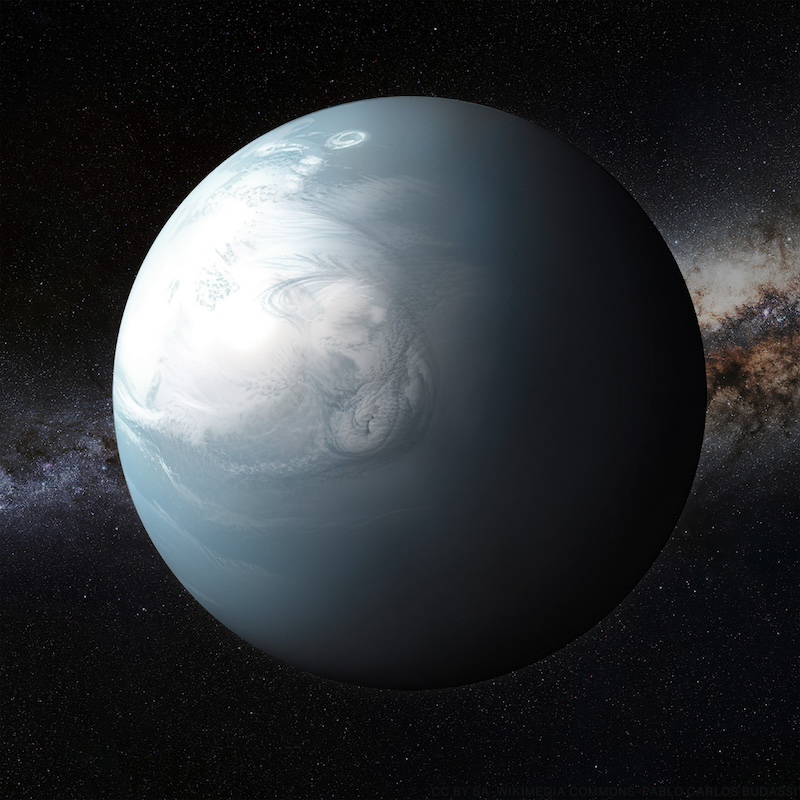
Various possible internal structures
Scientists think sub-Neptunes can have different kinds of internal structures. In the case of TOI-270 d, the two most likely scenarios were either hycean, with a global water ocean beneath the thick hydrogen atmosphere, or a much hotter interior, too hot for liquid water. As the paper explains:
The bulk properties of such planets are consistent with a range of possible internal structures, which can be distinguished through their interactions with the observable atmospheres. JWST observations of TOI-270 d, a temperate sub-Neptune, have previously led to contrasting conclusions: either a Hycean world, possessing a liquid water ocean, or a mixed-envelope sub-Neptune, where high temperatures prevent a liquid ocean and lead to a high mean molecular weight atmosphere.
The Surface and Interior Conditions of Temperate Sub-Neptune TOI-270 dastrobiology.com/2025/11/the-… #astrobiology #astrobiology
— Astrobiology (@astrobiology.bsky.social) 2025-11-27T17:26:39.435Z

A hycean or dark hycean world?
In the new paper, the researchers said the results are consistent with TOI-270 d being a hycean planet. The ocean could either be global or confined to the nightside of the planet (a “dark” hycean planet). TOI-270 d has a permanent dayside and a permanent nightside, because it is tidally locked to its star. That means the same side of the planet always faces the star. The paper says:
The present constraints are consistent with TOI-270 d being a hycean or dark hycean world, with planet-wide or nightside liquid water oceans. However, more observations are required to verify the present findings and robustly constrain the atmospheric conditions and internal structure of TOI-270 d.
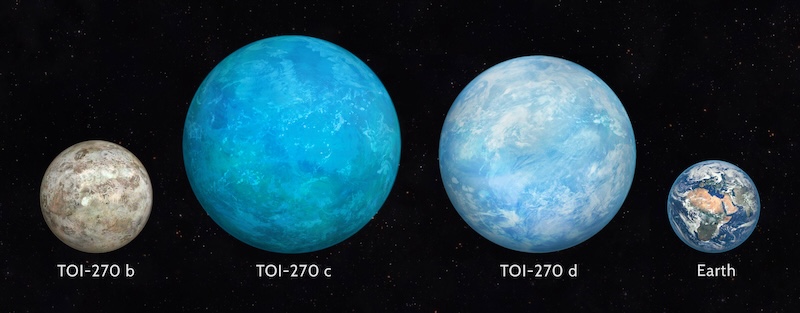
If there is an ocean, it would be rather different from oceans on Earth. It would be hidden beneath the deep hydrogen atmosphere. It would also likely be quite hot, even though the seabed would be high-pressure ice instead of rock.
Dimethyl sulfide on TOI-270 d?
Interestingly, the researchers also note the possible detection of ethane and dimethyl sulfide on TOI-270 d.
We also find tentative evidence for more complex methyl-bearing species such as C2H6 and/or DMS at a 2.1-2.5 sigma level.
In 2023, scientists announced they had also tentatively identified dimethyl sulfide in the atmosphere of K2-18b, an exoplanet 124 light-years away. The news received a lot of attention, because on Earth, the gas is primarily produced by marine life like plankton.
But scientists still heavily debate that detection, as it was very weak. And as of now, they don’t even know if K2-18b – another possible hycean world – has an ocean or not.
Bottom line: Is there an ocean on exoplanet TOI-270 d? A new study said this sub-Neptune exoplanet might be a water world with either a global or nightside ocean.
Source: The atmospheric composition of TOI-270 d
Read more: Possible hycean world found by Webb telescope
Read more: Hycean planets might be habitable ocean worlds
The post There might be an ocean on exoplanet TOI-270 d first appeared on EarthSky.










Related Posts

Stay Informed With the Latest & Most Important News
Previous Post
Next Post


Advertisement
-
 01Two Black Holes Observed Circling Each Other for the First Time
 -
 02From Polymerization-Enabled Folding and Assembly to Chemical Evolution: Key Processes for Emergence of Functional Polymers in the Origin of Life
 -
 03Astronomy 101: From the Sun and Moon to Wormholes and Warp Drive, Key Theories, Discoveries, and Facts about the Universe (The Adams 101 Series)
 -
 04True Anomaly hires former York Space executive as chief operating officer
 -
 05Φsat-2 begins science phase for AI Earth images
 -
 06Hurricane forecasters are losing 3 key satellites ahead of peak storm season − a meteorologist explains why it matters
 -
 07Binary star systems are complex astronomical objects − a new AI approach could pin down their properties quickly