
Now Reading: Time-dependent Chemical Evolution During Cloud Formation: H2-regulated Chemistry In Diffuse Molecular Cloud
-
01
Time-dependent Chemical Evolution During Cloud Formation: H2-regulated Chemistry In Diffuse Molecular Cloud

Time-dependent Chemical Evolution During Cloud Formation: H2-regulated Chemistry In Diffuse Molecular Cloud

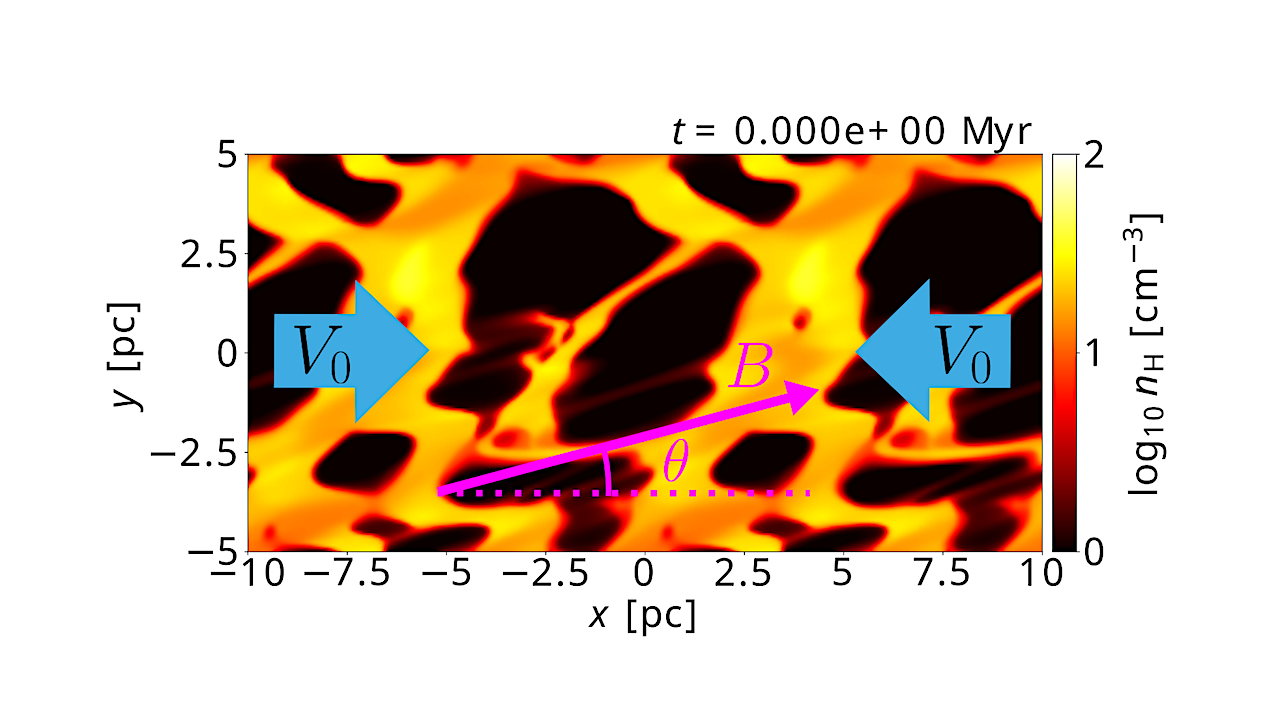

The initial condition of the converging flow simulation. The color shows the number density of hydrogen nuclei on the 𝑧 = 0 plane. — astro-ph.GA
We investigate the chemical evolution of a forming molecular cloud behind an interstellar shock wave. We conduct three-dimensional magnetohydrodynamics simulations of the converging flow of atomic gas, including a simple chemical network and tracer particles that move along the local velocity field. Then we perform detailed chemical network calculations along the trajectory of each tracer particle.
The diffuse part of forming molecular clouds is CO-poor; i.e., H2 and CO abundances do not correlate. In diffuse regions of nH≲103cm−3, we find that the abundances of hydrocarbons and oxygen-bearing molecules are determined by steady-state chemistry reflecting the local H2 abundance, which is determined by the gas density along the trajectory.
In denser regions, the abundances are affected by water ice formation, which changes the elemental abundance of carbon and oxygen (i.e., C/O ratio) in the gas phase. Assuming quasi-steady-state chemistry given the abundances of major molecules (e.g., H2) from the simple network, we derive analytic solutions for molecular abundances, which reproduce the calculation results.
We also calculate the molecular column densities based on the spatial distribution of tracer particles and their molecular abundances, and compare them with observations of diffuse molecular clouds. We find that the column densities of CH, CCH, and OH are linearly correlated with those of H2, which supports the empirical relation used in the observations.
On the other hand, the column density of HCO+ shows non-linear dependence on the H2 column density, reflecting the difference in HCO+ formation paths in CO-poor and CO-rich regions.
Yuto Komichi, Yuri Aikawa, Kazunari Iwasaki, Kenji Furuya
Comments: 25 pages, 20 figures, accepted for publication in MNRAS
Subjects: Astrophysics of Galaxies (astro-ph.GA)
Cite as: arXiv:2601.03441 [astro-ph.GA] (or arXiv:2601.03441v1 [astro-ph.GA] for this version)
https://doi.org/10.48550/arXiv.2601.03441
Focus to learn more
Submission history
From: Yuto Komichi
[v1] Tue, 6 Jan 2026 22:00:59 UTC (7,082 KB)
https://arxiv.org/abs/2601.03441
Astrobiology, Astrochemistry,










Related Posts
Stay Informed With the Latest & Most Important News
Previous Post
Next Post

Advertisement
-
 01Two Black Holes Observed Circling Each Other for the First Time
 -
 02From Polymerization-Enabled Folding and Assembly to Chemical Evolution: Key Processes for Emergence of Functional Polymers in the Origin of Life
 -
 03Astronomy 101: From the Sun and Moon to Wormholes and Warp Drive, Key Theories, Discoveries, and Facts about the Universe (The Adams 101 Series)
 -
 04True Anomaly hires former York Space executive as chief operating officer
 -
 05Φsat-2 begins science phase for AI Earth images
 -
 06Hurricane forecasters are losing 3 key satellites ahead of peak storm season − a meteorologist explains why it matters
 -
 07Binary star systems are complex astronomical objects − a new AI approach could pin down their properties quickly