
Now Reading: Titan’s Strong Tidal Dissipation Precludes A Subsurface Ocean
-
01
Titan’s Strong Tidal Dissipation Precludes A Subsurface Ocean


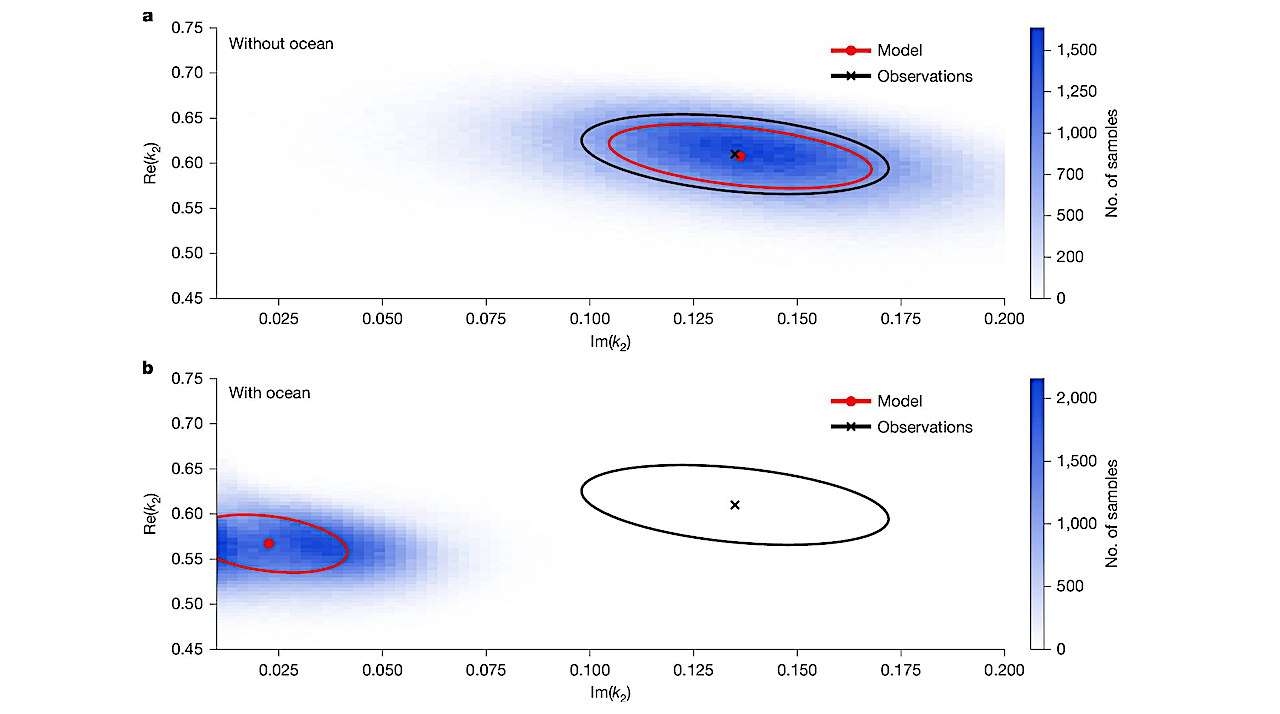
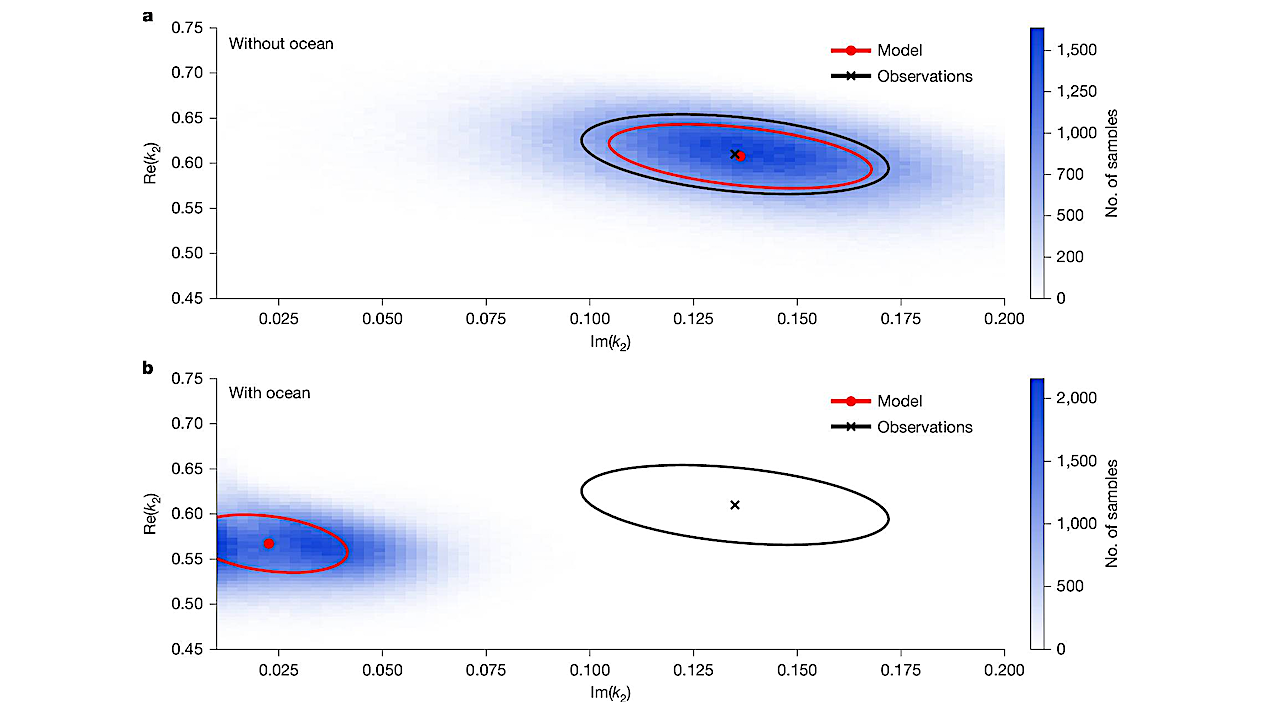
Histograms and uncertainty ellipse (red) for computed Re(k2) and Im(k2) compared with the observed uncertainty ellipse (black) for the interior models of Titan without (a) and with (b) an ocean. The centre and axes of the ellipses are computed from the covariance matrix of the posterior distributions obtained from the interior inversion (1σ level of uncertainty). — Nature via PubMed
The Cassini mission provided unprecedented insights into Saturn’s largest moon, Titan, from its atmosphere to the deep interior.
The moon’s large measured response to the tides exerted by Saturn was interpreted as evidence of the existence of a subsurface ocean. This response, twice the value predicted in pre-Cassini studies, has escaped complete explanation. Here we show that the signature of tidal dissipation in Titan’s gravity field is not consistent with the presence of an ocean.
Our results arise from the detection of this signature through a reanalysis of the radiometric data acquired by Cassini with improved techniques. We found that substantial energy is being dissipated in the interior (approximately 3–4 TW, corresponding to a tidal quality factor Q ≈ 5), consistent with recent studies of Titan’s rotational state.
Because the presence of a liquid layer reduces the tidal dissipation generated below it5, these new measurements preclude the existence of a subsurface ocean on Titan and are explained by a model in which dissipation is concentrated in a high-pressure ice layer close to its melting point. This model also reproduces Titan’s observed rotational state and static gravity field self-consistently, reconciling all available geophysical measurements.
Efficient ice shell convection can prevent widespread melting and ocean formation, but a slushy high-pressure ice layer is consistent with expectations, indicating that it probably hosts liquid water pockets. The forthcoming Dragonfly mission to Titan will provide a further test of whether a subsurface ocean exists.
Titan’s strong tidal dissipation precludes a subsurface ocean, Nature via PubMed (open access)
Astrobiology, Oceanography,











Related Posts

Stay Informed With the Latest & Most Important News
Previous Post
Next Post


Advertisement
-
 01Two Black Holes Observed Circling Each Other for the First Time
 -
 02From Polymerization-Enabled Folding and Assembly to Chemical Evolution: Key Processes for Emergence of Functional Polymers in the Origin of Life
 -
 03Astronomy 101: From the Sun and Moon to Wormholes and Warp Drive, Key Theories, Discoveries, and Facts about the Universe (The Adams 101 Series)
 -
 04True Anomaly hires former York Space executive as chief operating officer
 -
 05Φsat-2 begins science phase for AI Earth images
 -
 06Hurricane forecasters are losing 3 key satellites ahead of peak storm season − a meteorologist explains why it matters
 -
 07Binary star systems are complex astronomical objects − a new AI approach could pin down their properties quickly