
Now Reading: Tracking Arctic freshwater flow from space
-
01
Tracking Arctic freshwater flow from space



23/03/2026
51 views
0 likes
Arctic rivers and runoff from the land pour vast volumes of freshwater into the Arctic Ocean, influencing seawater salinity, sea-ice formation and ocean circulation, thereby playing an important role in regulating Earth’s heat balance.
As northern monitoring networks decline, scientists have turned to satellite data to reconstruct two decades of river discharge and runoff, revealing a striking mosaic of regional change as warming temperatures and shifting precipitation patterns reshape the Arctic’s hydrological system in uneven and unexpected ways.
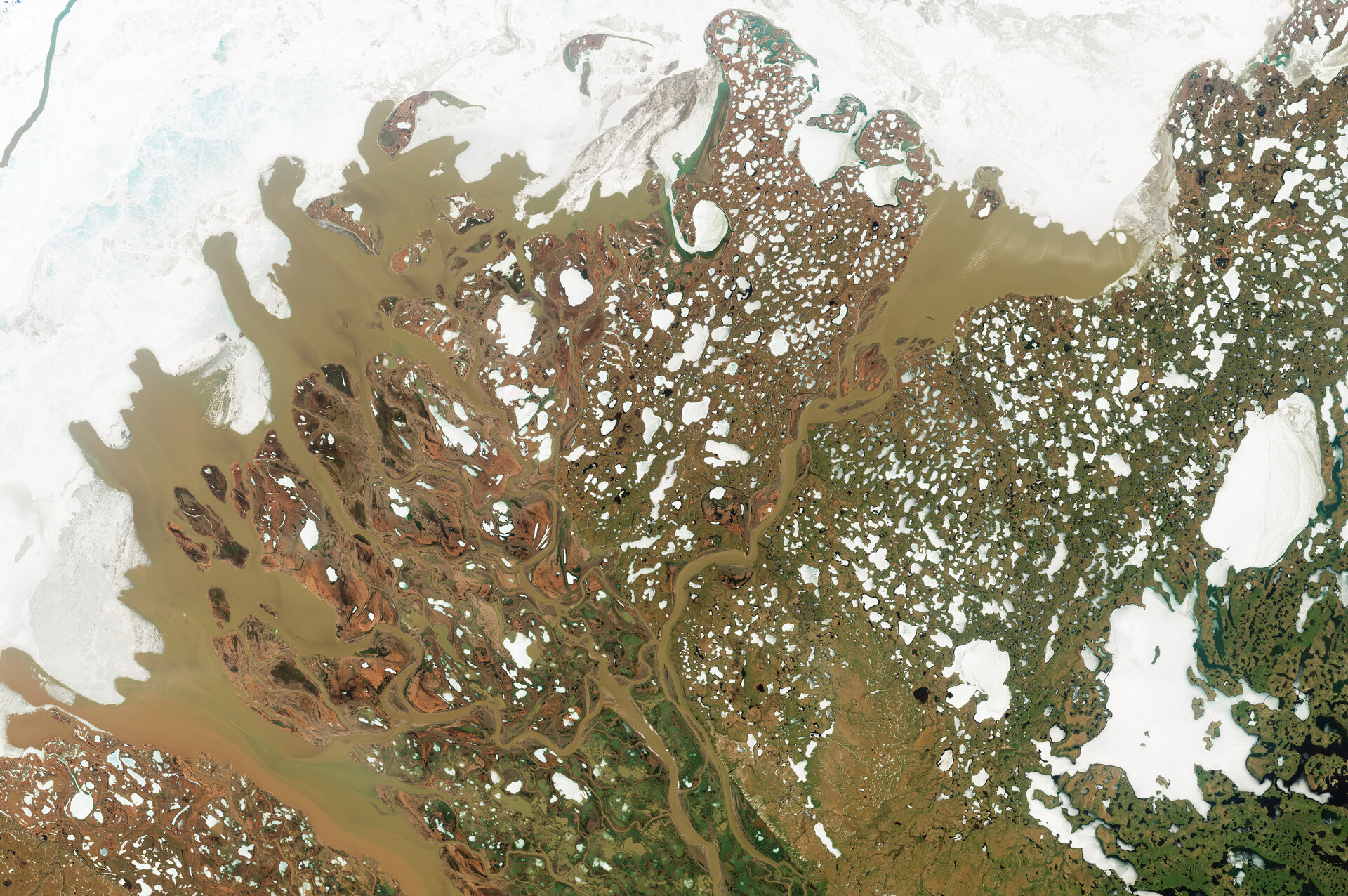
Arctic rivers wind through remote tundra and boreal forests, freezing solid in winter and surging each spring with snowmelt, eventually emptying into the ocean. Runoff – water that does not soak into the ground but instead flows over the land surface – further increases the volume of freshwater entering the sea.
Collectively, these Arctic waters contribute to regulating freshwater delivery to the ocean that influences climate processes extending far beyond the polar region. As well as the effects of climate change, understanding these flows is important for predicting the availability of freshwater for human and wildlife needs.
However, melting snow, thawing permafrost and changing rainfall patterns are transforming these vast freshwater networks that feed the Arctic Ocean. As the Arctic warms far faster than the global average, the urgency to understand these systems is growing.
For decades, river discharge was monitored using gauging stations installed along riverbanks. Yet maintaining instruments across remote Arctic landscapes is costly and logistically challenging, therefore many stations have been discontinued.
As a result, scientists are finding it increasingly difficult to track how Arctic hydrology is responding to rapid climate change. Satellites orbiting above offer an alternative.
Through the European Space Agency’s Earth Observation Science for Society STREAM-NEXT project, researchers have developed a new way to assess river flow and runoff across the Arctic from space.
A paper published recently in the journal Remote Sensing of Environment describes how scientists used satellite observations to estimate river discharge and runoff across the entire Arctic region between 2003 and 2022.
The research team, led by the Italy’s National Research Council’s Research Institute for Geo-Hydrological Protection in collaboration with University of Perugia, integrated water storage data from the NASA–German Aerospace Center GRACE and GRACE Follow-On gravity missions, soil moisture data from ESA’s Climate Change Initiative Soil Moisture project, snow cover data from ESA’s Climate Change Initiative Snow project, and precipitation information from NASA’s IMERG data product in order to calculate how water moves through Arctic river systems.
The approach relies on a hydrological model specifically adapted to Arctic conditions – and, importantly, rather than depending on local instruments, the STREAM model operates entirely on satellite-derived observations.
The model was first calibrated using data from the 15 largest Arctic river basins and then extended to ungauged regions, enabling the creation of a daily pan-Arctic dataset of runoff and river discharge based exclusively on satellite data.
The map above shows monthly runoff in 2003–2022 and indicates the associated 15 river basins.
Using this new data-driven method, the researchers estimate that Arctic rivers deliver roughly 4760 cubic kilometres of freshwater to the Arctic Ocean annually, consistent with gauge-based estimates and thereby increasing confidence in the new approach.
About 80% of this freshwater originates from Eurasian river basins, highlighting the dominant influence of Siberian watersheds on Arctic Ocean conditions.
One of the study’s most important findings is that Arctic hydrological change is not uniform. Between 2003 and 2022, trends in runoff varied widely across regions, as the map shows. Some areas experienced increasing runoff, while others showed declines.
Francesco Leopardi, from the University of Perugia and lead author of the paper, said, “While the expected response of the pan-Arctic region to climate change would suggest an overall increase in runoff, satellite-based estimates reveal a more heterogeneous picture.
“Across the Arctic, freshwater flow is not changing uniformly; instead, the region is exhibiting a patchwork of change. Some areas are becoming wetter, whereas others – such as the Mackenzie River basin – are experiencing declining runoff.
“Overall, these findings challenge the notion of a uniformly ‘wetter’ Arctic, highlighting instead a system undergoing uneven and regionally contrasting change.
The interactive graph shows daily discharge from the Mackenzie River in Canada since 2003 where the light blue line represents the measured river discharge from the gauging station, while the dark blue line indicates the simulation performed using the STREAM model.
This spatial complexity reflects interacting drivers such as rising air temperatures, shifting precipitation patterns, snow and glacier changes and evolving permafrost conditions.
Such varying responses are consistent with broader research showing that Arctic river systems respond differently depending on regional climate and landscape characteristics. In other words, the Arctic in general is not simply becoming wetter or drier – its water cycle is reorganising.
Moreover, this new research highlights a broader transformation underway in Earth observation. Satellites are increasingly acting as core environmental monitoring systems rather than supplementary tools.
In particular, ESA’s upcoming Next Generation Gravity Mission (NGGM) will provide frequent, high-precision gravity measurements, delivering unprecedented insight into mass distribution and transport within the Earth system, including water movement. By mapping Earth’s gravity field repeatedly over time, scientists can identify where water and ice are stored and, crucially, how these reservoirs change.
Although using gravity to measure water storage – in rivers, lakes, groundwater and ice – may seem counterintuitive, small temporal variations in Earth’s gravitational field reflect shifts in mass caused by changing water and ice volumes.
NGGM will form one satellite pair within the joint ESA–NASA MAGIC constellation, alongside a second pair from NASA–DLR’s GRACE-C mission.
Remote sensing already underpins global measurements of ice loss, vegetation change and sea-level rise. In polar regions, where field measurements are difficult and expensive, satellite-based hydrology is the only practical way to maintain continuous observations over decades.










Related Posts
Stay Informed With the Latest & Most Important News
Previous Post
Next Post

Advertisement
-
 01Two Black Holes Observed Circling Each Other for the First Time
 -
 02From Polymerization-Enabled Folding and Assembly to Chemical Evolution: Key Processes for Emergence of Functional Polymers in the Origin of Life
 -
 03Astronomy 101: From the Sun and Moon to Wormholes and Warp Drive, Key Theories, Discoveries, and Facts about the Universe (The Adams 101 Series)
 -
 04True Anomaly hires former York Space executive as chief operating officer
 -
 05Φsat-2 begins science phase for AI Earth images
 -
 06Hurricane forecasters are losing 3 key satellites ahead of peak storm season − a meteorologist explains why it matters
 -
 07Binary star systems are complex astronomical objects − a new AI approach could pin down their properties quickly