
Now Reading: Transformational Astrophysics And Exoplanet Science With Habitable Worlds Observatory’s High Resolution Imager
-
01
Transformational Astrophysics And Exoplanet Science With Habitable Worlds Observatory’s High Resolution Imager

Transformational Astrophysics And Exoplanet Science With Habitable Worlds Observatory’s High Resolution Imager

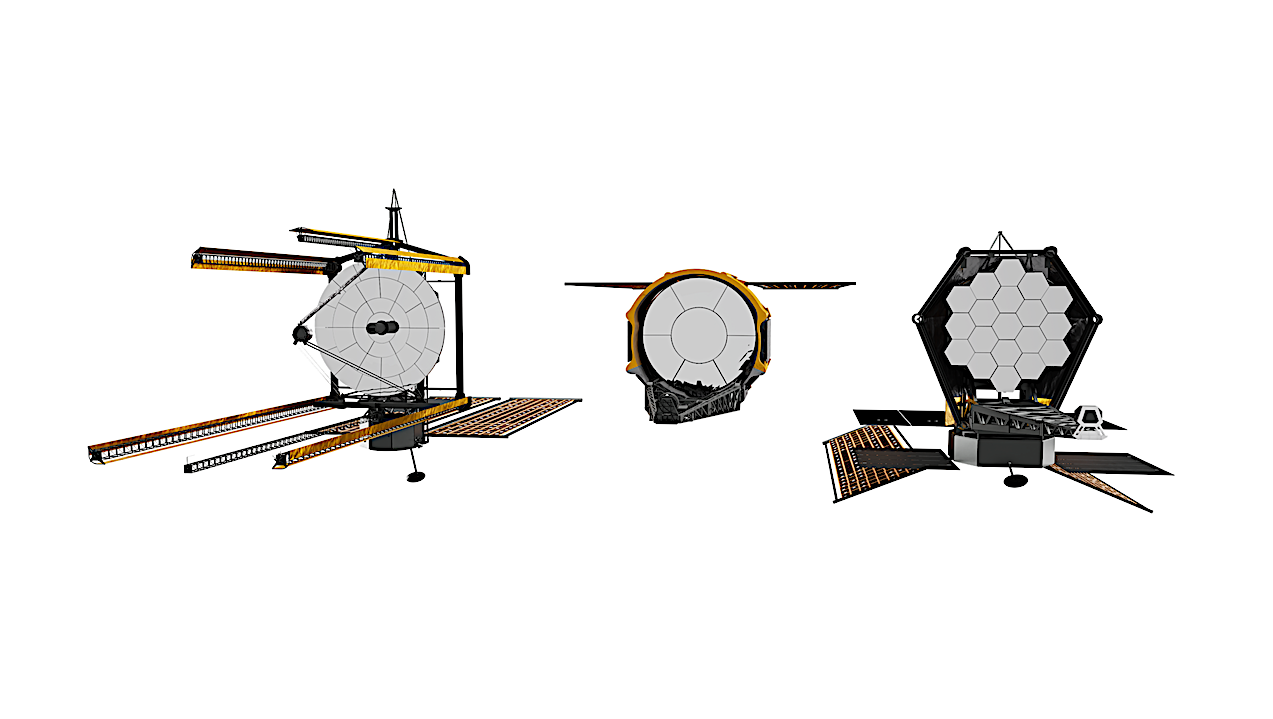

Three illustrations of what HWO may look like. From right to left, these are Engineering Architecture Concepts (EACs) 1, 2, and 3. Baffles to protect the mirror and reduce stray light are present in all designs, but are not shown for the sake of clarity. EAC-1 is a 6m, segmented, off-axis telescope. EAC-2 is the same but uses a round keystone mirror and surrounding segments. EAC-3 is an 8m on-axis telescope with round segments. Image from NASA Goddard/Conceptual Image Labs.
Habitable Worlds Observatory (HWO) will be NASA’s flagship space telescope of the 2040s, designed to search for life on other planets and to transform broad areas of astrophysics.
NASA are seeking international partners, and the UK is well-placed to lead the design and construction of its imaging camera – which is likely to produce the mission’s most visible public impact.
Early participation in the mission would return investment to UK industry, and bring generational leadership for the UK in space science, space technology, and astrophysics.
Vincent Van Eylen, Richard Massey, Saeeda Awan, Jo Bartlett, Louisa Bradley, Andrei Bubutanu, Kan Chen, Andrew Coates, Mark Cropper, Ross Dobson, Fabiola Antonietta Gerosa, Emery Grahill-Bland, Leah Grant, Daisuke Kawata, Tom Kennedy, Minjae Kim, Adriana Adelina Mihailescu, Jan-Peter Muller, Georgios Nicolaou, Mathew Page, Paola Pinilla, Louisa Preston, Ted Pyne, Hamish Reid, Santiago Velez Salazar, Jason L. Sanders, Giorgio Savini, Ralph Schoenrich, George Seabroke, Alan Smith, Philip J. Smith, Nicolas Tessore, Marina Ventikos, Esa Vilenius, Francesca Waines, Silvia Zane, James Betts, Sownak Bose, Cyril Borgsom, Shaun Cole, Jessica E. Doppel, Vincent Eke, Carlos Frenk, Leo W. H. Fung, Qiuhan He, Mathilde Jauzac, Owen Jessop, Zane Deon Lentz, Gavin Leroy, Simon Morris, Yuan Ren, Jurgen Schmoll, Ray Sharples, Fionagh Thomson, Maximilian von Wietersheim-Kramsta, Kai Wang, Stephane V. Werner, Subhajit Sarkar, Jacob Kegerreis, James Kirk, Subhanjoy Mohanty, John Southworth, John Philip Stott, Ashley King, James W. Nightingale, David Rosario, Paola Tiranti, Edward Gillen, Cynthia S. K. Ho, Christopher Watson, Andrzej Fludra, Chris Pearson, Yun-Hang Cho, Yu Tao, Joanna Barstow, James Bowen, Chris Castelli, Chiaki Crews, Angaraj Duara, Mark Fox-Powell, David Hall, Carole Haswell, Kit-Hung Mark Lee, Joan Requena, Anabel Romero, Jesper Skottfelt, Konstantin Stefanov, Olivia Jones, Sean McGee, Annelies Mortier, Graham P. Smith, Amalie Stokholm, Amaury Triaud, Becky Alexis-Martin, Malcolm Bremer, Katy L. Chubb, Joshua Ford, Ben Maughan, Daniel Valentine, Hannah Wakeford et al. (71 additional authors not shown)
Comments: White paper submitted to the UK Space Agency’s initiative “UK Space Frontiers 2035” this https URL
Subjects: Instrumentation and Methods for Astrophysics (astro-ph.IM); Earth and Planetary Astrophysics (astro-ph.EP); Astrophysics of Galaxies (astro-ph.GA)
Cite as: arXiv:2512.16416 [astro-ph.IM] (or arXiv:2512.16416v1 [astro-ph.IM] for this version)
https://doi.org/10.48550/arXiv.2512.16416
Focus to learn more
Submission history
From: Richard Massey
[v1] Thu, 18 Dec 2025 11:14:02 UTC (1,852 KB)
https://arxiv.org/abs/2512.16416
Astrobiology, exoplanet,










Related Posts
Stay Informed With the Latest & Most Important News
Previous Post
Next Post

Advertisement
-
 01Two Black Holes Observed Circling Each Other for the First Time
 -
 02From Polymerization-Enabled Folding and Assembly to Chemical Evolution: Key Processes for Emergence of Functional Polymers in the Origin of Life
 -
 03Astronomy 101: From the Sun and Moon to Wormholes and Warp Drive, Key Theories, Discoveries, and Facts about the Universe (The Adams 101 Series)
 -
 04True Anomaly hires former York Space executive as chief operating officer
 -
 05Φsat-2 begins science phase for AI Earth images
 -
 06Hurricane forecasters are losing 3 key satellites ahead of peak storm season − a meteorologist explains why it matters
 -
 07Binary star systems are complex astronomical objects − a new AI approach could pin down their properties quickly