
Now Reading: TrustPoint sets 2027 target for initial rollout of LEO-based navigation services
-
01
TrustPoint sets 2027 target for initial rollout of LEO-based navigation services


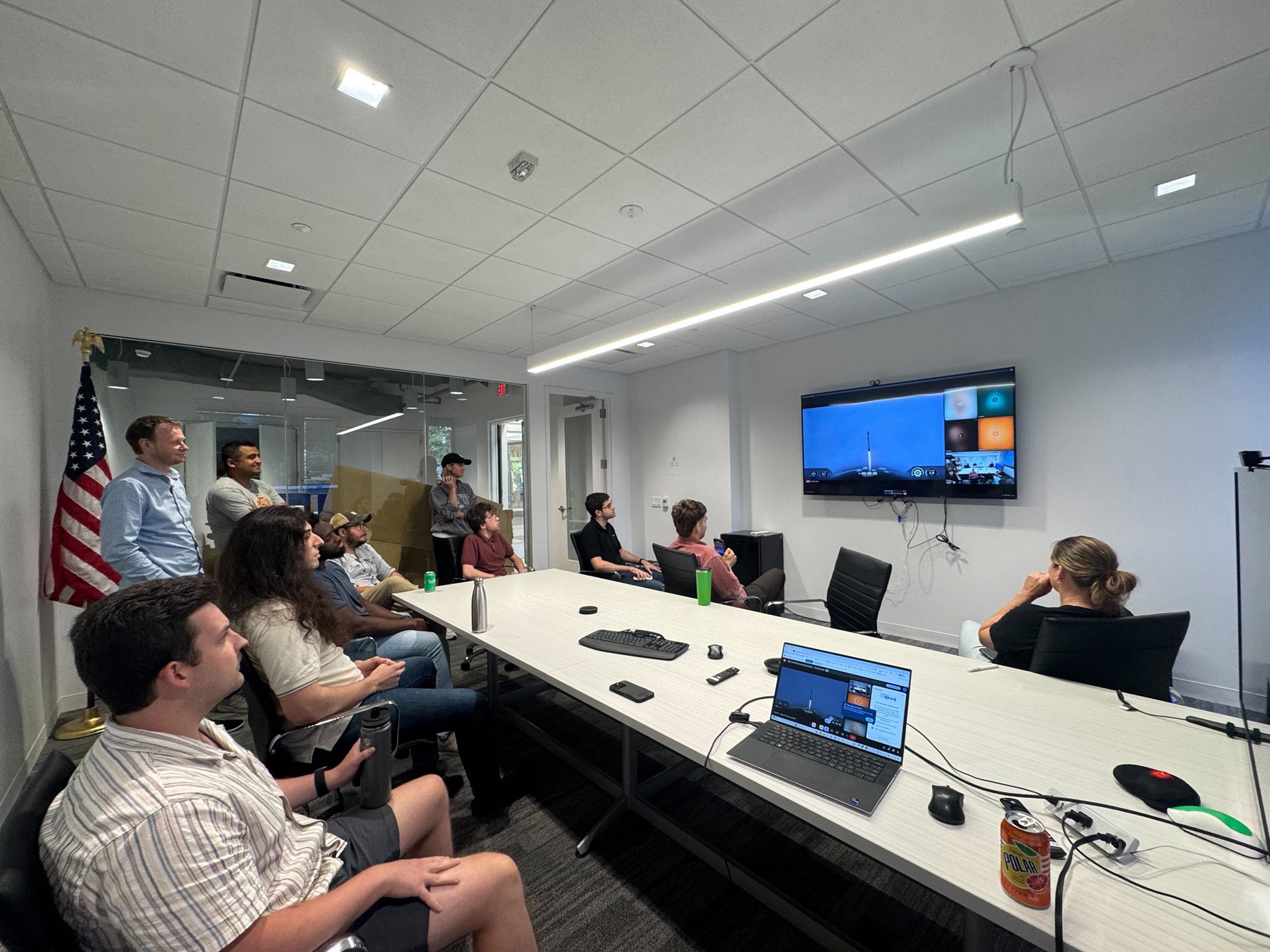

WASHINGTON — TrustPoint, a five-year-old startup building a low-Earth-orbit navigation network as an alternative or complement to GPS, says it is on track to soft launch C-band PNT services in 2027. The schedule depends on continued on-orbit demonstrations and receiver integration over the next two years, but the company says early tests and government interest are strong enough to support the target.
CEO and co-founder Patrick Shannon told SpaceNews that TrustPoint expects to draw on both military and commercial funding to accelerate deployment of a constellation that could eventually reach 300 satellites. The company bills itself as a complementary PNT provider to global navigation satellite systems such as GPS and Galileo, with differentiation rooted in its business model, orbital architecture and signal design.
Shannon said TrustPoint’s early development has been financed through private seed investments and government SpaceWERX contracts to validate ground infrastructure and its encrypted C-band payload. Those efforts have supported tests now underway using three satellites in orbit. Even at this stage, he said, the company is getting a “strong demand signal from the U.S. government.”
Defense agencies in the United States and abroad are looking for alternatives as jamming incidents continue to expose weaknesses in legacy GPS signals, particularly in Eastern Europe and the Middle East, Shannon said. He described TrustPoint’s approach as “throwing out the rule book” in order to meet modern security and performance needs.
A central choice is to broadcast navigation signals solely in C-band, which runs roughly from 4 to 8 GHz, a higher frequency than L-band’s range of 1 to 2 GHz, a spectrum traditionally used by GPS and other GNSS operators. C-band signals can carry more data but demand more precise antennas.
From a security perspective, Shannon said adversaries are well-versed in jamming and spoofing L-band signals. Operating in C-band could complicate hostile efforts tuned to legacy frequencies.
Goal to build 300 satellites
TrustPoint, based in Herndon, Virginia, builds its payloads in-house and plans to announce a U.S. manufacturing partner for its cubesat-class satellites. Shannon estimates the full system will reach about 300 spacecraft, although “you can do quite a bit with as few as 60 or 80.”
A service reliable enough for military use could be available in 2027, he said, with a complete buildout by 2029. The full constellation would be needed for the most challenging applications, including street-level urban environments.
By 2027, “we will have enough satellites on orbit to provide some augmentation capability,” Shannon said. As more satellites come online, customers would gain access to receivers built by a network of partners designing hardware for the TrustPoint signal.
“We expect there to be two sources of capital to build out the system,” said Shannon. “The first source is private money. I think it’s safe to say commercial companies, backed by private capital, have shown to be very potent in the defense space for their speed and how effective they are at innovating in today’s environment.” That will be paired with “some substantial government support,” he said.
While the U.S. military is central, “there’s interest globally,” he added. Governments across “top tier allies” are evaluating funding paths and technical requirements aligned with U.S. concerns about PNT resilience.
“We’ve seen advanced Western weapons fail in Eastern Ukraine because of GPS denial. And everyone’s looking for a solution around those problems,” Shannon said.
Competitive PNT market
A direct competitor to TrustPoint is Xona Space Systems, which is developing a LEO-based PNT constellation called Pulsar. The company launched a demonstration satellite called Huggin in 2022 and its first production-class spacecraft in June 2025. Xona recently said it has shifted its primary focus to L-band signals and tabled its C-band plans for the time being. The decision was driven by practical engineering challenges and market compatibility considerations.
In a blog post, the company said it “learned with Huginn that the C-band signals proved much more challenging for manufacturers to integrate into existing user equipment than we anticipated” and that the signals “were also shown to offer fewer benefits to jamming resistance than initially expected.”
Another emerging player, oneNav, is pursuing a next-generation GNSS receiver built around modern L5-band signals. Speaking in October at the MilSat conference in California, oneNav co-founder and CEO Stephen Poizner described Xona and TrustPoint as “really interesting startups” working to build “a system that’s equivalent to GPS, effectively, but just with LEOs.”
Lower orbits, he said, bring stronger signals and better in-building penetration, with the caveat that “it’s going to require a lot of capital.”
Shannon insists that C-band is the right bet. “I think we need to move away from L-band, use more C-band or other frequencies as needed,” he said, noting that some European and Asian firms are exploring similar approaches. Customer feedback supports the strategy, he said. “We get a lot of traction because we’re not in L-bands.”
TrustPoint is also designing a GPS-independent ground architecture, with up to 100 stations providing contact with LEO satellites. Under SpaceWERX contracts, the company is developing a ground control network that does not rely on GPS for timing or orbit determination. Ground transceivers will both monitor the space segment and send ranging signals to satellites, creating a navigation system for LEO constellations.
The company sees potential demand from companies developing space-based interceptor prototypes for the Pentagon’s Golden Dome missile-defense program. “Space-based interceptors need to know what time it is, and they need to navigate,” Shannon said, noting that TrustPoint’s ground architecture could be adapted for interceptor constellations.
He added that interest spans both ground-to-space and space-to-ground navigation. Operators facing interference over conflict zones have approached the company because “terrestrial jamming sources affect LEO satellites.” Shannon said commercial satellite operators with assets over the Middle East and Eastern Ukraine have reported GPS disruption degrading spacecraft performance. “They’re aware that we’re building our network, and they’ve shown interest in tapping into that network.”










Related Posts


Stay Informed With the Latest & Most Important News



Advertisement
-
 01Two Black Holes Observed Circling Each Other for the First Time
 -
 02From Polymerization-Enabled Folding and Assembly to Chemical Evolution: Key Processes for Emergence of Functional Polymers in the Origin of Life
 -
 03Astronomy 101: From the Sun and Moon to Wormholes and Warp Drive, Key Theories, Discoveries, and Facts about the Universe (The Adams 101 Series)
 -
 04True Anomaly hires former York Space executive as chief operating officer
 -
 05Φsat-2 begins science phase for AI Earth images
 -
 06Hurricane forecasters are losing 3 key satellites ahead of peak storm season − a meteorologist explains why it matters
 -
 07Binary star systems are complex astronomical objects − a new AI approach could pin down their properties quickly