
Now Reading: Two Temperate Earth- and Neptune-sized Planets Orbiting Fully Convective M dwarfs
-
01
Two Temperate Earth- and Neptune-sized Planets Orbiting Fully Convective M dwarfs


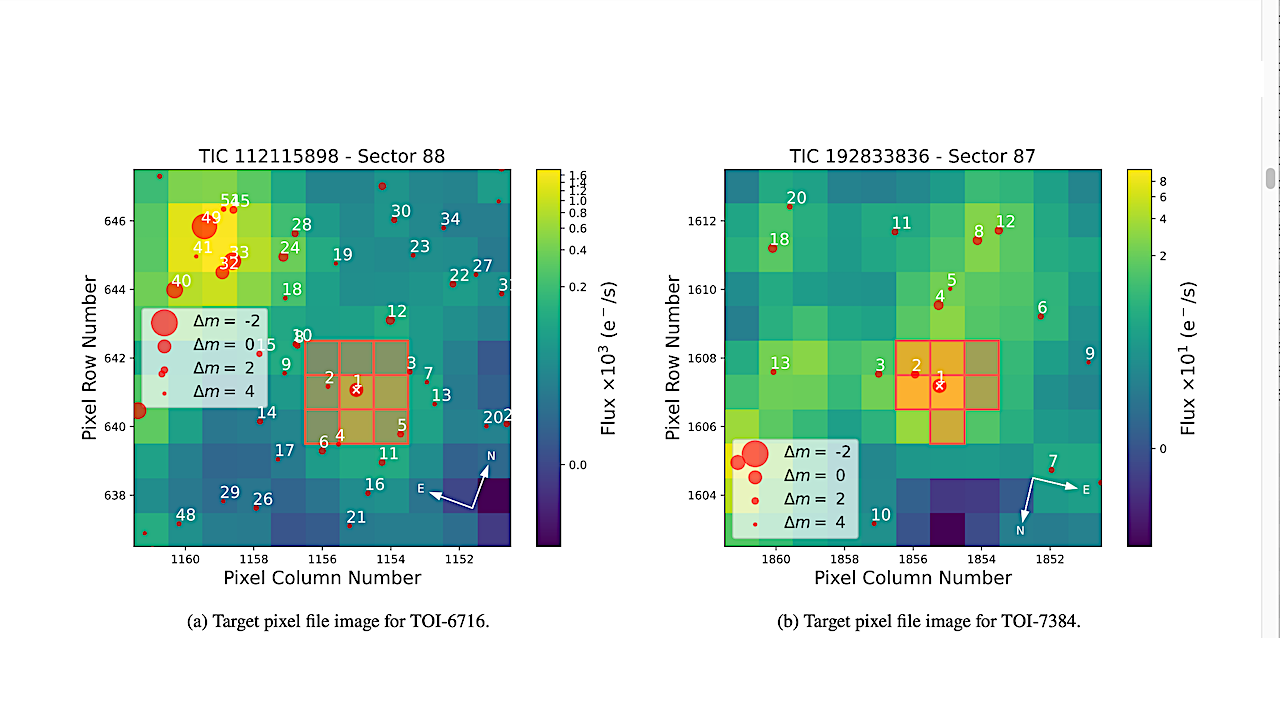

TESS target pixel file image created with tpfplotter for TOI-6716 (left) and TOI-7384 (right) observed in Sector 88 (2025 Jan 14 – 2025 Feb 11) and Sector 87 (2024 Dec 18 – 2025 Jan 14) respectively. The target stars are indicated by a white cross, and the TESS aperture is represented by the red hatch. Red dots highlight GAIA-DR3 sources with varying sizes corresponding to their magnitude relative to the respective target stars. — astro-ph.EP
As the diversity of exoplanets continues to grow, it is important to revisit assumptions about habitability and classical HZ definitions. In this work, we introduce an expanded ‘temperate’ zone, defined by instellation fluxes between 0.1<S/S⊕<5, thus encompassing a broader range of potentially habitable worlds.
We also introduce the TEMPOS survey, which aims to produce a catalogue of precise radii for temperate planets orbiting M dwarfs with Teff≤3400 K. This work reports the discovery and characterisation of two planets in this temperate regime orbiting mid-type M dwarfs: TOI-6716 b, a 0.98±0.07R⊕ planet orbiting its M4 host star (R⋆=0.231±0.015R⊙, M⋆=0.223±0.011M⊙, Teff=3110±80K) with a period P=4.7185898+0.0000054−0.0000041d, and TOI-7384 b, a 3.56±0.21R⊕ planet orbiting an M4 (R⋆=0.319±0.018R⊙, M⋆=0.318±0.016M⊙, Teff=3185±75K) star every P=6.2340258+0.0000034−0.0000036d.
The radii of TOI-6716 b and TOI-7384 b have precisions of 6.8% and 5.9% respectively. We validate these planets with multi-band ground-based photometric observations, high-resolution imaging and statistical analyses. We find these planets to have instellation fluxes close to the inner (hotter) edge of the temperate zone, with 4.4±1.1S⊕ and 4.9±1.1S⊕ for TOI-6716 b and TOI-7384 b respectively.
Also, with a predicted TSM similar to the TRAPPIST-1 planets, TOI-6716 b is likely to be a good rocky-world JWST target, should it have retained its atmosphere.

Stellar mass vs instellation flux for transiting planets with 0.4 < 𝑅𝑝 < 4 R⊕ and 𝑀𝑝 < 500 M⊕ obtained from the Composite NASA exoplanet archive (grey points). Instellation flux recalculated for all planets for consistency. Approximate spectral types are indicated by the shaded background and highlighted labels. Planets for which SPECULOOS observations contributed to the validation/confirmation are highlighted with blue circles. TOI-6716 b and TOI-7384 b are depicted by red diamonds, and sit at the inner (hotter) edge of the temperate regime (shown by the green box). — astro-ph.EP
Madison G. Scott, Georgina Dransfield, Mathilde Timmermans, Amaury H.M.J. Triaud, Benjamin V. Rackham, Khalid Barkaoui, Adam J. Burgasser, Karen A. Collins, Michaël Gillon, Steve B. Howell, Alan M. Levine, Francisco J. Pozuelos, Keivan G. Stassun, Carl Ziegler, Yilen Gomez Maqueo Chew, Catherine A. Clark, Yasmin Davis, Fatemeh Davoudi, Tansu Daylan, Brice-Olivier Demory, Dax Feliz, Akihiko Fukui, Maximilian N. Günther, Emmanuël Jehin, Florian Lienhard, Andrew W. Mann, Clàudia Janó Muñoz, Norio Narita, Peter P. Pedersen, Richard P. Schwarz, Avi Shporer, Abderahmane Soubkiou, Sebastián Zúñiga-Fernández
Comments: 22 pages, 15 figures, accepted for publication in MNRAS
Subjects: Earth and Planetary Astrophysics (astro-ph.EP)
Cite as: arXiv:2601.05799 [astro-ph.EP] (or arXiv:2601.05799v1 [astro-ph.EP] for this version)
https://doi.org/10.48550/arXiv.2601.05799
Focus to learn more
Submission history
From: Madison Scott
[v1] Fri, 9 Jan 2026 13:57:46 UTC (8,097 KB)
https://arxiv.org/abs/2601.05799
Astrobiology, exoplanet,










Related Posts
Stay Informed With the Latest & Most Important News

Advertisement
-
 01Two Black Holes Observed Circling Each Other for the First Time
 -
 02From Polymerization-Enabled Folding and Assembly to Chemical Evolution: Key Processes for Emergence of Functional Polymers in the Origin of Life
 -
 03Astronomy 101: From the Sun and Moon to Wormholes and Warp Drive, Key Theories, Discoveries, and Facts about the Universe (The Adams 101 Series)
 -
 04True Anomaly hires former York Space executive as chief operating officer
 -
 05Φsat-2 begins science phase for AI Earth images
 -
 06Hurricane forecasters are losing 3 key satellites ahead of peak storm season − a meteorologist explains why it matters
 -
 07Binary star systems are complex astronomical objects − a new AI approach could pin down their properties quickly