
Now Reading: UFO Credibility Crisis Emerges in Del Rio Incident
-
01
UFO Credibility Crisis Emerges in Del Rio Incident


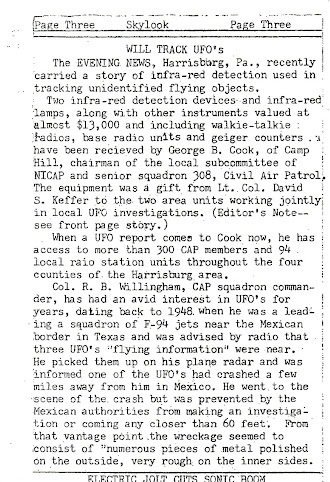

The story of the Del Rio UFO incident hinges significantly on the figure of Robert Willingham, a man whose vibrant claims about his military background and experiences have come under intense scrutiny. Initially presenting himself as a credible source, Willingham purported to have been involved in multiple UFO encounters and crashes, including the infamous Del Rio event. However, a deeper examination into his credentials reveals a pattern of embellishment and outright fabrication.
Willingham claimed to be a lieutenant colonel in the Air Force and a fighter pilot who served in Korea, but investigations into his military record suggest a different narrative. As it turns out, his status as a lieutenant colonel was derived from his role in the Civil Air Patrol, a volunteer organization that, while valuable, does not equate to the authority and experience of an actual Air Force officer. In fact, his military record, once analyzed, shows a severe lack of the accolades and combat experience he touted. Some might see this as a minor issue; however, when discussing national security and UFO incidents, accuracy in a witness’s background is paramount.
Willingham’s account, first introduced in 1968, claims he witnessed the aftermath of a UFO crash and even cited multiple incidents involving extraterrestrial crafts, raising eyebrows and igniting interest in the UFO community. Yet, subsequent inquiries into his narrative yield a troubling inconsistency: the timelines he provides for the Del Rio incident have shifted over the years, with Willingham himself unable to firmly articulate whether the event took place in 1954 or 1955. This lack of consistency raises fundamental questions about the reliability of his testimony.
Furthermore, despite the extensive investigation into the Del Rio incident, no additional witnesses have emerged to corroborate Willingham’s claims. This absence of supporting testimonies lends weight to the argument that the crash narrative may have been largely constructed by Willingham himself. In the sphere of extraordinary claims, the burden of proof lies with the claimant—in this case, Willingham, whose fabrications appear to overshadow any tangible evidence he could provide.
For those interested in the mechanics of eyewitness testimony, it’s essential to recognize how memory can be influenced by various factors, including personal biases and cultural contexts. In UFO lore, the allure of the unknown often leads individuals to embellish their stories or even create them from scratch. This calls attention to the critical importance of verifying sources and scrutinizing the credentials of those who present themselves as experts or witnesses. The Del Rio incident serves as a poignant reminder of the need for meticulous research and a healthy skepticism in the pursuit of truth, especially when the subject matter challenges our understanding of reality.
The case surrounding Robert Willingham offers a cautionary tale about the pitfalls of uncritical acceptance of sensational stories. The UFO community must remain vigilant against the charm of captivating narratives that lack robust, independent verification. As we continue to explore the cosmos and our understanding of unidentified phenomena, it’s imperative that we ground our explorations in verifiable facts rather than the word of individuals with dubious credentials.
The challenge of substantiating claims regarding UFO crashes often leads to a complex interplay between classified information and public perception. Dr. Eric Davis’s assertions about the Del Rio incident draw upon a foundation of classified evidence, which raises a critical question: how do we discern fact from speculation in a realm that thrives on secrecy? Proponents of the UFO phenomenon argue that certain truths remain concealed, shielded by national security protocols, which inherently complicates the quest for transparency.
National security classifications exist to protect sensitive information but can inadvertently obscure the truth. The existence of classified programs implies that there may indeed be verifiable evidence of extraterrestrial encounters, yet this evidence often remains locked away, inaccessible to researchers and the public alike. As Dr. Davis and others like him contend, the absence of publicly available proof does not equate to the nonexistence of evidence. This perspective, while plausible, creates a chasm between those privy to secret evidence and the public, which fuels skepticism and conspiracy theories.
To illustrate this complex relationship, we might consider the historical context surrounding other notable UFO claims. Events such as the Roswell incident or the Phoenix Lights phenomenon showcase how witness testimonies and classified information can create a tumultuous landscape of interpretation. In the case of Roswell, initial reports of a “crash” were swiftly revised to a “weather balloon,” leading to decades of speculation about what really occurred. The secrecy surrounding military operations often yields a fertile ground for conspiracy, with individuals like Willingham capitalizing on this ambiguity to fabricate narratives that gain traction despite their dubious origins.
Moreover, the reliance on classified evidence also poses a philosophical dilemma. If we accept that some information about UFOs is classified, how do we establish the criteria for what constitutes credible testimony? For every witness like Dr. Davis who claims to have been informed of classified details, a high number of others are left adrift in a sea of misinformation. This serves as a reminder that extraordinary claims require extraordinary evidence—and that such evidence must be scrutinized rigorously. The burden of proof should not only reside with the witnesses but also extend to those who assert that secrets exist without ever presenting tangible proof to the public.
In the pursuit of truth within the UFO community, the importance of transparency cannot be overstated. Researchers and enthusiasts alike must demand clarity from those who claim to possess insider knowledge. By fostering a culture of accountability and evidence-based inquiry, we can begin to dismantle the layers of ambiguity that cloud the discussion surrounding incidents like the Del Rio crash. The scientific method, rooted in observation, hypothesis, experimentation, and repeatability, should be our guiding star. As we navigate through the fog of speculation and classified information, the principles of rigorous research will help us separate legitimate claims from those that are mere fabrications born from a desire for notoriety.
This intersection of classified evidence and UFO claims invites a broader dialogue about the ethics of disclosure. What obligations do governments have to the public regarding potentially groundbreaking discoveries? The debate extends beyond mere curiosity about extraterrestrial life; it also encompasses governmental transparency, the integrity of scientific inquiry, and the need for public trust in institutions that govern sensitive information. The Del Rio incident serves as a microcosm of this larger struggle, highlighting the necessity for open discourse and verification in the field of ufology.










Related Posts

Stay Informed With the Latest & Most Important News
Previous Post
Next Post


Advertisement
-
 01Two Black Holes Observed Circling Each Other for the First Time
 -
 02From Polymerization-Enabled Folding and Assembly to Chemical Evolution: Key Processes for Emergence of Functional Polymers in the Origin of Life
 -
 03Astronomy 101: From the Sun and Moon to Wormholes and Warp Drive, Key Theories, Discoveries, and Facts about the Universe (The Adams 101 Series)
 -
 04True Anomaly hires former York Space executive as chief operating officer
 -
 05Φsat-2 begins science phase for AI Earth images
 -
 06Hurricane forecasters are losing 3 key satellites ahead of peak storm season − a meteorologist explains why it matters
 -
 07Binary star systems are complex astronomical objects − a new AI approach could pin down their properties quickly