
Now Reading: ULA’s Vulcan launches U.S. Space Force mission to geosynchronous orbit
-
01
ULA’s Vulcan launches U.S. Space Force mission to geosynchronous orbit


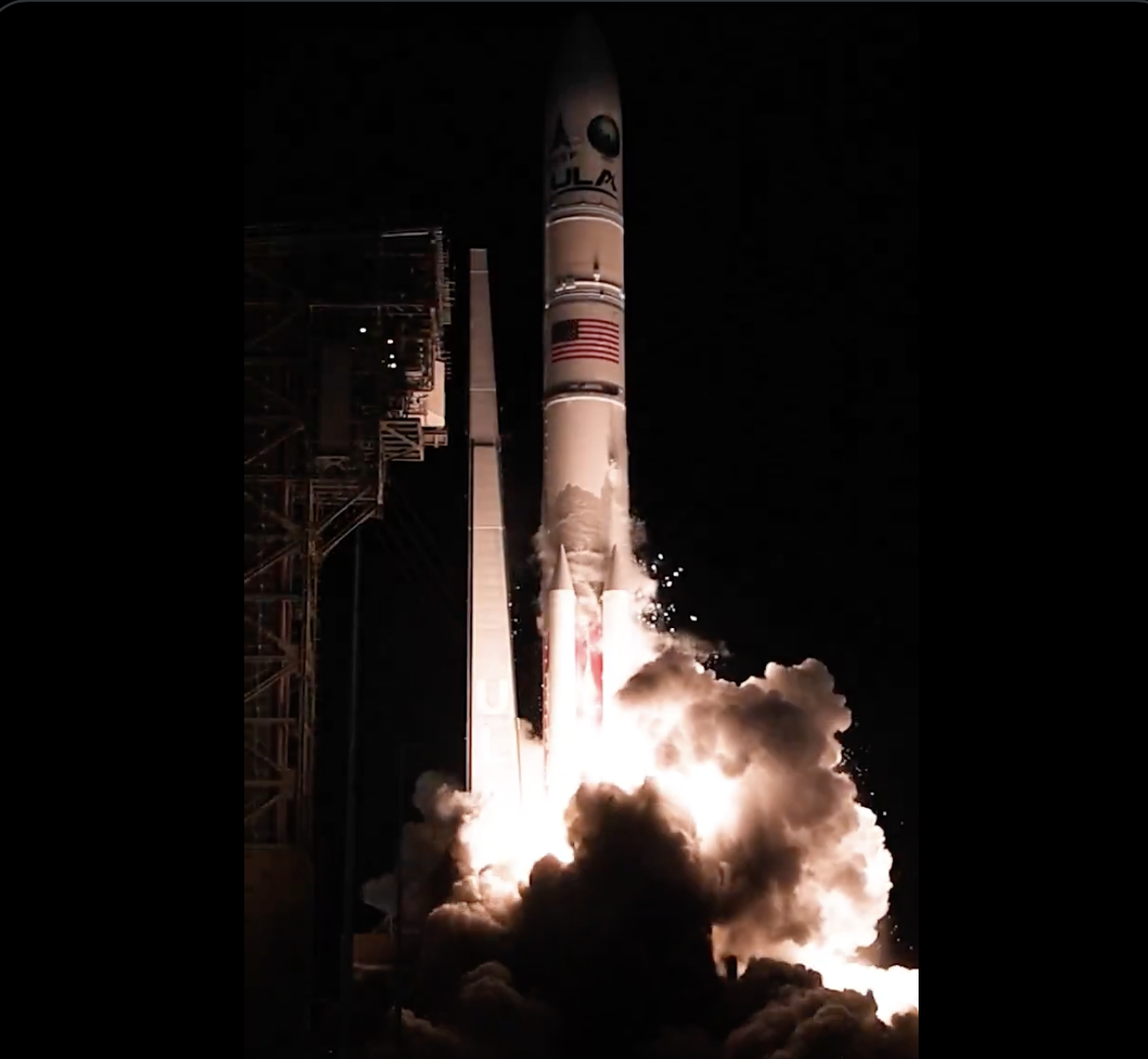

WASHINGTON — A United Launch Alliance Vulcan Centaur rocket lifted off early Feb. 12 on a multi-manifest national security mission, sending payloads directly to geosynchronous orbit more than 22,000 miles above Earth.
The rocket launched from Space Launch Complex 41 at Cape Canaveral Space Force Station at 4:22 a.m. Eastern, roughly an hour into a two-hour window.
Vulcan flew in a high-performance configuration with four strap-on solid rocket boosters, which burned for about 90 seconds before separating from the core stage. ULA ended its live broadcast after first-stage separation. The company said it would take about 10 hours for the Centaur upper stage to reach geosynchronous Earth orbit and deploy all payloads.
Shortly after liftoff some observers on social media noted what appeared to be an irregular plume or burn pattern from one of the solid rocket boosters during ascent, reminiscent of the anomaly seen on Vulcan’s second flight.
ULA confirmed it “had an observation early during flight on one of the four solid rocket motors, the team is currently reviewing the data. The booster, upper stage and spacecraft continued to perform on a nominal trajectory.”
The U.S. Space Force mission, designated USSF-87, marked Vulcan’s fourth flight overall and its second under the National Security Space Launch program.
GSSAP payload
The primary payload is the Geosynchronous Space Situational Awareness Program, or GSSAP, a constellation the Space Force relies on to monitor activity in geosynchronous orbit, known as GEO.
Built by Northrop Grumman, the maneuverable satellites carry optical sensors designed to track and characterize objects in and around GEO. The system provides insight into on-orbit activity near U.S. and allied spacecraft.
GSSAP satellites have previously launched in pairs. Space Force officials have said this mission would carry two GSSAP spacecraft, though the Space Systems Command confirmed only that the payload is a GSSAP system.
Secondary propulsive ESPA ring
USSF-87 also carries a secondary payload: a propulsive ESPA ring hosting additional spacecraft for the Space Force.
The propulsive ESPA-ring is a powered version of the standard EELV Secondary Payload Adapter, a ring-shaped structure originally developed to carry secondary payloads on military launches. Unlike a passive adapter, the propulsive version includes its own power and maneuvering capability.
On USSF-87, the ring carries research, development and training payloads for the Space Force. The ESPA ring will be deployed along with the primary GSSAP payload near geosynchronous orbit and will operate independently.










Related Posts
Stay Informed With the Latest & Most Important News
Previous Post
Next Post


Advertisement
-
 01Two Black Holes Observed Circling Each Other for the First Time
 -
 02From Polymerization-Enabled Folding and Assembly to Chemical Evolution: Key Processes for Emergence of Functional Polymers in the Origin of Life
 -
 03Astronomy 101: From the Sun and Moon to Wormholes and Warp Drive, Key Theories, Discoveries, and Facts about the Universe (The Adams 101 Series)
 -
 04True Anomaly hires former York Space executive as chief operating officer
 -
 05Φsat-2 begins science phase for AI Earth images
 -
 06Hurricane forecasters are losing 3 key satellites ahead of peak storm season − a meteorologist explains why it matters
 -
 07Binary star systems are complex astronomical objects − a new AI approach could pin down their properties quickly