
Now Reading: Unexpected atmosphere on lava planet is an exciting surprise
-
01
Unexpected atmosphere on lava planet is an exciting surprise



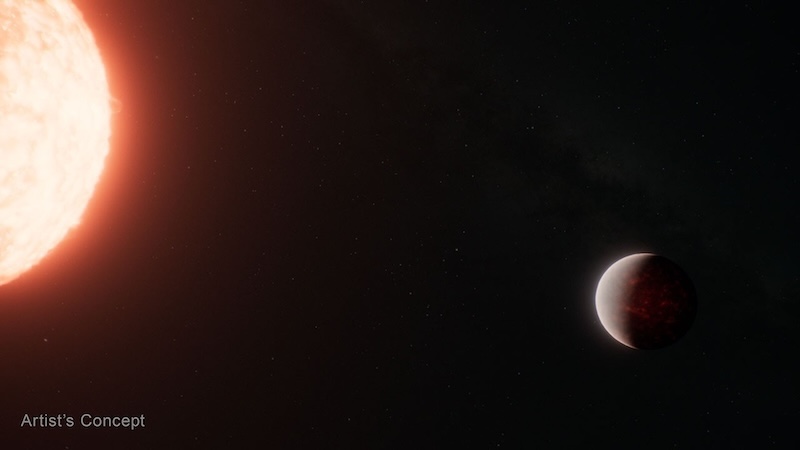
- TOI-561 b is a hot, rocky super-Earth exoplanet 560 light-years from Earth. Does it have an atmosphere?
- New observations by the James Webb Space Telescope show it has an atmosphere that is a lot denser than expected. It is also likely covered in an ocean of lava.
- A dense atmosphere was unexpected, because the planet is broiling hot on its dayside and orbits so close to its star. How does it keep its atmosphere?
EarthSky’s 2026 lunar calendar is available now. Get yours today! Makes a great gift.
A dense atmosphere on lava planet TOI-561 b
Astronomers have discovered many rocky exoplanets orbiting other stars. If the rocky worlds in our solar system are any indication, some of them should have atmospheres. Now, a team of researchers led by the Carnegie Institution for Science (Carnegie Science) in Washington, D.C, has found what they say is the best evidence yet for a rocky exoplanet with an atmosphere. On December 10, 2025, the researchers said the planet – TOI-561 b – is a scorching hot super-Earth that orbits close to its star. The planet is likely covered in an ocean of lava and has a thick, volatile-rich atmosphere. The finding is surprising, because scientists thought the planet was too small and hot to have retained an atmosphere.
The researchers used NASA’s James Webb Space Telescope for their observations.
TOI-561 b, about 560 light-years away, is a super-Earth, meaning it’s larger than Earth but smaller than Neptune. Its radius is 1.4 times Earth’s, and its mass is about twice that of Earth’s. Scientists also found it’s significantly lower in density than Earth. The presence of a thick atmosphere could help explain that. The planet’s star, TOI-561, is similar to but slightly smaller than our sun.
In 2024, astronomers also announced that another super-Earth, 55 Cancri e, might have an atmosphere of carbon dioxide or carbon monoxide. And like TOI-561 b, it also orbits close to its star and might have a molten surface. It’s 41 light-years away.
The researchers published their peer-reviewed results in The Astrophysical Journal Letters on December 11, 2025.
A Carnegie-led team of astronomers has reported the strongest evidence yet for an atmosphere on a rocky exoplanet—and it's in a place no one expected. (?)? carnegiescience.edu/ultra-hot-lava-world-has-thick-atmosphere-upending-expectations
— Carnegie Science (@carnegiescience.bsky.social) 2025-12-15T18:44:38.643Z
#NASAWebb has detected a thick blanket of gas surrounding the distant lava world TOI-561 b, challenging the idea that small planets so close to their stars are not able to sustain atmospheres: https://bit.ly/3MvZQRQ ? ?
— Space Telescope Science Institute (@stsci.edu) 2025-12-11T15:12:04.355529393Z
Surprise! TOI-561 b has an atmosphere
TOI-561 b orbits very close to its star, completing an orbit in only 10.56 hours. As a result, it is broiling hot. Scientists thought the planet was too small and too hot to hold onto an atmosphere. But the researchers were in for a surprise. Nicole Wallack, the second author of the new paper at Carnegie, said:
Based on what we know about other systems, astronomers would have predicted that a planet like this is too small and hot to retain its own atmosphere for long after formation. But our observations suggest it is surrounded by a relatively thick blanket of gas, upending conventional wisdom about ultra-short-period planets.
In our own solar system, Mercury – which orbits further from the sun than TOI-561 b orbits its star – only has an extremely thin exosphere, not a true atmosphere. Yet somehow TOI-561 b has been able to hold onto a dense atmosphere.
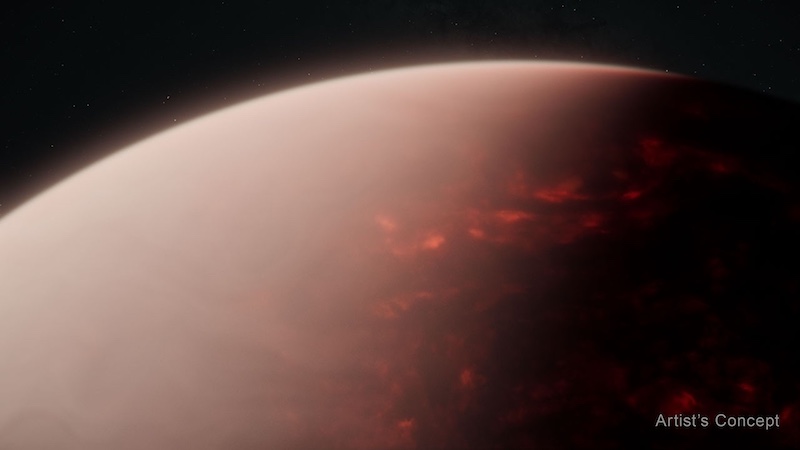
Unusual low density
Scientists knew that TOI-561 b also had an unusually low density. They surmised that a thick atmosphere might help explain that mystery. That would make the planet appear to be larger but less dense than it really was. As lead author Johanna Teske at Carnegie Science explained:
It’s not what we call a super-puff, or ‘cotton candy’ planet, but it is less dense than you would expect if it had an Earth-like composition.
The researchers also hypothesized that TOI-561 b might have a smaller rocky core and a mantle that is less dense than Earth’s. Teske said:
TOI-561 b is distinct among ultra-short period planets in that it orbits a very old – twice as old as the sun – iron-poor star in a region of the Milky Way known as the thick disk. It must have formed in a very different chemical environment from the planets in our own solar system.

Looking for an atmosphere
But it was still difficult to explain the results based on the planet’s composition alone. So could it really have a thick atmosphere?
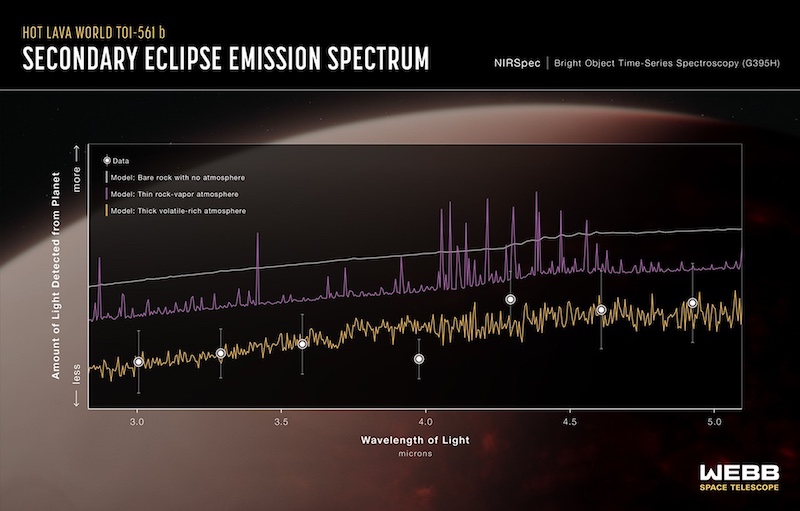
The researchers used the Near-Infrared Spectrograph (NIRSpec) instrument on the James Webb Space Telescope to search for signs of an atmosphere. They did this by measuring the temperature of the planet on its dayside in near-infrared (TOI-561 b is tidally locked to its star, so the same side always faces the star).
In theory, if the planet had no atmosphere, then the temperature on its surface should be around 4,900 degrees Fahrenheit (2,700 degrees Celsius). But it was actually a lot cooler, about 3,200 degrees Fahrenheit (1,760 degrees Celsius). That’s still scorching hot of course, but much cooler than expected.
Narrowing down the possibilities
The team posited various possibilities. The magma ocean would circulate some heat, but the lava would be solid on the colder nightside of the planet. That would limit heat flow from the dayside. A thin rock vapor atmosphere was also possible. But it probably wouldn’t produce as much cooling as Webb had observed.
The other, and best, option is a thick atmosphere composed of volatiles like water, oxygen and carbon dioxide. Volatiles are compounds that can easily vaporize. Co-author Anjali Piette at the University of Birmingham in the U.K. explained it this way:
We really need a thick volatile-rich atmosphere to explain all the observations. Strong winds would cool the dayside by transporting heat over to the nightside. Gases like water vapor would absorb some wavelengths of near-infrared light emitted by the surface before they make it all the way up through the atmosphere. (The planet would look colder because the telescope detects less light.) It’s also possible that there are bright silicate clouds that cool the atmosphere by reflecting starlight.
How did TOI-561 b keep its atmosphere?
The question remains, however: How was TOI-561 b able to maintain a thick atmosphere? As co-author Tim Lichtenberg at the University of Groningen in the Netherlands postulated:
We think there is an equilibrium between the magma ocean and the atmosphere. At the same time that gases are coming out of the planet to feed the atmosphere, the magma ocean is sucking them back into the interior. This planet must be much, much more volatile-rich than Earth to explain the observations. It’s really like a wet lava ball.
As is often the case, the findings bring new questions to contemplate. As Teske noted:
What’s really exciting is that this new data set is opening up even more questions than it’s answering.
Bottom line: Astronomers have found evidence for a thick atmosphere on lava planet TOI-561 b. It’s a broiling hot super-Earth world 560 light-years from Earth.
Source: A Thick Volatile Atmosphere on the Ultrahot Super-Earth TOI-561 b
Read more: Researchers question methane atmosphere on TRAPPIST-1e
Read more: Possible atmosphere on rocky exoplanet found for 1st time
The post Unexpected atmosphere on lava planet is an exciting surprise first appeared on EarthSky.










Related Posts
Stay Informed With the Latest & Most Important News
Previous Post
Next Post



Advertisement
-
 01Two Black Holes Observed Circling Each Other for the First Time
 -
 02From Polymerization-Enabled Folding and Assembly to Chemical Evolution: Key Processes for Emergence of Functional Polymers in the Origin of Life
 -
 03Astronomy 101: From the Sun and Moon to Wormholes and Warp Drive, Key Theories, Discoveries, and Facts about the Universe (The Adams 101 Series)
 -
 04True Anomaly hires former York Space executive as chief operating officer
 -
 05Φsat-2 begins science phase for AI Earth images
 -
 06Hurricane forecasters are losing 3 key satellites ahead of peak storm season − a meteorologist explains why it matters
 -
 07Binary star systems are complex astronomical objects − a new AI approach could pin down their properties quickly