
Now Reading: Universe’s expansion rate: ‘Something doesn’t add up’
-
01
Universe’s expansion rate: ‘Something doesn’t add up’


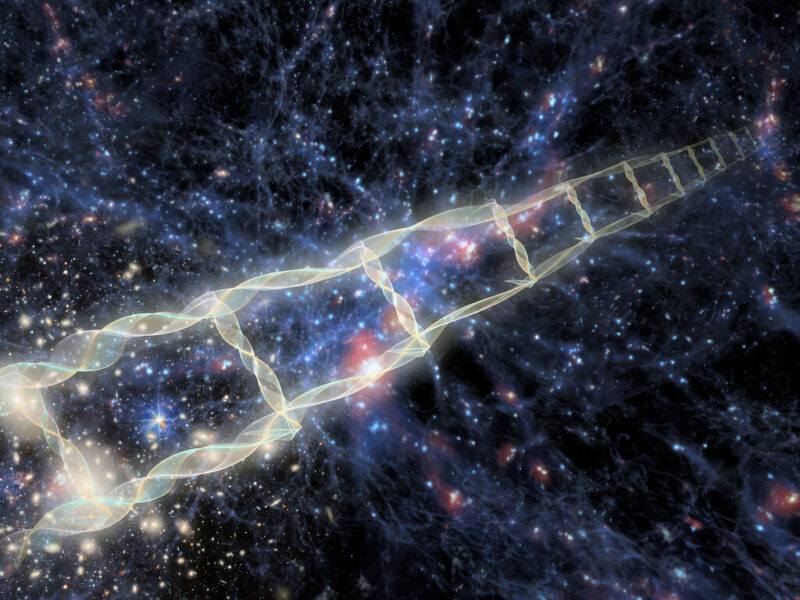

- Astronomers have pinned down one of the most precise measurements yet of how fast the universe is expanding: about 73.5 kilometers per second per megaparsec.
- That number deepens a growing mystery known as the “Hubble tension,” a stubborn mismatch between measurements of the nearby universe and what we’d expect based on the early universe.
- The universe’s expansion rate isn’t behaving as current models predict. This means there could be new physics still waiting to be discovered.
NOIRLab published this story on April 10, 2026. Edits by EarthSky.
Astronomers refine knowledge of universe’s expansion rate
Astronomers have tried to measure the expansion rate of the universe using two fundamentally different approaches. One method relies on measuring distances to stars and galaxies in the nearby universe. The other uses measurements of the cosmic microwave background to predict what the expansion rate would be today under the standard model of cosmology.
These two approaches should yield the same result … but they don’t.
Measurements based on the nearby universe consistently indicate a faster expansion rate – around 73 kilometers per second (160,000 mph) per megaparsec – while predictions derived from the early universe yield a lower value, closer to 67 or 68. Although the numerical difference is modest, it is far larger than can be explained by statistical uncertainty. This persistent disagreement, known as the Hubble tension, has now been observed across multiple independent studies and techniques.
By bringing together decades of independent observations into a single, unified framework, an international collaboration of astronomers says it has achieved the most precise direct measurement to date of the expansion rate of the nearby universe. In a paper published on April 10, 2026, in Astronomy & Astrophysics, the H0 Distance Network (H0DN) Collaboration reports a value of the Hubble constant of 73.50 ± 0.81 kilometers per second per megaparsec, corresponding to a precision of just over 1%.
The study is called The Local Distance Network: a community consensus report on the measurement of the Hubble constant at ~1% precision – is the outcome of a a broad community effort, launched at the International Space Science Institute Breakthrough Workshop titled What’s under the H0od?, in Bern, Switzerland, in March 2025.
Many astronomers participated
The collaboration noted:
This isn’t just a new value of the Hubble constant. It’s a community-built framework that brings decades of independent distance measurements together, transparently and accessibly.
Rather than relying on a single method, the team constructed a “distance network” that links many overlapping techniques for measuring distances across the local universe. These include observations of pulsating Cepheid variable stars, red giant stars that shine with a known brightness, Type Ia supernovae, and certain types of galaxies.
This approach enables multiple independent paths to the same final result. And it allows for a critical test: is the discrepancy caused by an error within a single method? The results indicate that this is unlikely. Even when individual techniques are removed from the analysis, the overall result changes only minimally. Independent measurements remain consistent with one another, reinforcing the robustness of the locally measured expansion rate.
The authors conclude:
This work effectively rules out explanations of the Hubble tension that rely on a single overlooked error in local distance measurements. If the tension is real, as the growing body of evidence suggests, it may point to new physics beyond the standard cosmological model.
The implications are significant. The lower expansion rate inferred from the early universe depends on the standard model of cosmology, which describes how the universe has evolved since the Big Bang. If that model is incomplete – for example, if it does not fully account for the behavior of dark energy, new particles, or modifications to gravity its predictions for the present-day expansion rate would be affected.
In that case, the Hubble tension may not be the result of measurement error, but rather evidence that the current model of the universe is missing a key component. The local distance network also establishes a framework for future investigations. By making its methods and data openly available, the collaboration has created a foundation that can be expanded with new observations. With next-generation observatories expected to provide even more precise measurements, astronomers aim to determine whether this discrepancy will ultimately be resolved or continue to point toward new physics.
John Blakeslee, astronomer and Director of Research and Science Services at NSF NOIRLab, is a member of the collaboration. The study includes data from telescopes at NSF Cerro Tololo Inter-American Observatory (CTIO) in Chile and NSF Kitt Peak National Observatory (KPNO) in Arizona, both programs of NSF NOIRLab. Those data were incorporated into a broader, collaborative framework spanning both ground and space-based observatories, helping to strengthen the overall result.
Bottom line: We think we understand the local universe’s expansion rate. But new measurements confirm a persistent mismatch that could point to a need for new physics.
The post Universe’s expansion rate: ‘Something doesn’t add up’ first appeared on EarthSky.










Related Posts
Stay Informed With the Latest & Most Important News
Previous Post
Next Post
Advertisement
-
 01Two Black Holes Observed Circling Each Other for the First Time
 -
 02From Polymerization-Enabled Folding and Assembly to Chemical Evolution: Key Processes for Emergence of Functional Polymers in the Origin of Life
 -
 03Astronomy 101: From the Sun and Moon to Wormholes and Warp Drive, Key Theories, Discoveries, and Facts about the Universe (The Adams 101 Series)
 -
 04True Anomaly hires former York Space executive as chief operating officer
 -
 05Φsat-2 begins science phase for AI Earth images
 -
 06Hurricane forecasters are losing 3 key satellites ahead of peak storm season − a meteorologist explains why it matters
 -
 07Binary star systems are complex astronomical objects − a new AI approach could pin down their properties quickly