
Now Reading: University of Hawaii 88-inch Telescope Observations of the Interstellar Comet 3I/ATLAS: Spectrophotometric Blue-Sensitive Spectral Time Series Spanning Two Months from Discovery
-
01
University of Hawaii 88-inch Telescope Observations of the Interstellar Comet 3I/ATLAS: Spectrophotometric Blue-Sensitive Spectral Time Series Spanning Two Months from Discovery

University of Hawaii 88-inch Telescope Observations of the Interstellar Comet 3I/ATLAS: Spectrophotometric Blue-Sensitive Spectral Time Series Spanning Two Months from Discovery

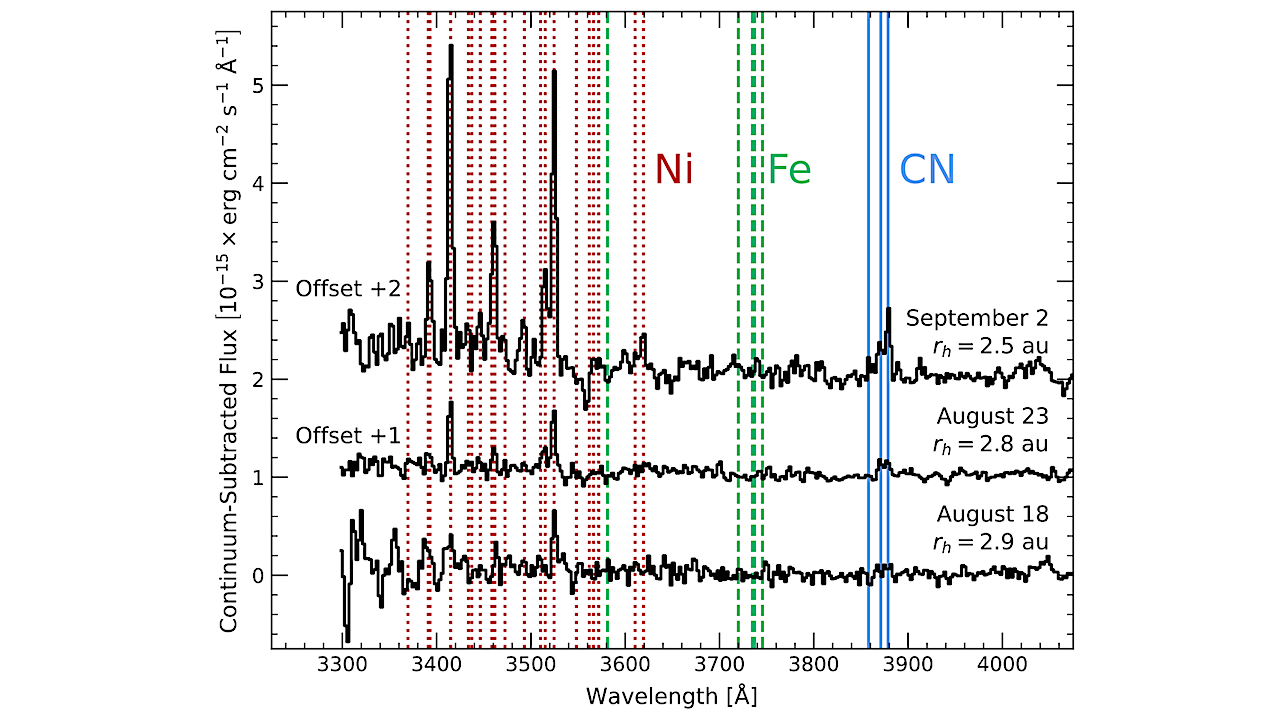
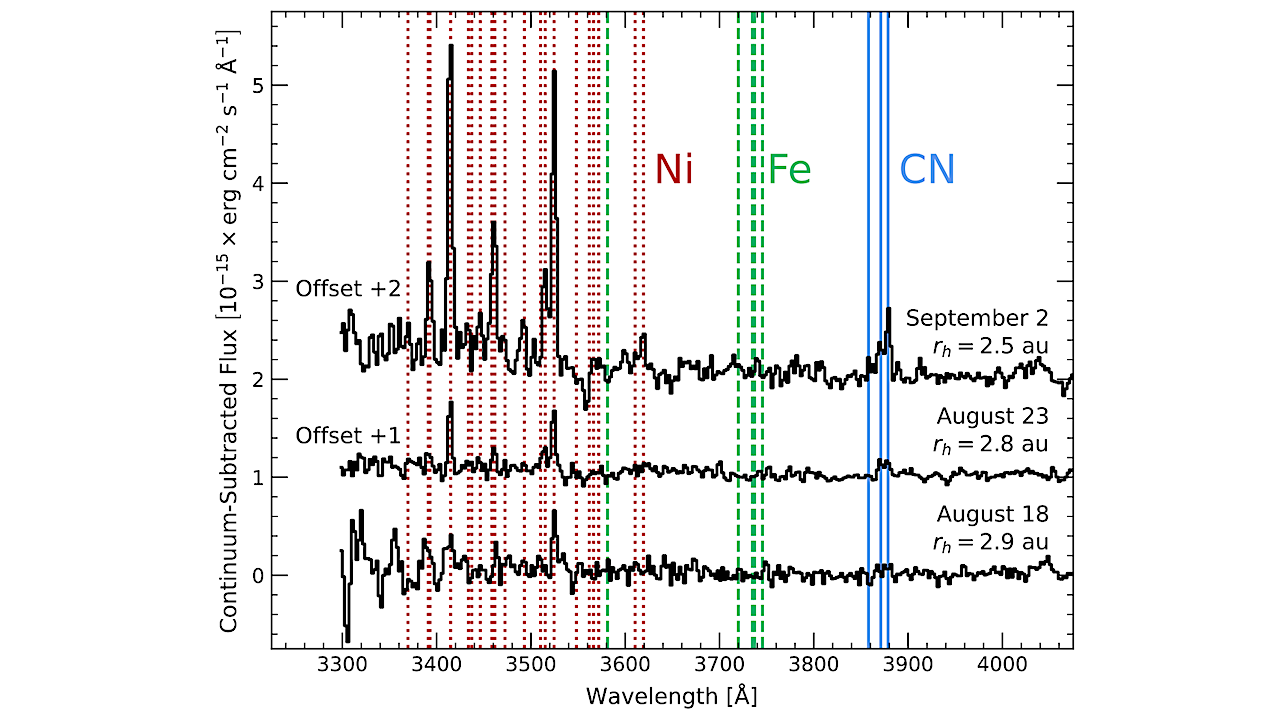
The continuum-subtracted spectra showing emission lines from Ni (dotted red), Fe (dashed green), and CN (solid blue). — astro-ph.EP
Interstellar objects are the ejected building blocks of other solar systems. As such, they enable the acquisition of otherwise inaccessible information about nascent extrasolar systems.
The discovery of the third interstellar object, 3I/ATLAS, provides an opportunity to explore the properties of a small body from another solar system and to compare it to the small bodies in our own.
To that end, we present spectrophotometric observations of 3I/ATLAS taken using the SuperNova Integral Field Spectrograph on the University of Hawaii 2.2-m telescope. Our data includes the earliest λ≤3800 A spectrum of 3I/ATLAS, obtained ∼12.5 hours after the discovery announcement. Later spectra confirm previously reported cometary activity, including Ni and CN emission.
The data show wavelength-varying spectral slopes (S≈(0%-29%)/1000 A, depending on wavelength range) throughout the pre-perihelion (rh=4.4-2.5 au) approach of 3I/ATLAS. We perform synthetic photometry on our spectra and find 3I/ATLAS shows mostly stable color evolution over the period of our observations, with g−r colors ranging from ∼0.69-0.75 mag, r−i colors ranging from ∼0.26-0.30 mag, and c−o colors ranging from ∼0.50-0.55 mag. Ongoing post-perihelion observations of 3I/ATLAS will provide further insight into its potentially extreme composition.
W. B. Hoogendam, D. Kuesters, B. J. Shappee, G. Aldering, J. J. Wray, B. Yang, K. J. Meech, M. A. Tucker, M. E. Huber, K. Auchettl, C. R. Angus, D. D. Desai, J. T. Hinkle, J. Kiyokawa, G. S. H. Paek, S. Romagnoli, J. Shi, A. Syncatto, C. Ashall, M. Dixon, K. Hart, A. M. Hoffman, D. O. Jones, K. Medler, C. Pfeffer
Comments: Comments welcome! 11 pages, 5 figures, to be submitted to the Open Journal of Astrophysics
Subjects: Earth and Planetary Astrophysics (astro-ph.EP); Astrophysics of Galaxies (astro-ph.GA)
Cite as: arXiv:2512.09020 [astro-ph.EP] (or arXiv:2512.09020v1 [astro-ph.EP] for this version)
https://doi.org/10.48550/arXiv.2512.09020
Focus to learn more
Submission history
From: Willem Hoogendam
[v1] Tue, 9 Dec 2025 19:00:00 UTC (629 KB)
https://arxiv.org/abs/2512.09020
Astrobiology










Related Posts
Stay Informed With the Latest & Most Important News



Advertisement
-
 01Two Black Holes Observed Circling Each Other for the First Time
 -
 02From Polymerization-Enabled Folding and Assembly to Chemical Evolution: Key Processes for Emergence of Functional Polymers in the Origin of Life
 -
 03Astronomy 101: From the Sun and Moon to Wormholes and Warp Drive, Key Theories, Discoveries, and Facts about the Universe (The Adams 101 Series)
 -
 04True Anomaly hires former York Space executive as chief operating officer
 -
 05Φsat-2 begins science phase for AI Earth images
 -
 06Hurricane forecasters are losing 3 key satellites ahead of peak storm season − a meteorologist explains why it matters
 -
 07Binary star systems are complex astronomical objects − a new AI approach could pin down their properties quickly