
Now Reading: Upper Atmosphere Dynamics And Drivers Of Volatiles Loss From Terrestrial-type (exo)Planets
-
01
Upper Atmosphere Dynamics And Drivers Of Volatiles Loss From Terrestrial-type (exo)Planets

Upper Atmosphere Dynamics And Drivers Of Volatiles Loss From Terrestrial-type (exo)Planets

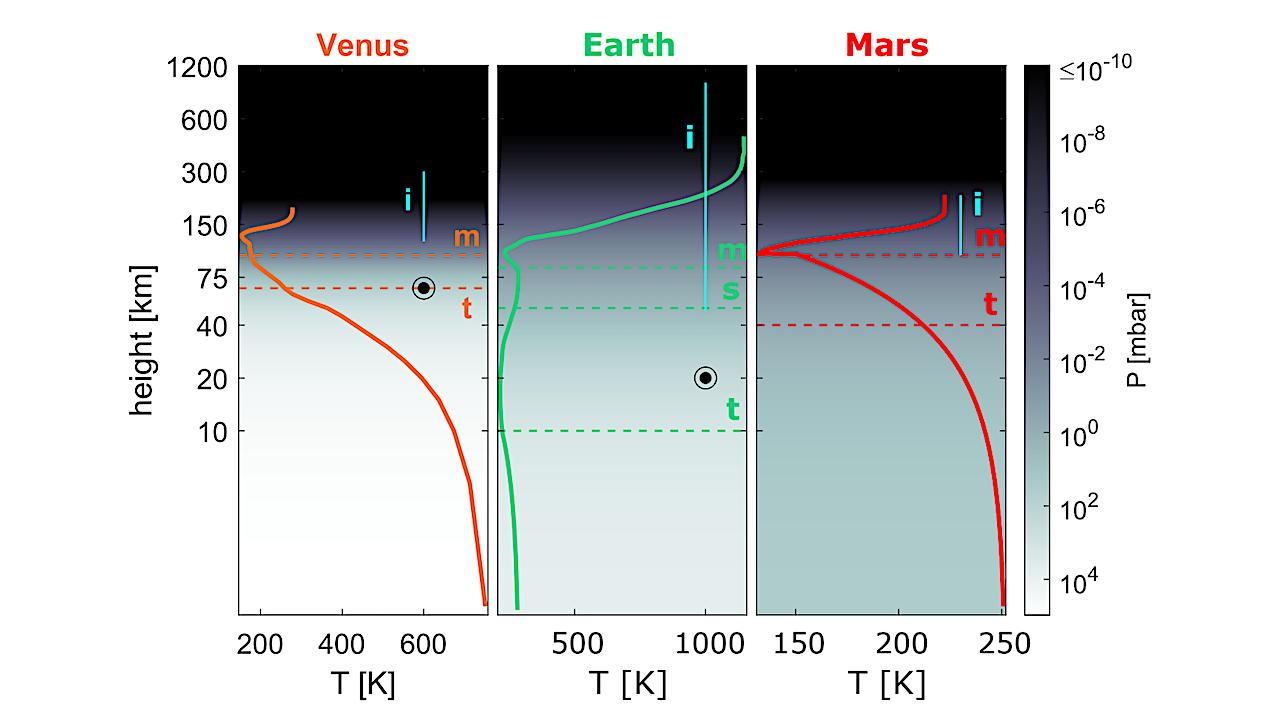
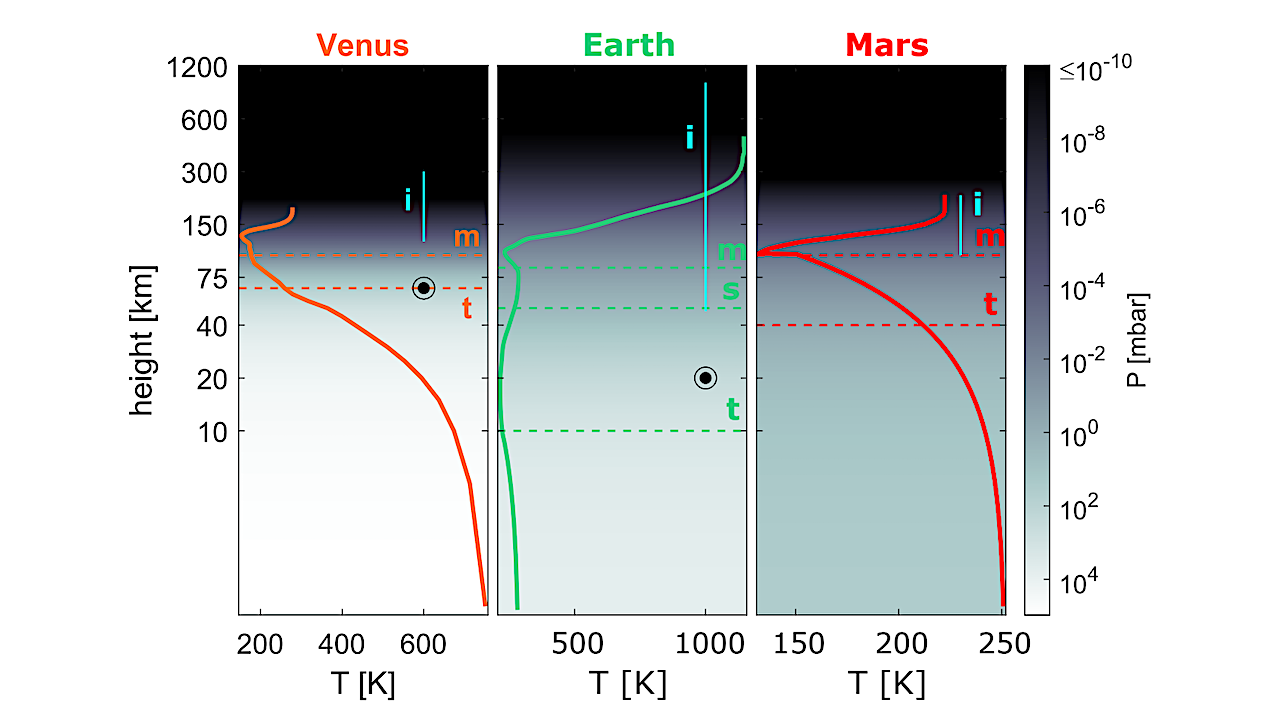
Height scales of atmospheres of Solar System’s terrestrial planets. The solid lines show the temperature profiles against altitude, while the background color reflects the atmospheric pressure. Horizontal dashed lines denote the average positions of atmospheric boundaries: tropopause (“t”), stratopause (“s”), and mesopause (“m”). Vertical cyan lines depict the extension of ionospheres (“i”) under typical conditions. The “⊙” symbol denotes the 100 mbar level. — astro-ph.EP
Volatile loss from exoplanetary atmospheres and its possible implications for the longevity of habitable surface conditions is a topic of vigorous debate currently.
The vast majority of the habitable zone terrestrial-like exoplanets known to date orbit low-mass M- and K-dwarf stars and are subject to the conditions drastically different to those of terrestrial planets in the Solar System.
In particular, they orbit far closer to their host stars than similar planets around G-dwarfs similar to the Sun. Therefore they receive higher X-ray and UV fluxes, even though luminosities of M- and K-dwarfs are lower than those of heavier stars. Furthermore, due to their slower evolution, M-dwarfs retain high activity on the gigayear timescales.
The combination of these two effects has led to claims that most terrestrial planets orbiting M-dwarfs may have their atmospheres stripped from the higher X-ray and UV fluxes of their host stars. Opposing this are researchers who point out that volatile inventories for terrestrial exoplanets are ill-constrained, and hence, they may be able to “weather the storm” of these higher X-ray and UV fluxes.
In this chapter, we focus on exploring volatile loss in the upper atmospheres of terrestrial planets in our solar system and applications to those in exoplanetary systems around stars of different types.
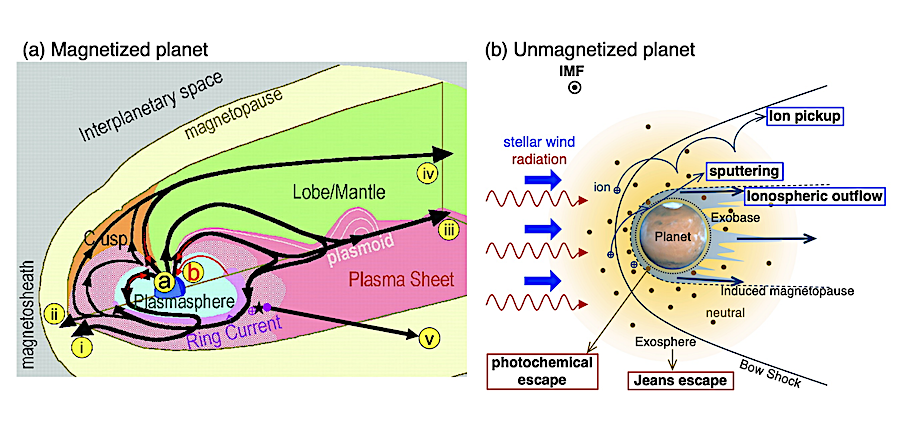
Schematic illustrations of (a) ion escape routes from a magnetized planet (modified from Seki et al, 2001) and (b) atmospheric escape mechanisms from unmagnetized planets. In panel (a), ○a and ○b show outflow and return flow from/to the ionosphere, respectively. The escape routes ○ii , ○iii , and ○iv in the panel (a) result from polar wind and auroral outflows, while routes ○i and ○v correspond to the plasmaspheric drainage plume and ENA production by charge exchange between the ring current ions and geocorona. — astro-ph.EP
Daria Kubyshkina, Michael J. Way, Iannis Dandouras, Helmut Lammer, Antonino Francesco Lanza, Manasvi Lingam, Rumi Nakamura, Moa Persson, Manuel Scherf, Kanako Seki
Comments: 100 pages, 22 figures, 3 tables. Accepted for publication in Space Science Reviews (Topical collection “Geoscience of Exoplanets”)
Subjects: Earth and Planetary Astrophysics (astro-ph.EP)
Cite as: arXiv:2602.15507 [astro-ph.EP] (or arXiv:2602.15507v1 [astro-ph.EP] for this version)
https://doi.org/10.48550/arXiv.2602.15507
Focus to learn more
Submission history
From: Daria Kubyshkina
[v1] Tue, 17 Feb 2026 11:29:29 UTC (8,639 KB)
https://arxiv.org/abs/2602.15507
Astrobiology, exoplanet,










Related Posts
Stay Informed With the Latest & Most Important News
Previous Post
Next Post


Advertisement
-
 01Two Black Holes Observed Circling Each Other for the First Time
 -
 02From Polymerization-Enabled Folding and Assembly to Chemical Evolution: Key Processes for Emergence of Functional Polymers in the Origin of Life
 -
 03Astronomy 101: From the Sun and Moon to Wormholes and Warp Drive, Key Theories, Discoveries, and Facts about the Universe (The Adams 101 Series)
 -
 04True Anomaly hires former York Space executive as chief operating officer
 -
 05Φsat-2 begins science phase for AI Earth images
 -
 06Hurricane forecasters are losing 3 key satellites ahead of peak storm season − a meteorologist explains why it matters
 -
 07Binary star systems are complex astronomical objects − a new AI approach could pin down their properties quickly