
Now Reading: US Space Force is installing a ‘next level’ system to combat drones near Cape Canaveral launch sites
-
01
US Space Force is installing a ‘next level’ system to combat drones near Cape Canaveral launch sites

US Space Force is installing a ‘next level’ system to combat drones near Cape Canaveral launch sites

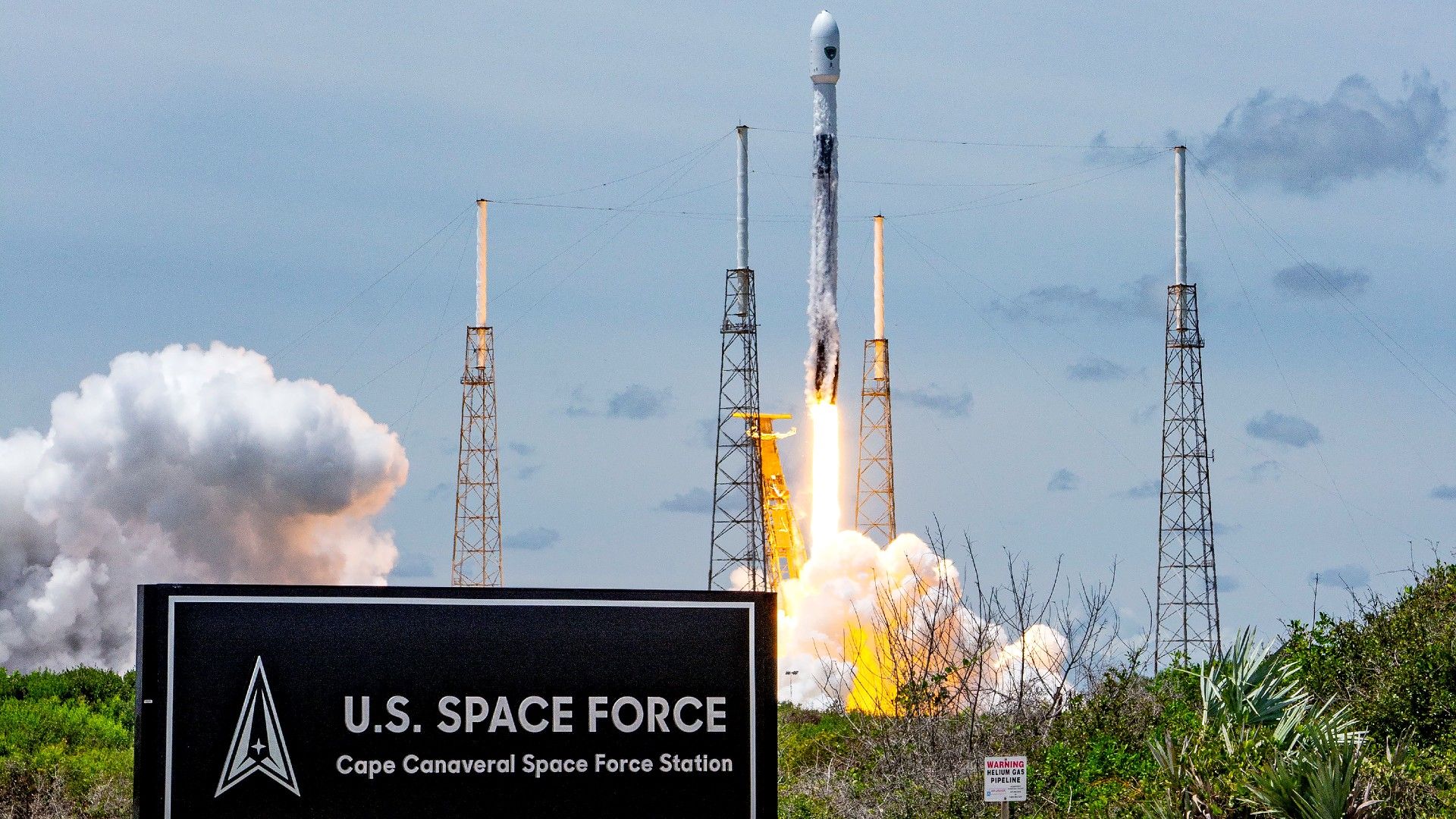
The U.S. Space Force is getting serious about drone threats.
Space Force is looking to boost its ability to deter and defeat uncrewed aerial systems (UAS) in the vicinity of Cape Canaveral Space Force Station and the Eastern Range, the 15-million-square-mile (39 million square kilometers) stretch of airspace over the Atlantic Ocean through which the United States launches most of its space missions. That’s according to comments made by Col. Brian L. Chatman, director of the Eastern Range.
The new system will also involve testing new experimental technologies developed by the Air Force Research Laboratory and National Reconnaissance Office, Chatman added. It’s unclear what those might be. But any counter-UAS (C-UAS) systems, particularly experimental ones, are tricky in such a busy area.
With record numbers of rocket launches, and a fairly high-density airspace full of support aircraft of all types, any counter-drone systems must be carefully calibrated so as to not interfere with the communication, navigation or telemetry of rockets or other vehicles. Many C-UAS systems defeat drones by jamming or interfering with their radio transmissions or navigation systems, which has the potential to interfere with launch operations or other vehicles at the range.
Adding any new C-UAS systems will therefore be a balancing act, Chatman told Breaking Defense, adding that he wants to ensure these new capabilities will “protect and defend the Eastern Range, while not having second order effects that will impact other operations.”
“As the research labs develop new capabilities, we’re open to bringing them out, taking a look at what that would look like out on the Eastern Range, and then if we get to spectrum deconfliction, affording them the opportunity to come out and test those capabilities,” Chatman said.
There are other ways to defeat drones, however, including using traditional weapons, blowing them out of the sky with other drones armed with explosive warheads, or simply ramming into them.
There is a clear need for a more robust C-UAS capability at American launch facilities. In January, Canadian national Xiao Guang Pan was charged with flying a drone over and photographing launch facilities and munitions bunkers at Cape Canaveral Space Force Station. After taking a plea deal, the man was sentenced to 12 months of probation and deported from the United States.
Just months before, a Chinese citizen and lawful resident of California was arrested attempting to board a flight to China after using a drone to photograph facilities at Vandenberg Space Force Base. The man, Yinpin Zhao, was sentenced to four months in jail and deported.
Drone and UAS incursions have been reported at a large number of other U.S. military facilities in recent years, although in many cases, law enforcement agencies have been unable to attribute them to any particular group or actor — at least publicly.










Related Posts

Stay Informed With the Latest & Most Important News


Advertisement
-
 01Two Black Holes Observed Circling Each Other for the First Time
 -
 02From Polymerization-Enabled Folding and Assembly to Chemical Evolution: Key Processes for Emergence of Functional Polymers in the Origin of Life
 -
 03Astronomy 101: From the Sun and Moon to Wormholes and Warp Drive, Key Theories, Discoveries, and Facts about the Universe (The Adams 101 Series)
 -
 04True Anomaly hires former York Space executive as chief operating officer
 -
 05Φsat-2 begins science phase for AI Earth images
 -
 06Hurricane forecasters are losing 3 key satellites ahead of peak storm season − a meteorologist explains why it matters
 -
 07Binary star systems are complex astronomical objects − a new AI approach could pin down their properties quickly