
Now Reading: Voyager Technologies and Max Space partner on lunar infrastructure
-
01
Voyager Technologies and Max Space partner on lunar infrastructure


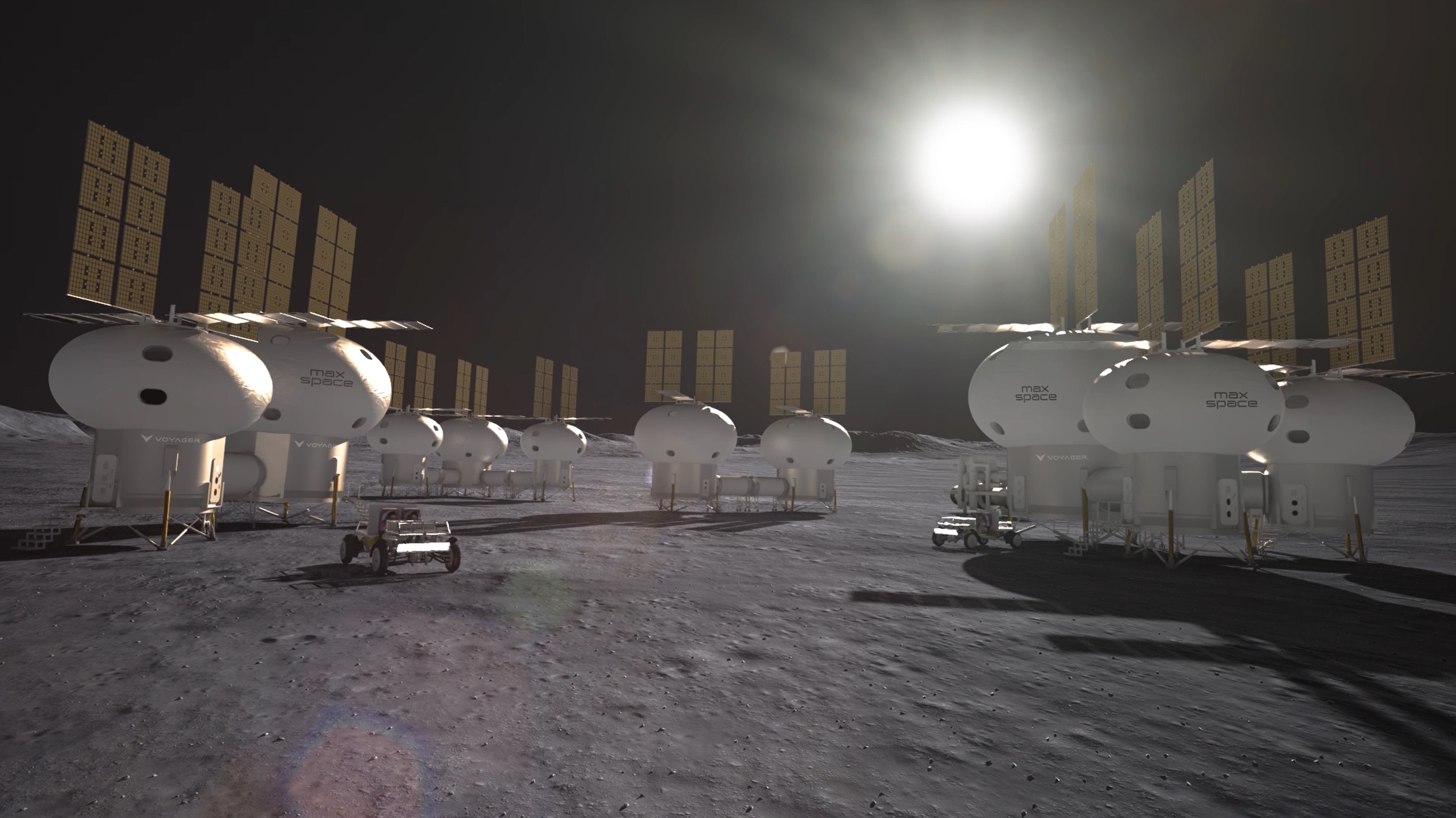

WASHINGTON — Voyager Technologies and Max Space, a company working on expandable habitats, plan to work together to see how that technology could be used for lunar exploration.
The companies announced Feb. 5 a strategic partnership to examine how expandable modules could be used to support lunar exploration, such as habitats on the lunar surface. The partnership would combine Max Space’s work on expandable modules with Voyager’s space technology expertise.
“It was clear to us that inflatable technology was critical for habitat and deep-space use cases,” Dylan Taylor, chairman and chief executive of Voyager, said in an interview. The company had previously explored uses of inflatable modules for the Starlab space station in partnership with Lockheed Martin before electing to work with Airbus Defence and Space on large rigid modules.
He added he knew one of the founders of Max Space, Aaron Kemmer, from Kemmer’s time at space manufacturing company Made In Space, which Taylor had invested in. “It just felt very synergistic in terms of what we were trying to achieve and what Max was doing.”
The companies plan to work together to demonstrate the capabilities of expandable modules for lunar exploration. “We’re looking at putting together very specific programs of work that support NASA’s ambitions to move quickly,” said Saleem Miyan, Max Space’s chief executive, in an interview.
That would include both ground and in-space technology demonstrations by the end of the decade. “I think it will be a much more aggressive timeline than that,” Taylor said, with the goal of getting a habitat on the moon as quickly as possible. “That’s the litmus test: working hardware in the lunar environment.”
A space policy executive order signed by President Trump in December directs NASA to establish the “initial elements of a permanent lunar outpost” by 2030. NASA has yet to articulate what it considers those initial elements, or other plans to establish such an outpost, which would require habitats as well as power, communications and other equipment.
Miyan said he has had some conversations with NASA about their interest in expandable module technology for lunar exploration, but with few details about specific requirements. “So we have to be creative. And I can tell you that we are jointly being extremely creative about making sure that we are front and center in the minds of the people at NASA,” he said, “and maybe changing the way in which NASA looks at things.”
The new emphasis on lunar exploration and infrastructure has led companies to emphasize their capabilities along those lines. Two days before announcing its partnership with Max Space, Voyager unveiled a “strategic lunar initiative” to offer such infrastructure.
“We’ve got some very relevant technology for the lunar environment,” Taylor said. That includes its Clear Dust-Repellant Coating tested on Firefly Aerospace’s Blue Ghost 1 lunar lander last year to limit the accumulation of lunar regolith. Voyager has also developed technologies for extracting iron and oxygen from that regolith.
Miyan said Voyager’s portfolio of technologies led Max Space to work with the company on lunar habitats rather than seek another partner or go it alone.
“The way in which companies really make progress in in this economy that we’re working on is through collaboration,” he said. “I think that’s really where we’ve got the best chance of winning and adding real value.”
Max Space announced in December plans to develop Thunderbird Station, a commercial space station using its expandable module technology. Miyan said the work on the station is “extremely complementary” to the plans to use expandable modules for the moon.
“We can take a lot of the work that we’ve been doing on Thunderbird and then evolve that into a lunar orbit or lunar surface habitat, and that that speed of development allows us to be able to pivot very quickly based on where that NASA priority might be,” he said.
While Max Space is pursuing its own space station, Voyager is the lead company on the Starlab Space joint venture that is developing its own space station in low Earth orbit. Miyan hinted there may be opportunities for the companies to work together on space stations rather than complete against one another.
“You can safely assume that there’s areas of collaboration on LEO as well,” he said. “There’s a lot of there’s a lot of collaboration effort between what we announced for Thunderbird and how that complements other Voyager programs.”










Related Posts
Stay Informed With the Latest & Most Important News
Previous Post
Next Post


Advertisement
-
 01Two Black Holes Observed Circling Each Other for the First Time
 -
 02From Polymerization-Enabled Folding and Assembly to Chemical Evolution: Key Processes for Emergence of Functional Polymers in the Origin of Life
 -
 03Astronomy 101: From the Sun and Moon to Wormholes and Warp Drive, Key Theories, Discoveries, and Facts about the Universe (The Adams 101 Series)
 -
 04True Anomaly hires former York Space executive as chief operating officer
 -
 05Φsat-2 begins science phase for AI Earth images
 -
 06Hurricane forecasters are losing 3 key satellites ahead of peak storm season − a meteorologist explains why it matters
 -
 07Binary star systems are complex astronomical objects − a new AI approach could pin down their properties quickly