
Now Reading: Water bears on Mars: Tardiguardians of the Galaxy?
-
01
Water bears on Mars: Tardiguardians of the Galaxy?


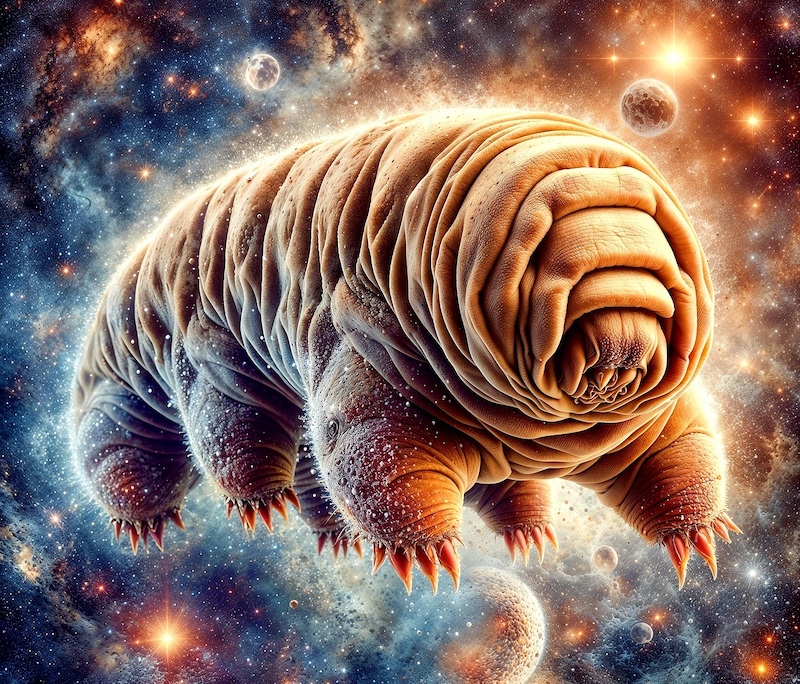

- Tardigrades – also known as water bears – are tiny animals about 1 mm or less in size. They’re known for being able to survive in extreme environments.
- Tardigrades can survive in simulated Martian regolith, researchers found … if you rinse it with water first.
- Future astronauts could use tardigrades to help grow plants and survive in habitats on Mars.
Tardiguardians of the Galaxy
You’ve probably heard of tardigrades – commonly known as water bears – microscopic creatures that look like chubby, cute bears. A new study from researchers in the U.S., Poland and the U.K. shows how these critters might help future astronauts survive on Mars. The researchers said on February 27, 2026, that tardigrades could survive in Mars’ regolith and help grow plants in Martian greenhouses. The regolith would simply need to be washed with water first.
The study shows how humans can use tardigrades to help us adapt extraterrestrial resources to support the exploration of Mars or other locations in the solar system. It suggests tardigrades might also be able to help protect against contaminants that human astronauts would bring with them.
The researchers proposed a fun nickname for these tiny creatures: Tardiguardians of the Galaxy.
They published their peer-reviewed study in the International Journal of Astrobiology on December 5, 2025.

Water bears on Mars
Mars is covered in regolith – loose, rocky debris and dust – instead of regular soil as we think of it on Earth. With this in mind, the researchers created two kinds of simulated Martian regolith. Both of them were based on regolith seen by the Curiosity rover at Rocknest in Gale Crater. The first one, MGS-1, represented the regolith on Mars in general. The second, OUCM-1, was more specific to the Rocknest location.
The researchers added living tardigrades to each simulant. They kept an eye on the tiny creatures using microscopes. Surprisingly, the first simulant affected the tardigrades much more than the second one. In fact, the tardigrades no longer showed any activity after only two days of exposure to the simulant. Altoona Professor of Microbiology Corien Bakermans at Penn State is the first author of the new paper. She said:
We know a lot about bacteria and fungi in simulated regolith, but very little about how they impact animals, even microscopic animals, like tardigrades. We investigated the specific, isolated impact of the regolith on tardigrades.
For the MGS-1 simulant, we saw significant inhibition – reduced activity – within two days. It was very damaging compared to OUCM-1, which was still inhibitory but much less so.

Short-term Survival Of Tardigrades In Martian Regolith Simulantsastrobiology.com/2026/02/shor… #astrobiology #Tardigrade #Mars
— Astrobiology (@astrobiology.bsky.social) 2026-02-28T18:46:07.886Z
Just add water
Why was the first simulant more damaging than the second one? Was there some kind of toxic chemical that killed the tardigrades? If so, the researchers suggested that perhaps it was something that could simply be washed off with water. Bakermans said:
We were a little surprised by how damaging MGS-1 was. We theorized that there might be something specific in the simulant that could be washed away.
To test this idea, the research team rinsed the simulant with water. They then added new tardigrades. And surprise … the tardigrades survived! There was almost no reduction in their activity. The researchers’ hunch seemed to be correct, Bakermans noted:
It seems that there’s something very damaging in MGS-1 that can dissolve in water, maybe salts or some other compound. That was unexpected, but it’s good in a sense, because it means that the regolith’s defense mechanism could stop contaminants. At the same time, it can be washed to help support plant growth or prevent damage to humans who come in contact with it.
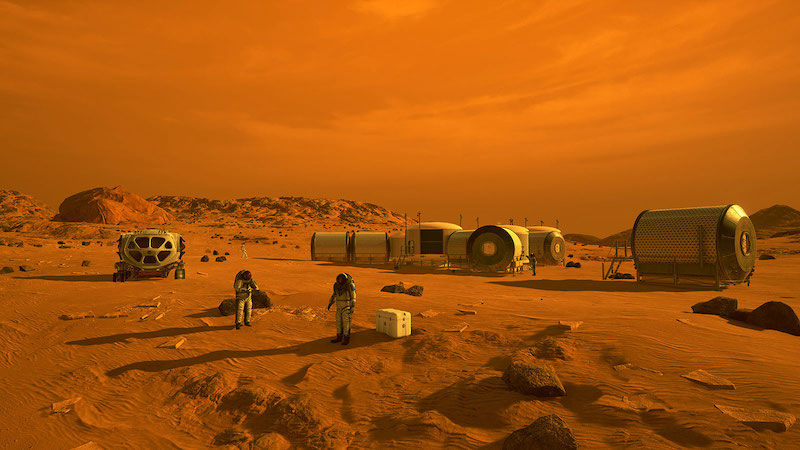
Future astronauts and water bears on Mars
The results show that water bears could help future astronauts survive on Mars. The tardigrades would be useful for growing plants in the Martian regolith, in a contained greenhouse though, of course. And the toxic regolith on its own – without water bears added – would help defend against contamination by earthly microbes that might have hitched a ride on the astronauts.
The paper cautions that more study is need though, saying:
These experiments have ramifications for the choice of species for functional soils to support plants and humans on Mars and for the limitations of terrestrial life; however, more testing is necessary to fully understand the potential habitability and dangers of Martian regolith.
Bottom line: Scientists at Penn State said tiny water bears on Mars could help future astronauts survive there. They nicknamed them Tardiguardians of the Galaxy.
Read more: Why NASA sent tiny water bears into space
Read more: Did these tardigrades survive crash-landing on the moon?
The post Water bears on Mars: Tardiguardians of the Galaxy? first appeared on EarthSky.










Related Posts


Stay Informed With the Latest & Most Important News
Previous Post
Next Post
Advertisement
-
 01Two Black Holes Observed Circling Each Other for the First Time
 -
 02From Polymerization-Enabled Folding and Assembly to Chemical Evolution: Key Processes for Emergence of Functional Polymers in the Origin of Life
 -
 03Astronomy 101: From the Sun and Moon to Wormholes and Warp Drive, Key Theories, Discoveries, and Facts about the Universe (The Adams 101 Series)
 -
 04True Anomaly hires former York Space executive as chief operating officer
 -
 05Φsat-2 begins science phase for AI Earth images
 -
 06Hurricane forecasters are losing 3 key satellites ahead of peak storm season − a meteorologist explains why it matters
 -
 07Binary star systems are complex astronomical objects − a new AI approach could pin down their properties quickly