
Now Reading: What the first medical evacuation from the International Space Station tells us about healthcare in space
-
01
What the first medical evacuation from the International Space Station tells us about healthcare in space

What the first medical evacuation from the International Space Station tells us about healthcare in space

This article was originally published at The Conversation. The publication contributed the article to Space.com’s Expert Voices: Op-Ed & Insights.
For the first time in 25 years of continuous crewed operations, an astronaut has been medically evacuated from the International Space Station (ISS). The Crew-11 mission ended when a SpaceX Dragon capsule brought the four astronauts of Crew 11 home following a medical incident in early January 2026.
To protect the crewmember’s privacy, NASA hasn’t yet disclosed details about what happened – and this article won’t speculate. But the evacuation raises a question worth exploring: how do astronauts stay healthy in space, and why is this early evacuation so unusual?
Astronauts undergo rigorous medical screening before selection. They are assessed for conditions that might worsen in microgravity, evaluated for psychological resilience, and monitored throughout their careers.
Although modelling suggests a medical emergency could be expected roughly every three years on the ISS, serious issues are remarkably rare in practice.
Every ISS mission includes medical support both in space and on the ground. Each crew has a designated Crew Medical Officer – sometimes a qualified doctor, sometimes someone with extensive training in space medicine procedures. They can perform basic examinations, administer medications, and conduct telemedicine consultations with specialists on Earth.
What health issues do occur in space?
A 2015 study found that medication use on the ISS was relatively low, with roughly ten doses of over-the-counter medication taken per astronaut per week, most of which are for common, manageable conditions, such as:
- Skin irritation is the most frequently reported medical issue in spaceflight. A recent systematic review found that space-related dermatoses including dry skin, rashes, hypersensitivity reactions, and impaired wound healing – occur at rates approximately 25 times higher than on Earth. The cold, dry, low-humidity spacecraft environment exacerbates these problems, and hygiene is limited to wet wipes and rinse-less products for months at a time.
- Congestion and headaches affect most astronauts, particularly early in a mission. Without gravity pulling fluids downward, blood shifts toward the head, causing a puffy face and stuffy nose – what astronauts call “space sniffles.” This can trigger headaches, reduced appetite, and poor sleep.
- Sleep disruption is widespread. The ISS orbits Earth every 90 minutes, creating 16 sunrises and sunsets over 24 hours, which disrupts circadian rhythms. Combined with equipment noise, reduced personal space, and the stress of spaceflight, astronauts typically get one to two hours less sleep per night compared to on Earth.
- Musculoskeletal injuries are surprisingly common. A NASA study catalogued 219 in-flight injuries across the US space programme, with an incidence of roughly 0.02 per flight day.
- Hand injuries were most frequent, mostly small cuts from moving between modules or handling equipment. But exercise, ironically the leading countermeasure designed to protect astronauts’ bones and muscles, is now the leading source of injuries on the ISS.
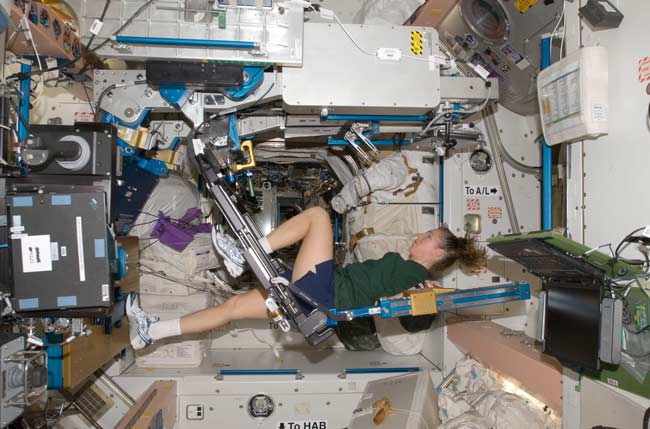
Astronauts exercise for around two hours each day to combat bone and muscle loss and cardiovascular deconditioning in microgravity. Without gravity’s constant load, bones can lose about 1% of their density per month, particularly in the legs, hips, and spine.
Yet this essential countermeasure carries its own risks. Spacewalks present additional hazards – the study found 0.26 injuries per extravehicular activity, often caused by spacesuit components.
Research continues to make these countermeasures safer and more effective. At Northumbria University, the Aerospace Medicine and Rehabilitation Laboratory works with European Space Agency, NASA, Canadian Space Agency and private spaceflight companies including SpaceX to develop exercise-based interventions to protect astronaut health. The research team are pioneering approaches to maintain physical function during longer missions and accelerate recovery on return to Earth.

Space-specific conditions
Some health issues are unique to spaceflight. Spaceflight Associated Neuro-ocular Syndrome (SANS) affects up to 70% of astronauts on long-duration missions. The headward fluid shift changes pressure in the eye, leading to optic nerve flattening and vision changes that can persist for years after returning to Earth.
Perhaps most striking was an incident reported in 2020, when a blood clot was discovered in an astronaut’s jugular vein during a routine research ultrasound. The astronaut had no symptoms; the clot was found by chance. In what became the ultimate telemedicine case, doctors on Earth guided treatment over more than 90 days.
Blood thinners were administered, additional medication was sent on a resupply vessel, and the astronaut performed their own ultrasound scans with radiologists directing from hundreds of kilometers below. They completed their mission and returned safely at the end of their mission without any health consequences.
The Crew-11 evacuation demonstrates that space agencies prioritize crew safety above all else. As missions move beyond low Earth orbit into deep space, new approaches to medical care will be needed – referred to as Earth Independent Medical Operations, potentially using AI to assist crew medical officers alongside lessons from current missions.
That this is the first expedited medical evacuation in 25 years highlights how effectively space medicine has developed. But it’s also a reminder that space remains inherently challenging for human biology, and sometimes there really is no place like home.










Related Posts


Stay Informed With the Latest & Most Important News
Previous Post
Next Post

Advertisement
-
 01Two Black Holes Observed Circling Each Other for the First Time
 -
 02From Polymerization-Enabled Folding and Assembly to Chemical Evolution: Key Processes for Emergence of Functional Polymers in the Origin of Life
 -
 03Astronomy 101: From the Sun and Moon to Wormholes and Warp Drive, Key Theories, Discoveries, and Facts about the Universe (The Adams 101 Series)
 -
 04True Anomaly hires former York Space executive as chief operating officer
 -
 05Φsat-2 begins science phase for AI Earth images
 -
 06Hurricane forecasters are losing 3 key satellites ahead of peak storm season − a meteorologist explains why it matters
 -
 07Binary star systems are complex astronomical objects − a new AI approach could pin down their properties quickly