
Now Reading: What To Make Of The Earth’s Curiously Intermediate Land Fraction?
-
01
What To Make Of The Earth’s Curiously Intermediate Land Fraction?


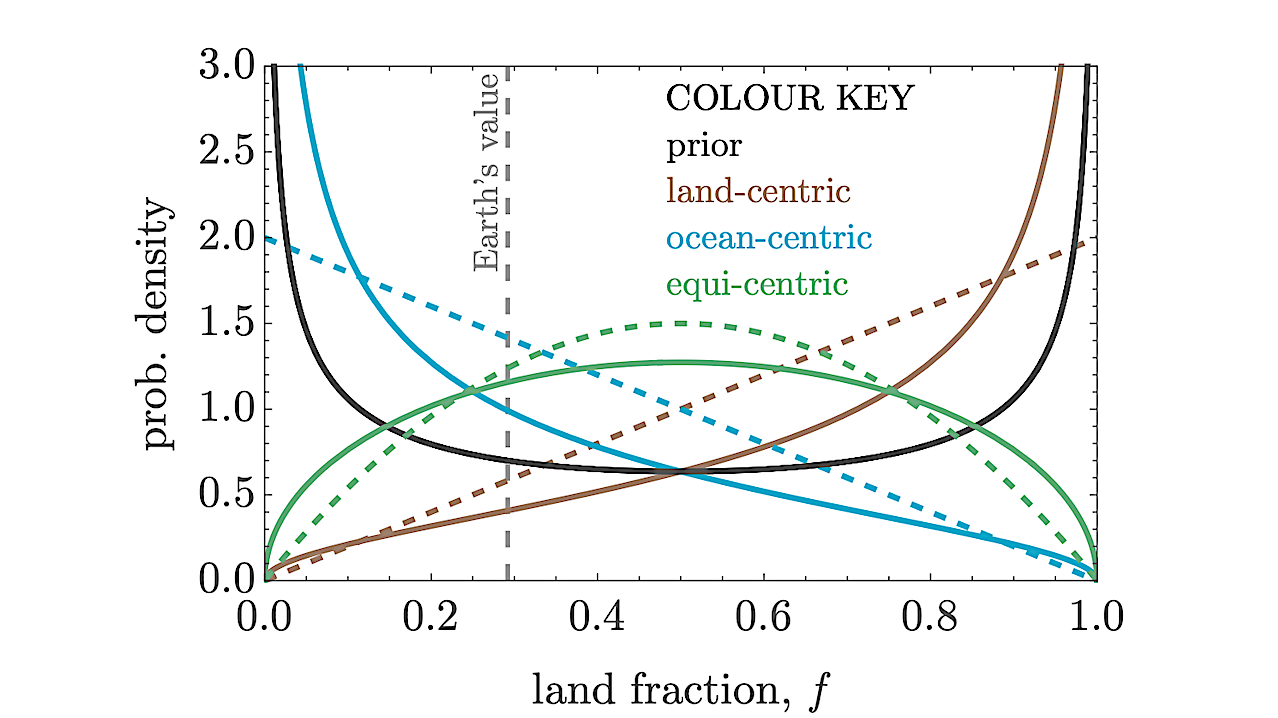
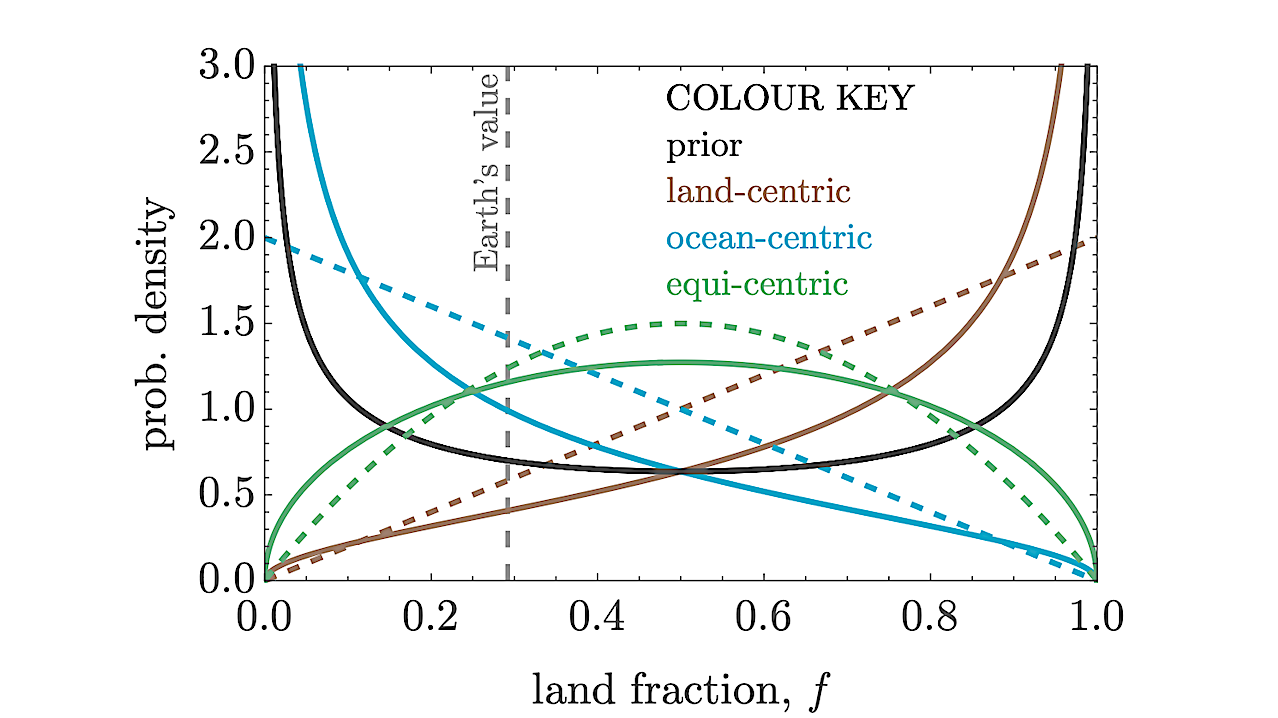
Comparison of the posteriors (solid lines) from our four different fiducial models, labeled inset. The dashed-lines represent the likelihood functions of each, and the solid grey line is the prior – which is identical to the fourth model of indifference and thus not explicitly shown. — astro-ph.EP
Approximately two-thirds of the Earth, the only known inhabited planet, is covered in ocean. Why not 0.01% or 99.99%? It has been previously suggested that this may represent a certain degree of fine-tuning, and thus perhaps observers are a-priori more likely to develop on those rare worlds with nearly equal land-ocean ratios, such as our own.
In this work, we take the single datum of the Earth and then use Bayesian inference to compare four models for the probability distribution of a planet becoming inhabited by observers as a function of land-fraction, f, which we classify as i) land-centric ii) ocean-centric iii) equi-centric and iv) indifference.
We find that no model is strongly favoured over the others, but that 1) the land-centric model is disfavoured over all others, and, 2) the equi-centric model is favoured over all competitors. Further, we show that more extreme models with heavy tail-weighting are strongly disfavoured even when conditioned upon the Earth alone. For example, a land-centric model where the median planet has f=0.82 (or greater) is in strong tension with our existence.
Finally, we consider the potential addition of more data via Mars or exoplanets. Should paleo-Mars have once harboured life and had f<0.20, then this would strongly favour the ocean-centric model for life, over a land-centric hypothesis. We show that strong evidence for/against the equi-centric model versus its competitors would likely require at least a dozen inhabited exoplanets, offering a well-motivated sample size for future experiments.
David Kipping
Comments: Accepted to AJ
Subjects: Earth and Planetary Astrophysics (astro-ph.EP)
Cite as: arXiv:2602.02392 [astro-ph.EP] (or arXiv:2602.02392v1 [astro-ph.EP] for this version)
https://doi.org/10.48550/arXiv.2602.02392
Focus to learn more
Submission history
From: David Kipping
[v1] Mon, 2 Feb 2026 17:52:38 UTC (178 KB)
https://arxiv.org/abs/2602.02392
Astrobiology











Related Posts
Stay Informed With the Latest & Most Important News
Previous Post
Next Post



Advertisement
-
 01Two Black Holes Observed Circling Each Other for the First Time
 -
 02From Polymerization-Enabled Folding and Assembly to Chemical Evolution: Key Processes for Emergence of Functional Polymers in the Origin of Life
 -
 03Astronomy 101: From the Sun and Moon to Wormholes and Warp Drive, Key Theories, Discoveries, and Facts about the Universe (The Adams 101 Series)
 -
 04True Anomaly hires former York Space executive as chief operating officer
 -
 05Φsat-2 begins science phase for AI Earth images
 -
 06Hurricane forecasters are losing 3 key satellites ahead of peak storm season − a meteorologist explains why it matters
 -
 07Binary star systems are complex astronomical objects − a new AI approach could pin down their properties quickly